Managed Crawling APIs for RAG Index Freshness
Most production RAG systems fail silently because crawling only solves half the freshness problem.
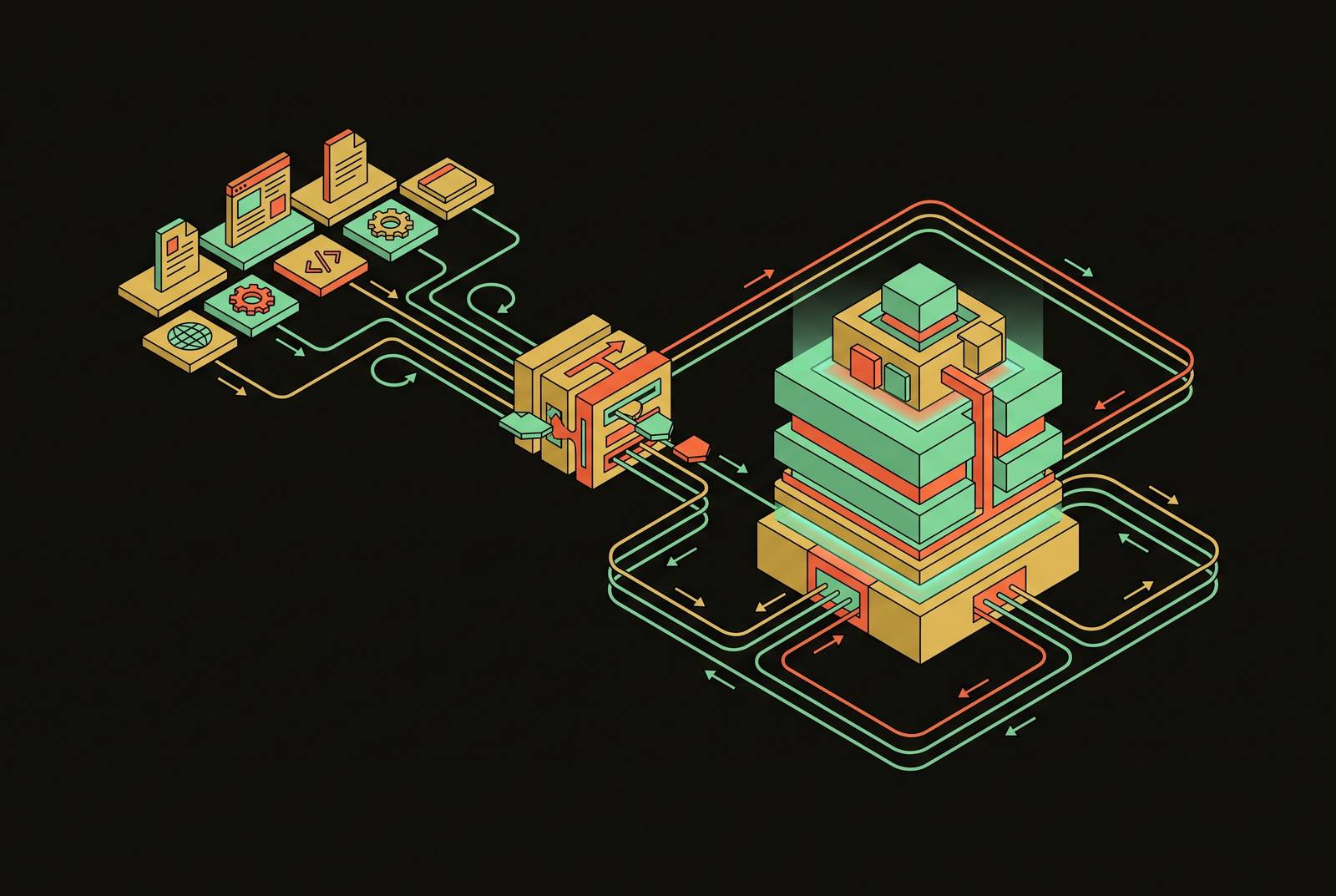
RAG index freshness gets treated like a scheduling problem: run the crawler more often, get fresher answers. That's the wrong model entirely. Freshness spans four separate stages, discovery, extraction, validation, and supersession, and a crawl job only touches the first one and a half. Retrieval-augmented generation was supposed to make updates cheap by splitting knowledge from model weights, so you patch a document store instead of retraining. That part worked. Nobody solved the harder problem, which is that "cheap to update" and "actually up to date" are two different claims, and the space between them is where most production RAG systems rot without anyone noticing.
A crawl can succeed and the index can still be stale. Confusing those two outcomes is the root of most silent failure in these systems, and four specific things go wrong even after the fetch comes back clean.
JavaScript-rendered content never shows up to a raw-HTML collector, so the page looks fetched but the actual text is missing. Extraction can succeed against a broken template and still hand back a chunk that's cut in half. A new version of a page comes in fine, but the old chunk sitting in the vector store never gets marked dead, so both versions sit there competing for the same query. And permissions get captured at crawl time, not at query time, so a document that should now be restricted, or newly visible, gets scored against access rules that are already out of date.
None of this throws an error. Missing sections, reordered fields, hidden text blocks, a product page that quietly switched to client-side rendering last month: all of it sails through a pipeline that only checks for HTTP 200. By the time the model starts giving bad answers, the actual cause sits two or three stages upstream, and nobody's looking there because the crawl logs say everything worked fine.
A fresh corpus means two things are true at once: the newest valid version of a document is queryable, and the older version is no longer eligible for retrieval, both inside some defined time window. "We ran the crawl last night" doesn't clear that bar unless someone can also say the old chunks are gone. Retrieval drift is the tell: precision degrades over weeks as duplicate and outdated chunks pile up, and hallucinations that get pinned on the model are often just a pipeline that never finished the job it started.
The four pipeline stages that freshness actually spans
Discovery is the detection layer: knowing a page exists, changed, or got pulled down. A scheduled re-crawl covers part of this, but real discovery means watching sitemaps, catching change signals, and following the link graph to find pages nobody bothered to list.
Extraction turns a live page into something an LLM can actually use. Raw HTML is a bad format for this job. Embedded SVGs, tracking scripts, and div hierarchies six levels deep don't just waste tokens, they flood the model's attention with noise that has nothing to do with the actual content.
Validation checks that what came out of extraction is structurally sound and complete before it ever reaches the index. A 200 response tells you the page loaded. It says nothing about whether the extractor grabbed the right selector or quietly dropped half the page.
Supersession retires the old chunk once a new one lands. Skip this step and both versions sit in the vector store side by side. Retrieval picks whichever one scores higher on similarity, and nothing guarantees that's the current one.
Most in-house crawl stacks handle discovery fine and get partway through extraction. Validation and supersession tend to be manual, ad hoc, or missing outright. The failures compound from there: a clean fetch with sloppy extraction produces a chunk that looks fine and is wrong, and a valid chunk with no supersession step just adds a duplicate that drags down precision for every query that touches it from then on.
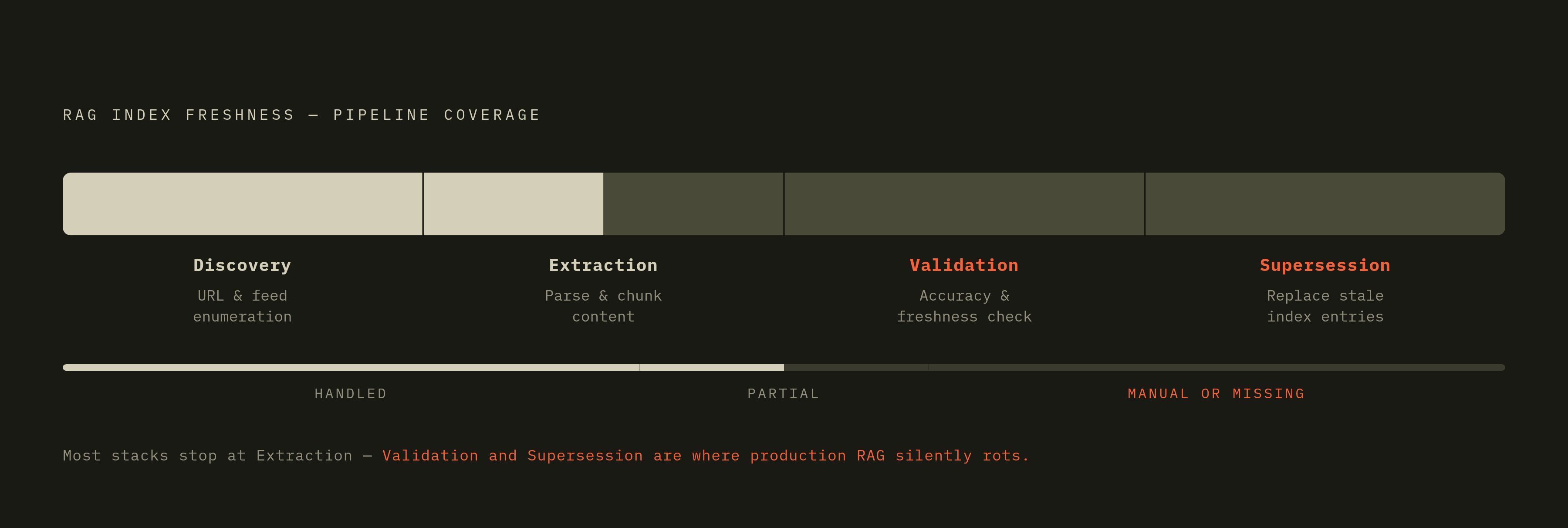
Where in-house crawl stacks break under production load
Anti-bot defenses have gotten hard to beat. The web application firewall market hit $11 billion in 2025, according to Mordor Intelligence, and vendors like Cloudflare, DataDome, Kasada, and HUMAN Security (formerly PerimeterX) block a well-built in-house scraper on a protected domain in seconds, not hours.
Bulk re-crawling to keep an index fresh puts real load on the sites being crawled, and those sites weren't built to take it. Atlassian has warned that high-volume crawls degrade performance for its actual users, and has signaled it will enforce rate limits because of it. That's a preview of what happens at scale: freshness work on your end becomes a traffic problem on someone else's servers.
A lot of the content that matters most sits behind interaction. Login walls, "Load More" buttons, filter dropdowns, and search forms remain unreachable by a plain HTTP request. If the thing that changed is hidden behind a click, a raw collector never sees the change happen.
The maintenance treadmill follows from there. Every time a target site redesigns its layout, CSS selectors break, scripts stop firing, and someone spends the next few days patching scraper code instead of building anything new. Teams commonly end up stitching together a search API, a separate scraper, and a PDF parser: three vendors, three different ways to fail, none of them aware the other two exist. Nobody owns the seams between them, and that's exactly where corrupted or duplicate data gets in.
What a managed crawling API actually handles across the freshness chain
Discovery gets handled at the API layer: scheduled re-crawls, sitemap traversal, and change detection run without a team owning the scheduler or the servers behind it.
Extraction, done right, hands back something an LLM can actually read: clean Markdown from any URL, JavaScript rendered automatically, boilerplate stripped before it ever reaches the model, and APIs such as Context, a Y Combinator-backed scraping and crawling API built for LLM pipelines that converts any URL to structured Markdown, are designed specifically for that output contract. Getting a model to read a well-formatted page is the easy part. Getting the page into that shape in the first place, past the JavaScript and the anti-bot layer, is the actual problem a managed API is paid to solve.
For validation, schema-driven extraction is the right tool for the job. A developer defines a JSON schema up front, and the API checks the fetched content against that contract instead of against a CSS selector that snaps the next time the site redesigns. Simon Willison has called structured extraction from unstructured text the single most commercially useful thing large language models currently do, and this is that idea applied straight to the freshness problem: a broken layout fails the schema check loudly, instead of quietly handing over a corrupted chunk.
Supersession gets handled through crawl-level deduplication and delta ingestion: re-embed only what changed, and name exactly which URLs changed so the vector store knows what to retire. Queues, retries, and throttling all sit on the provider's side, which matters, because that operational surface grows invisibly in a self-hosted stack until someone's spending a quarter just keeping the crawler alive. Swapping a three-vendor stack for one API doesn't just cut cost. It closes the coordination gaps between stages where bad data used to sneak through unnoticed.
How leading managed crawling APIs handle the freshness pipeline in practice
Scrapfly offers a Crawler API built for site-wide traversal rather than one URL at a time, handling the queues, retries, throttling, and result pipelines a full-site RAG ingestion job needs. It fits site-wide ingestion, competitor monitoring, and content tracking at scale, and it ships an MCP server for teams building agent-native workflows.
Crawl4AI, open-source with roughly 51,000 GitHub stars, is a common default for teams that want to feed web content into an LLM but need the data to stay on infrastructure they control. The tradeoff is real: the team absorbs proxy costs, anti-bot maintenance, and general infrastructure overhead. Every stage a managed API would otherwise handle turns into a DIY project here.
Browser Use, also open-source, has crossed 79,000 GitHub stars and is one of the fastest-growing projects in this space, with an 89% success rate on the WebVoyager benchmark. It works with any LLM and does best where reaching the content takes actual interaction, clicking, filling in forms, which is exactly the problem of content locked behind interactive rendering at the extraction stage.
Bright Data runs enterprise-grade proxy and search-result pipelines, and its Web Unlocker product returns raw HTML. Fetch reliability is strong, but a team still has to build the conversion layer to get from raw HTML to something an LLM can use cleanly.
Oxylabsfits teams that already run workflows built on a scraping framework and want mature anti-bot handling paired with automatic field extraction.
Parallel AI raised a $100 million Series A in early 2025, built on the idea that existing search infrastructure was designed for human users, not AI as the primary consumer. It runs multi-agent retrieval with provenance attached to every result, and reports 47% on the HLE benchmark by its own listing.
No single platform covers all four stages with equal depth, and picking one without a clear bottleneck in mind is how teams end up back at three vendors instead of one. Ask which stage is actually broken: discovery, extraction fidelity, schema validation, or supersession automation. That answer should drive the pick, not the vendor's pitch deck.
Matching pipeline stage gaps to the right API capability
If pages change and the pipeline has no idea, the gap is discovery. Look for change-detection and monitoring built into the API rather than bolted on after the fact; sitemap traversal is the floor, not the ceiling.
If fetches come back clean but the chunks are noisy or half-missing, the gap is extraction. That calls for managed JavaScript rendering with Markdown output. An API that only returns raw HTML just hands the extraction problem right back to the team that hired it out to fix.
If extraction runs fine but the resulting chunks are structurally inconsistent, the gap is validation, and schema-driven extraction (a JSON schema applied at fetch time) is the fix. Natural-language extraction is more flexible, sure, but it's much harder to check at scale, and flexible isn't worth much when a broken chunk sails through unnoticed.
If old chunks keep hanging around next to new ones, the gap is supersession. Look for delta-crawl output that names exactly which URLs changed, so the ingestion layer knows what to retire. Without that signal, supersession means a full re-index every time, which defeats the entire point of doing delta work.
Agentic use cases add a separate constraint. An autonomous agent running a reasoning loop needs synchronous, real-time access to the web. It can't sit around waiting on a batch crawl pipeline when it decides mid-task that it needs a live page right now. Managed APIs with synchronous endpoints cover that case; batch crawlers, by design, don't.
There's a rough build-vs-buy line worth naming: the build-vs-buy breakpoint is generally put at around three dedicated ML engineers. Below that headcount, managed APIs win on time-to-value, by a wide margin. Above it, a self-hosted framework can pay back the extra customization work, but even then, someone still has to own each of the four freshness stages explicitly. Buying the infrastructure doesn't buy the discipline that goes with it.
Designing the ingestion loop so freshness is a measurable pipeline property
Start by naming a freshness time objective. What's the maximum acceptable lag between a source changing and that change becoming queryable? That single number sets both the crawl frequency floor and the supersession deadline. Skip it, and freshness is just a feeling someone on the team has, not a number anyone can check.
Instrument every stage on its own. An HTTP 200 is not proof a chunk is valid, so schema conformance rate, chunk completeness, and duplicate chunk count need tracking as separate metrics from fetch success. They will diverge from each other, and that divergence is the entire reason to track them separately in the first place.
Favor delta ingestion over full re-crawls. Re-embedding only what changed cuts compute cost, and more importantly, it scopes the supersession job down to something specific: the right chunks only get retired if the crawl actually told you which URLs changed.
Freshness isn't a setup task, it's a running operation. Retrieval drift builds up quietly over weeks, so index hygiene, pulling chunks whose source page no longer returns valid content, needs its own recurring schedule, separate from the ingestion cadence.
Retrieval architecture compounds all of this. Combining dense vector search with sparse keyword matching (BM25) and a reranking pass measurably improves precision. Third-party benchmarks have clocked LlamaIndex retrieval accuracy at around 92% against roughly 85% for LangChain, and at production scale that gap widens rather than closes, especially once the index is also carrying stale chunks a cleaner pipeline would already have retired.
At the far end, when the freshness objective approaches zero, the whole model shifts: retrieval stops leaning on a maintained vector index and starts hitting the live web on every single request. That's the ceiling case, and it needs a managed crawling API built for synchronous, per-request fetches, not scheduled batch jobs.
The throughline across all of it: one API that handles discovery, extraction, validation signals, and delta output together closes the seams between separate tools where silent corruption used to slip in. Every handoff between vendors is a place a stale or broken chunk can get through, and nobody catches it until the model starts sounding wrong.