ETL Handoff Patterns Between Crawlers and Warehouse Ingestion Layers
Four handoff patterns determine where web crawlers normalize data before it reaches AI consumers.
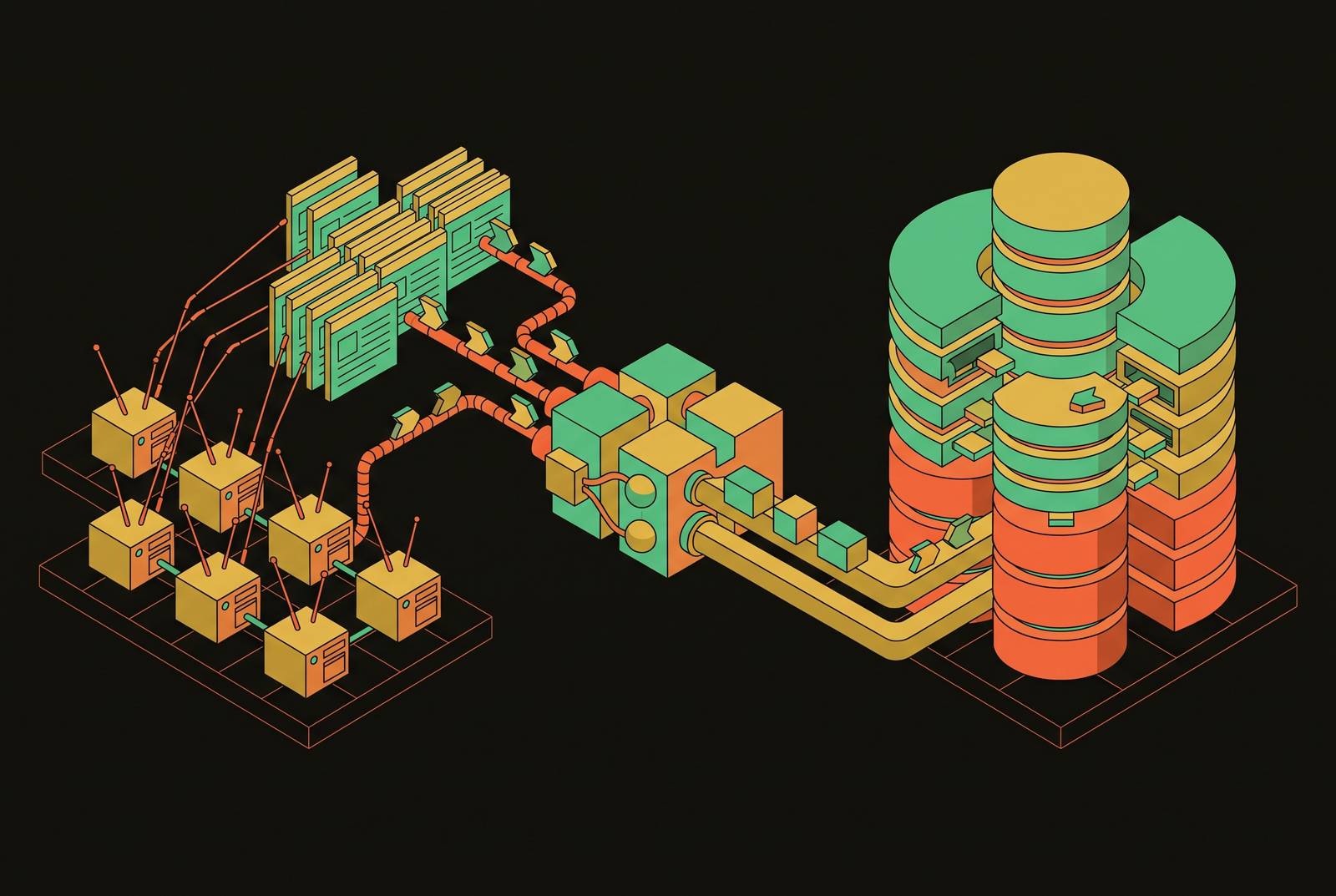
A reliable web scraping pipeline depends on both successful crawling and the handoff between crawler output and warehouse ingestion. The four main patterns are raw-first ELT, schema-on-read, micro-batch streaming, and structured extraction at crawl time. The right choice puts normalization where the team can support it, keeps downstream AI consumers supplied with clean, fresh data, and limits the growing maintenance burden.
Why the crawler-to-warehouse handoff is where pipeline brittleness actually lives
A crawler can finish its job and still produce data that the ingestion layer cannot use correctly. Its output may be raw HTML, a rendered DOM, extracted Markdown, or JSON blobs, while the destination expects typed, schema-stable records. The mismatch sits between two otherwise working systems. MotherDuck identifies normalizing data structures and casting data types among common ingestion cleanup operations. For crawled content, those operations bridge the gap between what a page contains and what a warehouse can reliably store and query.
That gap moves whenever the source changes. A site can add fields, change its layout, or retire an endpoint without warning the pipeline operator. A fixed assumption about the output can then produce the wrong records without stopping the job. The handoff has to account for both the content and the structure that gives it meaning.
A pipeline that once ended at a BI dashboard may now feed a RAG system, vector store, or AI agent, with stricter demands for clean and current information. When malformed chunks enter retrieval, the agent can keep answering from them. Nothing has to crash for quality to fall. The useful test of a handoff pattern is therefore what reaches the consumer.
How ELT displaced ETL and why that shift created the handoff problem for web crawlers specifically
Legacy ETL transformed data before loading it into the destination. That approach required a rigid schema up front, making source changes a frequent cause of breakage. ELT reversed the order by loading raw data first and transforming it inside the warehouse with SQL. This moved schema changes into modeling work that could live in version control while ingestion continued uninterrupted. For structured SaaS data, that was a strong trade.
Modern ingestion reflects that shift toward warehouse compute. MotherDuck describes extracting and loading raw data before transforming it in the warehouse, with light initial work such as type casting, deduplication, and timestamp addition. The boundary does less work. Heavy transformation can then use the analytical database, removing the need for a separate processing layer. That setup works well when the data is already close to the columns and types the destination expects.
Web output is a much worse fit. It mixes untyped HTML, Markdown, and JSON across structurally unstable sites, often with high-cardinality data and large amounts of boilerplate. Loading everything preserves flexibility, but also preserves navigation chrome and other material that inflates storage and token costs. Warehouse compute is built for SQL over typed columns. The specialized handoff patterns exist because moving transformation downstream does not make that work disappear.
The four handoff patterns and what each one actually commits you to
Raw-first ELT puts almost all normalization after the load. The crawler writes HTML or unprocessed text to object storage or a warehouse staging zone, and downstream SQL or dbt models perform the transformation. Its biggest benefit is that it can replay data without another crawl. Preserved raw output can support new transformations when the downstream use case changes. That makes the pattern a good fit for archives, raw-record preservation, and projects whose eventual consumers are still undefined.
Raw HTML stored in a warehouse is expensive and poorly suited to direct LLM consumption, so the warehouse layer inherits work it does not handle naturally. Freshness also depends on when those transformations run. This is a deliberate commitment to retaining options rather than delivering immediately usable AI content. The replay value has to justify that burden.
Schema-on-read moves the contract to a separate reading step. Output lands in a data lake or bronze layer as semi-structured JSON or Parquet, and a later transformation applies the schema. A new source field can load successfully as another JSON key. Chunking and embedding still have to deal with boilerplate unless a staging transform removes it first.
An EtLT hybrid splits that work more practically. Light staging transforms normalize structures or flatten nested JSON, while heavier business transformations remain in the warehouse. MotherDuck lists those operations as optional light ingestion transforms. The hybrid suits structurally variable, high-volume, or regulated web workloads. Its commitment is a staging layer that can enforce useful contracts without freezing every source into one rigid shape.
Micro-batch streaming changes the delivery rhythm as well as the boundary. Crawl jobs run at short intervals, and small batches of normalized content enter the warehouse through optimized native APIs, bypassing bulk file loads. MotherDuck describes micro-batching as a 2026 architectural sweet spot, with seconds-to-minutes latency and medium infrastructure cost. It keeps many knowledge-retrieval indexes fresh without always-on stream processing. It needs upstream change detection to avoid paying to ingest the same unchanged content over and over.
That latency range has a clear limit. Micro-batching is not a substitute for true real-time streaming in sub-second alerting or live pricing. MotherDuck places streaming ingestion in the millisecond-to-second range and associates it with specialized, high-cost infrastructure. The choice depends on whether the consumer needs enough immediacy to justify the operating cost.
Structured extraction at crawl time moves normalization to the source boundary. The crawler converts HTML or rendered DOM into clean Markdown or validated JSON before handing it off. Markdown reduces the token load for downstream LLM consumers, while schema-driven JSON provides typed records without in-warehouse parsing. The output is ready much earlier. The cost shifts toward extraction, especially when an LLM performs it.
LLM-based extraction adds per-page inference cost and has lower throughput than selector-based extraction. For high-volume, price-sensitive pipelines, selector-based paths or cached extraction specifications are necessary. This pattern works best for AI consumers that need clean content right away and teams that cannot maintain a staging-and-transform layer. None of these patterns eliminates normalization. Each assigns it a home.
Why schema drift is the failure mode that makes all four patterns harder in practice
Schema drift is the problem every pattern inherits. Web sources rename fields, restructure navigation, change layouts, and retire pages on schedules the pipeline does not control. Raw-first loading absorbs those changes into storage, but downstream dbt models can still drop or misinterpret new fields. Schema-on-read puts off the contract, but the reader still has to make sense of the changed structure later.
Structured extraction encounters the same problem earlier. A selector can return nothing, a JSON field can become null, or Markdown output can contain navigation while omitting the intended page content. Micro-batching is still open to all of those failures. It can send the bad output along sooner. The patterns differ mainly in where source changes affect the data and how much work follows before someone notices.
Airbyte has had schema change detection since 2022, which can pause connections automatically when breaking changes occur, and added more improvements in 2026. That applies the right instinct at the ingestion layer. The equivalent for web pipelines is detection at the source-page level, where content and structural changes begin. Without it, changed layouts can produce poorly embedded or irrelevant chunks while an agent continues answering confidently. Governance adds another constraint, as GDPR, CCPA, HIPAA, and the EU AI Act push toward minimization at ingestion rather than landing everything and governing it later.
Treating change detection as a pipeline primitive, not an operational afterthought
The response to unstable sources is not simply more frequent crawling. The architectural shift is to make meaningful detected change the event that triggers ingestion. A monitoring layer watches pages for structural and content changes, then emits an event that gates downstream crawling and loading. Detection comes before the bad load.
A monitoring-driven pipeline has four distinct layers. Detection watches pages and identifies real changes, while processing filters, enriches, and routes the resulting change data. Action then triggers crawl jobs, writes to databases, or calls APIs. Storage preserves a queryable archive of change history.
The change can also become the payload itself. Structured JSON diffs can feed a RAG pipeline directly instead of merely requesting another full-page crawl. For micro-batch systems, this is what makes a frequent ingestion cadence economical. Jobs run when the detection layer finds a change worth processing, so the amount of data ingested tracks how much the source changes. Short intervals alone cannot provide that discipline.
How the handoff pattern choice propagates into RAG freshness and agent reasoning quality
RAG can retrieve only documents already in its index. When prices, library versions, regulations, or CVEs change faster than indexing runs, the system can answer from stale information regardless of model quality. The freshness gap starts before the retrieval request. It includes the time spent waiting for extraction, transformation, and indexing, so the handoff directly affects what the agent can know.
Raw-first ELT and schema-on-read generally leave the longest gap because transformation waits for its scheduled run after a source-change event. Micro-batch delivery and structured extraction can shorten that path substantially when change detection sits upstream. Without detection, crawling more often mostly means paying more to do the same work on unchanged content. Clean output and frequent delivery solve different problems. AI pipelines need both at the level the retrieval use case requires.
A common way to handle this in production is to use live fetch with a cached warehouse index. Live fetch serves time-sensitive queries but adds latency and per-query cost, while the cached index serves stable content quickly and remains bounded by its indexing cadence. LinkedIn’s 2026 paper, Self-evolving Agentic Customer Support System at LinkedIn, describes retrieval as an agent-invoked tool that lets the model decide when to retrieve and how to query. Its ETL pipeline chunks, embeds, facets, and retires content before loading a versioned content lake, with a snapshot pointer scoping retrieval to the latest version without deleting prior content.
For teams building AI pipelines, the practical implication is to choose the handoff around the retrieval freshness requirement. The easiest general-purpose ETL integration is not necessarily the right boundary. A consumer that tolerates an older archive creates different demands from one answering questions about changing source material.
Choosing the right pattern given team size, volume, and freshness requirements
The decision rests on three variables. They are how often sources change, how much content enters the pipeline, and how much delay the AI consumer can tolerate. Team capacity determines which processing layers are realistic to maintain. A technically workable design can still leave too much custom integration work for the people operating it. The choice therefore has to account for engineering effort as well as storage, extraction, and warehouse compute.
Teams should choose raw-first ELT when replay value is high, downstream uses remain undefined, and the AI consumer is not latency-sensitive. That choice comes with a lot of transformation work and higher costs for storing raw content. Schema-on-read or an EtLT hybrid is better suited to frequent structural variation. Light transforms at the boundary can enforce contracts while the warehouse does the business modeling. In regulated environments where raw PII cannot land in the warehouse, that pre-load boundary is especially important.
Micro-batching works well for a RAG index that needs to refresh within minutes. It needs upstream change detection so that the amount it collects tracks how much has changed. Structured extraction fits consumers that need clean, typed content immediately, particularly when the team cannot afford a staging-and-transform layer. At high volume, stable-layout pages should use selector-based extraction. LLM-based extraction can then be reserved for variable or complex sources.
Team size also changes the value of consolidation. A single extraction API can remove custom glue between bespoke crawlers, format converters, and staging transforms, reducing a major source of handoff brittleness. For agentic pipelines, the emerging MCP protocol adds another decision criterion by letting agents request external data within their reasoning loop rather than only running crawl jobs and polling results. Teams should evaluate whether the chosen handoff supports event-driven invocation as well as scheduled batches. The boundary must fit both how the consumer asks for data and how the crawler delivers it.