Deduplication and Normalization of Extracted Web Records
Clean records unlock accurate retrieval and agent decisions before the model runs.

Deduplication and normalization of extracted web records decide whether downstream AI systems get signal or noise. A reliable pipeline removes redundant records, reconciles formats, strips boilerplate, and validates what remains before those records shape retrieval or agent decisions.
Why raw extracted records undermine AI pipelines before the model ever runs
An extraction-to-AI pipeline can deliver wrong answers without raising an error, which makes dirty records harder to diagnose than a broken parser. Duplicate entities, dates that do not line up, leftover HTML, and conflicting types can all pass ordinary transport checks. The failure is silent because the pipeline keeps running.
These defects also compound. Removing a duplicate does not repair a malformed date in the surviving record, and a clean text field does not correct a misclassified entity. Retrieval-augmented generation inherits the same weaknesses when extracted records enter its search corpus. The MS MARCO V2 case demonstrates that near-duplicates degrade retrieval accuracy and reduce the diversity of retrieved documents. The model starts with a distorted selection of evidence before it produces any answer.
How duplicate records enter extracted datasets and why they are not a single problem
Exact duplicates are records identical across all fields, often created by scraper reruns, repeated pagination, or syndicated content at different URLs. Key or hash matching can remove them automatically and keep the preferred source record. Near-duplicates are different because surface variation may hide a shared identity without proving it. “John Smith” and “Jon Smith” may need comparison, but their resemblance alone does not justify keeping only one. Their retention rule must depend on confidence and conflicting evidence.
Cross-source duplicates also call for a choice of which website’s record to keep. The right survivor is the most complete or authoritative record. This class needs source tracking even when the records are easy to match. Together, the three classes distinguish identical content, uncertain identity, and competing source representations. Choosing a tool before making that distinction solves one problem while leaving another intact.
Exact-match hashing as the first and cheapest deduplication gate
Exact-match hashing clears the simplest redundancy without model inference, making it the cheapest first deduplication gate. It can compare identifiers such as SKUs, product IDs, and URLs, or use a composite hash of all fields. Removing identical records here leaves fewer records for expensive similarity checks later. The July 2026 ontology-guided extraction paper separates six deduplication algorithms requiring no model inference from its embedding-based resolution subsystem. That separation makes deterministic cleaning an architectural choice.
The ordering needs one qualification because formatting can hide genuine duplicates. Lightweight canonicalization, such as lowercasing and stripping whitespace, can precede hashing, while full normalization follows the exact-match pass. Broader transformations can reveal true matches, but they can also collapse distinctions that raw comparison would preserve. Source provenance must survive this gate so that a collision does not erase the basis for choosing a record. When exact records collide, the retention policy can favor the higher-authority or more recently fetched source.
Near-duplicate detection and the entity resolution problem it cannot fully automate
Near-duplicate detection finds candidates, but identity resolution decides whether they belong together. MinHash and locality-sensitive hashing narrow the search without comparing every possible pair, while embeddings catch paraphrastic overlap that token methods miss. The July 2026 ontology-guided system makes the distinction explicit through a conflict guard that blocks a merge when discriminator keys conflict. No similarity score can override conflicting evidence such as a date of birth, nationality, or passport number.
The paper’s evaluation on a 45-page intelligence report shows how much redundancy exact matching can miss. Title normalization merged 91 duplicate pairs because names with and without title prefixes had appeared as separate entities. Yet resolving names also brought to light invalid relationships in which the subject and object had become the same entity, and self-loop filtering removed 114 of them. A tiered policy makes sense for these cases: high-confidence candidates are merged automatically, medium-confidence candidates are reviewed, and low-confidence candidates are kept apart. The thresholds must reflect the application’s cost of a false merge versus a false distinction, with the conflict guard still taking precedence.
Format normalization and why inconsistent dates, currencies, and units break structured extraction
Once identity is settled, field values still need to mean the same thing before they can be compared. Dates written as MM/DD/YYYY and YYYY-MM-DD do not offer the same representation, while mixed currency symbols and decimal separators complicate price fields. Measurements have the same problem when they use different unit systems. Even categorical labels such as “Electronics” and “Electronic Devices” can divide records that belong together. An output can be structurally valid while comparisons or aggregations over those fields are factually wrong.
Schema-driven extraction reduces this risk by imposing types on text fields at capture. A field declared as a float with a currency ISO code rejects a symbol-bearing string before it can pass downstream as a price. Typed JSON therefore gives field-level operations a firmer contract than a Markdown representation alone. The operational benefit is not prettier output but fewer opportunities for an AI system to misread a price or infer a value from presentation. That contract needs to be kept up to date because source sites can change SKU formats or add currency symbols after the first normalization rules were written.
Boilerplate removal and why HTML noise is a cost problem as much as a quality problem
Fixing formats leaves the bulk of the irrelevant material around the record in place. Raw HTML carries navigation menus, headers, footers, ads, tracking scripts, and cookie banners that can dominate the tokens sent to an LLM. Every such token consumes inference budget without adding substantive evidence. Boilerplate removal cuts both noise and input cost across the pages processed. At the scale of millions of requests, leaving repeated site chrome in the input has a direct spending consequence.
Blu-WERP filters Common Crawl data meant for LLM training and checks its quality. Its results show that the quality of preprocessing affects how well the downstream model does on benchmarks, so cleaning matters for both storage and model performance. Its final pipeline uses deduplication based on a probabilistic data structure, distinct from the exact-hashing and MinHash combination discussed as a broader pipeline pattern. An embedder can encode shared navigation as content, causing retrieval to match site structure irrelevant to the meaning the user needs.
How the five-stage pipeline architecture sequences these operations in production
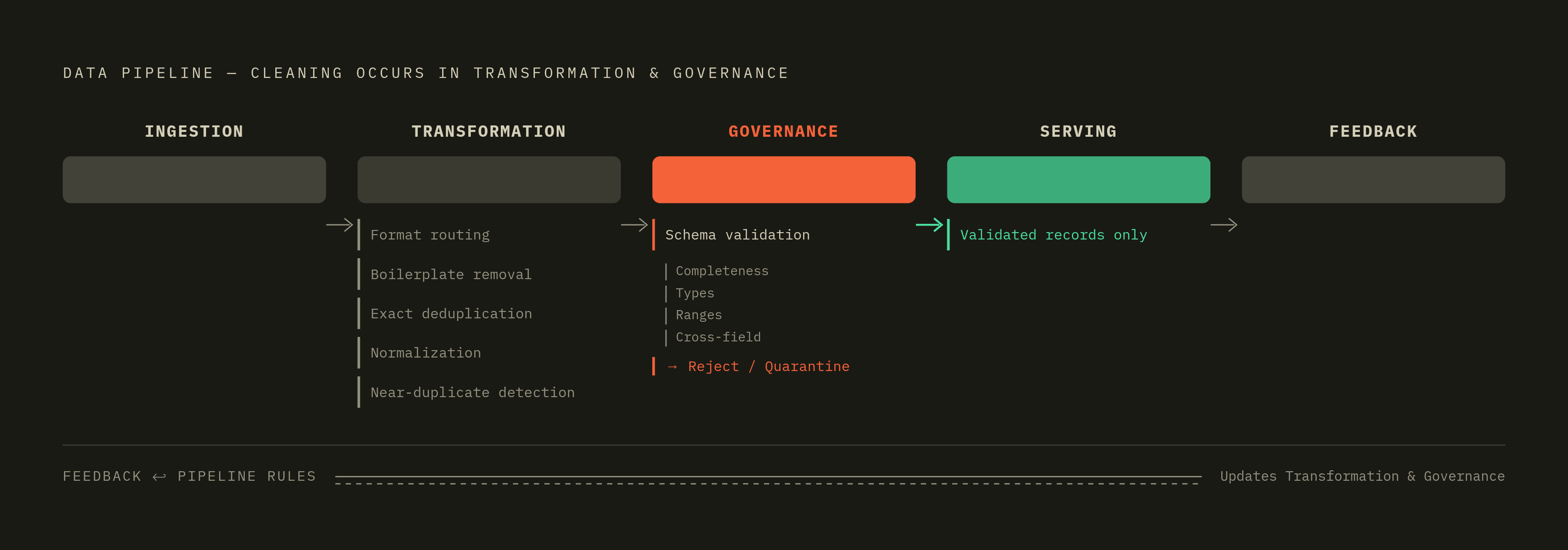
Growth Acceleration Partners describes five core stages for an agentic pipeline, which are ingestion, transformation, governance, serving, and feedback loops. These stages assign architectural responsibilities. Transformation contains cleaning and normalization, while governance applies schema checks before serving. Feedback then carries information about agent decisions and tool calls back into pipeline rules.
Within that architecture, format routing first identifies the MIME type and file extension and selects the appropriate parser. Boilerplate removal then produces clean Markdown or typed JSON before the first deduplication gate. Exact matching removes identical records and retains provenance, after which full normalization reconciles fields. Near-duplicate detection follows, with deterministic checks applied before probabilistic resolution and conflicts sent for review. Schema validation then enforces completeness, types, ranges, and cross-field consistency, rejecting or quarantining malformed records before serving. The sequence matters because each operation should receive the cleanest input the preceding operations can provide.
What a working deduplication-aware pipeline looks like in a real knowledge graph case
The July 2026 ontology-guided extraction research grounds that sequence in an evaluated document pipeline. The system consumes metadata through Kafka and routes PDF, spreadsheet, Office, and image content through format-specific handlers. A locally hosted Qwen3.5 model extracts entities and relationships, and the pipeline produces validated JSON graph output. Model calls remain separate from deterministic processing. That boundary makes it possible to distinguish extraction work from the checks that repair or reject its results.
The evaluation corrected seven classes of silent quality defect, ranging from source text truncated by a single character to systematic entity duplication caused by title prefixes. A substantial number of entities also received corrected type assignments, and search recall rose from well below target to near-complete coverage with no false merges recorded. The system retrieved relevant ontology slices from Neo4j through embedding similarity rather than inserting the full ontology into every prompt. This cut catalog overhead by roughly 94% compared with static domain slices. The evidence establishes useful measures, including merged pairs, removed invalid relationships, corrected types, and search recall.
Why agentic extraction adds new failure modes that static pipelines do not face
Agentic extraction adds errors that duplicate detection and format repair cannot fix. An agent may return the wrong price tier, confuse a product variant, or construct a field from surrounding text even though that field does not exist on the page. Such output can pass schema validation because the value has the expected type. A plausible price is still wrong if it belongs to another variant. Catching that failure requires cross-field validation and provenance checking.
Probabilistic output also changes what a duplicate means. The same URL can produce slightly different extracted values on separate runs even when the source has not changed, so run-to-run variance becomes a deduplication signal. Inference adds latency as well, making agents a complement for variable-layout or one-off extraction rather than a replacement for continuous high-frequency monitoring. Governance must therefore address both malformed records and semantically incorrect values. Feedback from incorrect agent decisions gives the pipeline a way to update rules to prevent the same mistake from recurring.
How WebMCP and schema-first extraction shift the normalization burden toward the source
WebMCP lets sites make their capabilities available as structured tools that agents can call directly. If broadly adopted with pre-normalized, schema-typed data, it would move some cleaning responsibility from the consumer toward the source. Rather than reconstructing structure from a page, the consumer could receive structure supplied by the site. Source-side deduplication could also cut down on repeated versions of the same record before extraction.
Schema-first extraction applies the same principle without depending on WebMCP adoption. A developer-defined JSON schema constrains output at capture and rejects malformed values before they spread through the pipeline. However, WebMCP depends on site operators implementing it, so scrape-then-clean remains necessary for nonparticipating sources. Even with structure supplied by the source, conflicts between websites can remain, and a well-typed value can still be wrong. The cleaning layer gains a narrower scope for participating sources, while cross-source identity and semantic validation remain consumer concerns.
Building the cleaning layer into the pipeline from the start rather than retrofitting it
Once a defective record enters a vector index, it can influence retrieval and agent decisions before a later cleaning job reaches it. Removing the record later leaves those earlier effects in place, and rebuilding an index costs more. Cleaning belongs right after extraction, before the records are used downstream. This is infrastructure work, and building a bespoke stack consumes engineering time that could otherwise go toward the application. Deferring the work does not remove that cost but lets defects accumulate before it is paid.
In practice, start by defining the schema before writing extraction logic and running exact-match deduplication before full normalization. Add quality metrics to each stage so that fixes can be measured. Monitoring must continue as formats drift, source changes introduce new duplicate patterns, and reruns accumulate near-duplicates. Alerts when error rates exceed thresholds make that maintenance part of normal operations. The dividing line is simple, because a pipeline stays reliable only when its cleaning layer is built and maintained as part of the system itself.