CSS Selector vs XPath vs AI Extraction for Structured Data
Each approach trades upfront cost against long-term maintenance burden.

Picking CSS selectors, XPath, or AI extraction sets the maintenance model your pipeline will live with for years, not just the code you write today. Selector-based pipelines run cheap but cost real engineering hours every time a site redesigns. AI-based pipelines cost more on every page, but once you get them running, they need barely any upkeep. If you pick wrong for your use case, the mismatch won't stay small. It grows every month the pipeline stays in production.
Three approaches are running in production right now, in 2026: CSS selectors, XPath, and AI extraction. Each one wins under different conditions, so "just use the modern one" isn't a real answer. Answering what wins, what breaks, and what it costs settles most of the syntax choice on its own.
What CSS selectors do well
CSS selectors started as a way to style web pages, but the same declarative syntax transfers cleanly to extraction. A developer can write div.product-price and know what it targets, making the resulting code easy to read and easy to debug months later. That clarity is not a small thing in a pipeline someone else will maintain.
CSS selectors also run natively in every major scraping library in use today: BeautifulSoup, parsel, Scrapy, Selenium, Playwright. Learn the syntax once, and you can carry it across the entire Python and JavaScript scraping ecosystem. Attribute selectors built on data-testid, data-qa, or data-test give extraction code a stable target too, since developers add those attributes for their own testing and rarely touch them during redesigns, unlike class names tied to styling.
The limits appear in how CSS selectors move through a page as it changes. But none of that fixes the core constraint, and it creates a real maintenance problem. A selector keyed to a class name breaks the moment a site redesigns its CSS. On dynamic sites, IDs get generated at random, like #react-root-7a3b2c on every page load, so a selector keyed to an ID breaks even faster. That fragility is the opening XPath exists to close.
Where XPath earns its place
XPath can move through the DOM in both directions, so it handles server-side data extraction better than CSS. A developer can find a parent element based on a child, grab a sibling, or locate a price tag by matching the text "Total", none of which CSS can do with any reliability. So you can lean on CSS for browser automation (clicks, form fills, navigation) and simple extraction, but you need XPath when your extraction calls for text-content matching or structural traversal that runs both ways. Most serious scraping projects end up using both, each for the job it does better.
Speed favors XPath too, under the right conditions. In Python using lxml, a direct-path XPath query runs roughly twice as fast as the equivalent CSS selector on a large document. lxml executes XPath natively, while a CSS selector first gets translated into XPath behind the scenes before it runs. That translation step costs time, even if it's invisible to the developer writing the selector.
The bigger risk sits inside XPath itself, in how you shape a query. The gap between a well-written XPath query and a poorly written one dwarfs the gap between XPath and CSS as engines. The // operator forces a full scan of every descendant node under that point in the tree, and stacking several of them compounds the cost fast. Anyone debugging a slow lxml scraper should count the // operators in the query before touching anything else. That single check catches more performance problems than tuning the rest of the pipeline.
Inside a browser, the equation flips. Browsers are deeply optimized for CSS because they use it for rendering every page, and they're still stuck on XPath 1.0. Solving that shared weakness is the whole reason AI extraction exists.
How AI extraction works
AI extraction swaps structural targeting for semantic interpretation. Instead of telling a parser exactly where data sits in the DOM, you define what data you want through a JSON schema, and a language model reads the page and returns structured output matching that shape. The parser needs to know the page's layout. The model just needs to understand what it's looking at.
Three distinct methods get lumped together under "AI scraping," and conflating them causes real confusion. Vision extraction goes further still: it sends a screenshot of the rendered page to a vision-capable model and skips the DOM entirely, which matters when the visual layout holds steady even as the underlying HTML churns.
None of this comes free. Per-page latency for AI extraction runs roughly 500 milliseconds to 3 seconds, against microseconds for a CSS selector. The trade is straightforward: pay more on every page, spend far less time on maintenance. A per-page cost that looks trivial in a demo turns into a real line item once it's multiplied across a full run and repeated on a schedule.
Accuracy has limits too. Even the strongest method tested, VGS running on GPT-4o, scored only about 48.58 F1 overall. You may not see reliability as the main objection to AI extraction anymore, but it still isn't solved.
The most common misconception is that AI extraction solves fetching along with parsing, but it doesn't. Every one of these three methods still has to retrieve the page first. That means dealing with rate limits, IP bans, CAPTCHAs, and JavaScript rendering before any model ever sees a single byte of content. AI changes how a page gets parsed once it's in hand. Getting that page in hand in the first place, especially on a protected site, is still the hard part.
The decision matrix: which method wins under which conditions
Three variables decide which method fits a given job: page stability (how often the target redesigns), extraction volume (how many pages run per cycle), and schema flexibility (whether the output shape needs to vary across sources).
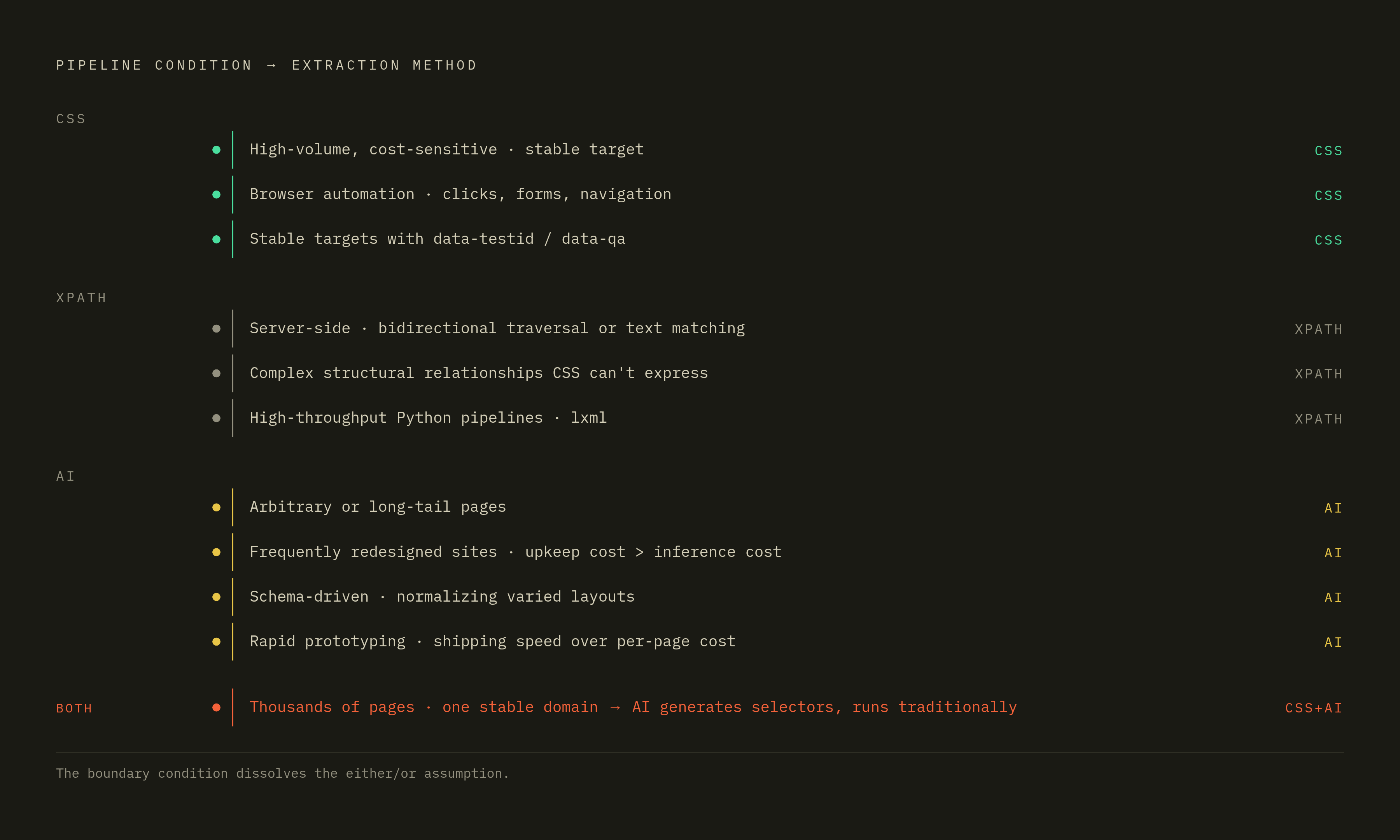
| Condition | Best fit | |---|---| | High-volume, cost-sensitive pipeline on a stable target | CSS selectors | | Browser automation: clicks, form fills, navigation | CSS selectors | | Stable targets with data-testid or data-qa attributes | CSS selectors | | Server-side extraction needing bidirectional traversal or text matching | XPath | | Complex structural relationships CSS combinators can't express | XPath | | High-throughput Python pipelines on lxml | XPath | | Arbitrary or long-tail pages, no economical case for custom selectors | AI extraction | | Frequently redesigned sites where selector upkeep costs more than inference | AI extraction | | Schema-driven pipelines normalizing varied layouts into one output shape | AI extraction | | Rapid prototyping where shipping speed beats per-page cost | AI extraction | | Thousands of pages from one stable domain | AI-generated selectors, run traditionally after |
That last row deserves attention on its own, because it quietly blurs the line between "AI" and "traditional" scraping. Using a model to write selectors once, then running those selectors through a conventional scraper at scale, captures AI's flexibility at setup time and CSS or XPath's speed at runtime. It's a hybrid disguised as a single choice, and it points directly at why most real systems don't pick one method and stop there.
Why most production pipelines use all three methods together
Production systems rarely commit to one extraction method across the board. The more common pattern layers them: CSS or XPath handle stable, high-volume fields, full-page LLM extraction kicks in as a fallback when selectors fail or a layout varies, and LLM validation checks whether the selector output is actually complete.
The decision happens at the level of each domain or field, not the whole pipeline. Traditional scraping covers stable, high-volume targets. AI extraction covers arbitrary or unfamiliar pages. Both live in the same system, applied where each fits. The self-healing selector pattern works like this: selectors run first, and only when they return nothing or fail a validation check does the pipeline fall back to a full-page LLM call, which can also regenerate the selector so the next run doesn't need the fallback again.
That logic fits a pipeline shaped like this: source, then a scraper handling fetching, then extraction (selector-based or AI-based depending on the target), then validation, then transformation, then storage. Dynamic pages add one more fixed requirement regardless of extraction method: the fetching layer needs to run JavaScript through something like Playwright to capture the fully rendered DOM, because neither a selector nor a model can read content that was never rendered.
The honest objection to this kind of hybrid setup is operational complexity. Running two extraction paths instead of one adds real overhead to build and monitor. The maintenance cost of a selector pipeline breaking repeatedly at scale tends to outweigh the complexity of a well-structured hybrid, especially once the LLM fallback fires only occasionally.
The choice compounds because your extraction infrastructure lives longer than the pages it targets. Sites redesign, frameworks change underneath them, and maintenance debt builds up fast when a pipeline depends on brittle selectors alone. Tools like Context can ingest entire websites and output structured data through schema-driven extraction, letting teams skip the selector-versus-XPath decision for certain use cases, though understanding the tradeoffs between traditional parsing and AI-driven approaches still matters for architecting the pipeline correctly.
How a well-designed extraction API removes the choice
Everything in the decision matrix above assumes a developer is separately maintaining the fetching layer, the selector logic, and the LLM integration. An API that handles all three removes that assumption, and that's the gap a consolidated extraction API is built to close.
Context is a web scraping and data extraction API built for AI agents and LLM pipelines. A single REST API converts any URL into LLM-ready Markdown, crawls entire websites, extracts structured data through a developer-defined JSON schema, and pulls brand intelligence, covering fetching, cleaning, and extraction behind one interface. The structured extraction piece maps directly onto the schema-driven extraction pattern described above: a developer defines the shape of the output they want, and the API handles the work of getting there. It supports clean Markdown, raw HTML, and screenshots as output formats, so a pipeline can pull whatever input format its model works best with, without a separate preprocessing step. Website monitoring watches pages for changes, and batch scraping covers runs across thousands of URLs; the same tool handles both a one-off extraction job and a recurring pipeline. It's also MCP-compatible, so an AI agent can call the scraping, extraction, or brand-lookup functions directly as tools inside a reasoning loop, with no custom integration code required. The goal is to get you from zero to working API calls in minutes, not days of infrastructure setup.
For teams covering known platforms at real scale, a structured data API returns normalized JSON for supported domains with no HTML to parse at all, no selector, no model call, no token cost on that path. This only works for domains the API already supports, which narrows where it applies.
There's still a real case for building and owning selectors or XPath in-house: deeply custom pipelines running against stable, high-volume targets, where the control that comes with owning the extraction logic outweighs the convenience of an integrated API. There's a genuine tradeoff in maintaining selectors against sites that keep changing underneath them, which takes more time than most developers assume when they start building.
Keeping extraction pipelines from becoming maintenance debt as targets change
The extraction method you choose on day one decides how the pipeline fails later, once the target site inevitably changes. Selectors fail silently: they return empty results or quietly wrong data with no warning. AI extraction tends to degrade more gracefully, adapting to minor layout shifts without falling over completely. Neither one protects against a structural content change the pipeline was never designed to handle. Change detection has to be part of the system from the start, not an afterthought bolted on after something breaks.
The basic pattern for monitoring looks the same across most pipelines: crawl the page, store it with a timestamp, diff it against the previous version, analyze what changed (an LLM can help separate a meaningful change from noise like a rotating ad or a cookie banner), then alert someone or trigger a downstream action automatically. Context's monitor capability builds this in as a native feature, watching pages for changes directly, so a change becomes an event the pipeline can act on instead of a notification waiting for a person to notice and investigate.
The real weakness appears at scale, when a selector that worked on one page fails across many others, not in a demo. A selector that works on Monday breaks on Wednesday when a site ships a redesign, and keeping a fleet of parsers working across hundreds of different targets turns into a full-time job on its own. That pressure is part of why some teams convert entire pages to structured Markdown first and extract from clean text afterward, removing the DOM-dependency problem that makes CSS selectors fragile. Visual diffs carry their own noise problem too: rotating ads, cookie notices, timestamps, and small layout shifts all trigger false alerts on pages that haven't changed in any way that matters, so semantic filtering has to do the work of separating real change from cosmetic churn.
For RAG systems, this problem compounds further. A grounding pipeline that breaks silently feeds the model stale or empty context, and no amount of prompt engineering lets the model make up for information that was never there to begin with. Freshness has to be guaranteed at the infrastructure level, not patched over at the prompt level after the fact.
Plan for failure before planning for scale. Set up monitoring before spending more time optimizing selectors. The real question for any extraction pipeline is whether the pipeline tells someone the moment selectors break, not just whether they will eventually break.