HTML to LLM-Ready Markdown Conversion at Scale
Clean HTML conversion to Markdown is the foundation for effective AI pipelines.

Raw HTML is built for browsers, not for language models, and that mismatch is the reason conversion has to happen before any AI pipeline can do useful work. A browser needs layout instructions, interactive scripts, navigation menus, and ad placements, all bundled together with the actual content of a page. A large language model needs none of that. It needs headings, lists, links, and code blocks it can parse and segment cleanly, without wading through tags whose only job is telling a browser where to draw a line or load a script.
That's why Markdown has become the standard first step in most AI and retrieval-augmented generation pipelines. It's token-efficient, it reads the same way to a human as it does to a model, and it keeps enough structure, headings, lists, emphasis, to support chunking and retrieval, without the overhead of parsing nested tags. A typical web page bundles navigation bars, cookie banners, sidebar widgets, and ad slots alongside the paragraph a RAG system actually needs. None of that belongs in front of a model. Stripping it is the precondition for any reasoning that happens downstream, not a nice-to-have cleanup pass tacked onto the end of a scraper.
A bad pipeline also limits what prompt engineering can fix. A carefully worded prompt cannot undo the damage of feeding a model three thousand tokens of navigation markup for every three hundred tokens of article text. The quality of what goes into the pipeline sets a ceiling on the quality of what comes out, and that ceiling gets decided at the conversion stage, long before any prompt gets written.
The five stages where noise, latency, and structural loss compound in a conversion pipeline
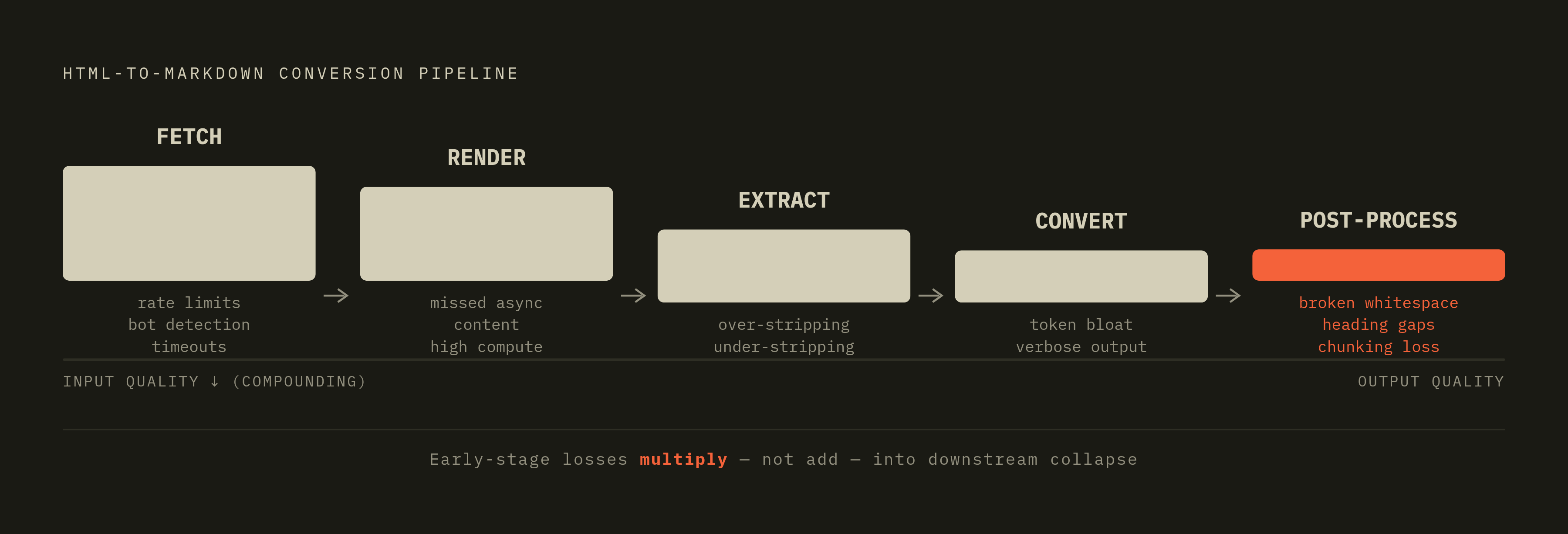
Converting HTML to Markdown at scale is a sequence of five stages, fetch, render, extract, convert, and post-process, and each one has its own way of losing quality or burning time. Developers tend to focus their attention on the conversion step, the part where HTML tags turn into Markdown syntax, because it's the most visible part of the pipeline. But losses accumulate at every stage before and after it, and a pipeline that looks fine in a demo can fall apart once it runs against thousands of pages a day.
The pipeline follows a canonical shape: a URL or an agent goal comes in, the page gets fetched, JavaScript gets rendered if the page needs it, the main content gets extracted from the surrounding noise, the extracted HTML gets converted to Markdown, the output gets normalized and validated, and finally the content gets chunked and embedded for retrieval. Seven steps, five stages, and each one can degrade what the previous stage produced.
Fetching can fail outright from rate limits, bot detection, or timeouts, long before you ever get to conversion. Rendering can miss entire sections of a page if the content loads asynchronously and the fetch only grabbed the initial HTML shell. Extraction can go wrong in both directions: strip too aggressively and meaningful content disappears, strip too little and boilerplate contaminates what should be clean. Conversion choices determine how many tokens the output costs once it reaches a model. Post-processing failures, inconsistent whitespace, broken tables, mangled heading hierarchies, quietly degrade how well the output chunks for retrieval.
None of these failure modes are independent. If a pipeline handles only a few dozen pages a day, it might show acceptable error rates at every stage. But push that same pipeline to thousands or millions of pages, and the error rates at each stage multiply against each other instead of adding up, so pipelines that looked solid in testing degrade sharply once volume increases. The rest of this piece goes stage by stage through where that compounding happens and what it costs.
JavaScript rendering as the infrastructure tax most pipelines underestimate
Rendering is the stage that separates a pipeline that works in a demo from one that survives production traffic. Modern websites lean heavily on JavaScript to build their actual content, so the initial HTML response a simple HTTP client receives is frequently an empty shell: a skeleton of divs waiting for a script to fill them in. A request made with a library like Requests, paired with a parser like BeautifulSoup, only ever sees that shell. These tools can't execute JavaScript, so they can't see content that loads asynchronously, and that describes a large and growing share of the pages any serious pipeline needs to handle.
The production-grade answer is automating a real browser with a tool like Playwright, which executes the page's JavaScript and captures the fully rendered DOM the way a human visitor would see it. That solves the visibility gap, but it introduces a different issue: running a browser is not the same as sending an HTTP request. Browser processes need to be managed, memory overhead climbs fast, timeouts have to be handled carefully, and none of it scales the way a single server can absorb at real volume.
This cost raises compute spend directly. Running headless browsers at scale demands substantially more processing power per page than a plain HTTP fetch. That makes rendering strategy an architectural decision with real tradeoffs that has to be made deliberately.
The real question for a team operating at scale is how to pay for JavaScript rendering without the cost spiraling. Three paths handle this in practice: render selectively, only on pages known to load content dynamically; cache rendered output so the same page doesn't get re-rendered on every request; or hand the rendering layer to a managed API built to absorb that infrastructure complexity. Programmatic APIs that handle JavaScript rendering, anti-bot evasion, and main-content extraction together exist because, once a team looks at it honestly, building and maintaining this layer in-house costs more than most can justify.
Conversion library choices and hidden token costs at scale
Once a page is fetched and rendered, the library doing the actual HTML-to-Markdown conversion makes its own mark on cost and quality, and most teams inherit whatever library is already in use without checking it against the criteria that matter for an LLM pipeline: speed, token efficiency, content extraction quality, async support, and active maintenance.
Conventional converters like Turndown and node-html-markdown were built for a different job. They were designed to turn HTML into readable Markdown for blogs, documentation, and note-taking tools, with no regard for how many tokens that output would cost a language model. That output stays verbose and holds onto redundant syntax, and the bloat worsens on complex, deeply nested HTML, exactly the kind a real web page produces. mdream takes a different approach, built specifically for LLM consumption, and it generates output using roughly half as many tokens as those conventional converters. It gets there not by stripping content aggressively but by producing Minimal GitHub Flavored Markdown, which keeps the semantic structure a model needs while it cuts the redundant syntax the model doesn't. On raw speed, mdream processes 1.8MB of HTML in about 60 milliseconds, well ahead of Turndown and node-html-markdown on typical workloads.
The Python ecosystem has its own set of tradeoffs, and six libraries come up most often in evaluation: html2text, markdownify, html-to-markdown, trafilatura, domscribe, and html2md. They differ enough on speed, HTML5 support, content extraction quality, async capability, and maintenance activity that picking one at random is a real gamble. markdownify, built on BeautifulSoup4, offers the most customizable tag handling of the group, making it the right pick when a pipeline needs domain-specific conversion logic. html-to-markdown, at version 1.8.0, lists full HTML5 support and comprehensive type hints as explicit features, which suits teams building type-safe production systems where catching errors early matters more than flexibility. html2text is mature and dependency-free, but its last release was April 2025, its HTML5 support is limited, and that maintenance gap is a real risk for a pipeline expected to run for years. Among the group, trafilatura stands out specifically on content extraction: its own benchmark reports an F1 score of 0.920 against 0.663 for html2text, and independent comparison has rated its content extraction as excellent where other libraries in the same comparison scored no better than good. html2md supports async processing, which matters once a pipeline needs to process many pages concurrently rather than one at a time, while domscribe sees limited active development. None of these libraries is wrong in isolation. The mistake is picking one without weighing it against what the pipeline actually needs to do at volume.
Content extraction and post-processing as the step that determines actual Markdown quality
Converting HTML to Markdown and extracting clean, usable content from a web page are two separate problems, and treating them as one is how pipelines end up producing Markdown that passes a syntax check while still being full of navigation text, footers, cookie banners, and sidebar clutter. A document can be perfectly valid Markdown and still be useless to a model if half of it is noise dressed up in heading tags.
Main content extraction, the work of isolating the article or document body from everything surrounding it, needs to happen before conversion or as part of it. Trying to do it afterward, once the HTML has already become Markdown, is a harder problem, because the structural signals that mark something as boilerplate, class names like "sidebar" or "footer", element roles like "navigation", have already been thrown away by the time conversion finishes. Once those cues are gone, distinguishing an article paragraph from a leftover nav link becomes a guessing game.
The cleaner approach removes script, style, nav, footer, header, and aside elements directly from the DOM before any HTML reaches a converter. It's a mechanical step, not a clever one, and it eliminates a large share of the noise before any conversion library logic even runs. But that step alone doesn't finish the job. Different converters handle whitespace differently, and the output that comes out the other side often needs its own cleanup pass: collapsing multiple consecutive blank lines, trimming trailing whitespace, fixing heading hierarchies that skip from an H1 straight to an H4. Left alone, these inconsistencies degrade chunking quality once the content reaches a retrieval system.
That matters because a RAG system retrieves chunks, not whole documents. If the chunking step operates on Markdown that still has navigation text interleaved with article paragraphs, the chunks it produces won't correspond to coherent units of meaning. A retrieval query can pull back a chunk that's half article, half cookie-consent boilerplate, and the model answering from that chunk pays the price for it. This is the stage where pipelines that look clean in a controlled test start failing quietly across millions of real documents, and it rarely announces itself as a conversion bug. It appears instead as degraded answer quality further down the pipeline, which makes it one of the harder failure modes to trace back to its source.
Schema-driven extraction as the upgrade path from Markdown to structured pipeline output
Clean Markdown solves the problem of giving a model readable, well-structured text to reason over. It doesn't solve a different problem: pulling out specific fields, a price, a product spec, a contact email, a piece of news metadata, in a form a downstream system can act on directly. For that kind of work, Markdown is an intermediate stop, not the destination, and schema-driven extraction is what turns it into something a pipeline can use reliably.
The pattern is straightforward. A developer defines the exact structure of the data needed as a JSON schema, then a language model extracts against that schema from the cleaned HTML or Markdown. The schema does double duty here: it tells the model what to extract and it gives the pipeline a contract to validate the output against.
Amazon's PARSE system, a peer-reviewed paper published at EMNLP 2025's Industry Track, offers a useful data point on how far this approach can go. PARSE reached up to a 64.7% improvement in extraction accuracy on the Structured Web Data Extraction benchmark, and its SCOPE component cut extraction errors by 92% within the first retry. Schemas can be optimized for how a language model reads them, not just handed over unchanged from whatever structure a database happens to expect, which is what drives the accuracy gains in those numbers.
A schema designed for database storage and a schema designed for LLM extraction are not the same artifact. Field names, how deeply fields are nested, and the data types chosen all affect how reliably a model can fill that schema in from messy, inconsistent web content. A field named "val" nested three levels deep gives a model less to work with than a field named "price_usd" sitting at the top level, even if both describe the same number in a database. Schema-driven extraction doesn't replace Markdown-based retrieval. It sits above it, as the layer a pipeline reaches for once the goal shifts from reasoning over free text to acting on specific, structured values.
Agentic pipelines: from batch jobs to on-demand tool calls
Everything described so far assumes a batch pipeline: pages get fetched, rendered, extracted, converted, and validated on a schedule, with seconds or minutes of slack available at each stage. Agentic pipelines break that assumption. When an agent is mid-reasoning and waiting on a tool call to return a web page, the latency budget doesn't look like a batch job anymore. It looks like a single web request, and the agent's whole reasoning loop stalls until that request comes back.
That shift moves where the complexity in a system lives. A batch pipeline's hard problems are crawl schedules, retry queues, and storage. An agentic pipeline's hard problem is different: the conversion layer itself needs to be fast, reliable, and reachable through a standard interface, because it's no longer a background job. It's a tool the agent calls in the middle of a live reasoning process, and if that tool is slow, the whole agent is slow.
Agentic use also raises a tradeoff that batch pipelines can mostly ignore: freshness versus latency. If you store pre-converted Markdown in a vector store, an agent can query already-processed content instead of re-scraping a page on every single call, and for content that doesn't change often, that's the right design. For content that changes frequently, pricing pages, news, live inventory, a cached copy can hand an agent stale information with full confidence, which is its own kind of failure. Deciding how fresh a piece of content needs to be, and how much latency a pipeline can tolerate to guarantee that freshness, is now a design decision made up front, not an afterthought patched in once an agent starts returning wrong answers.
Pipeline reliability and monitoring source pages for structural change
Every stage described above, fetching, rendering, extracting, converting, post-processing, is tuned against the structure of the pages a pipeline sees today. Websites change their HTML, their class names, their navigation layout, and their JavaScript frameworks without warning. A heuristic built to strip a particular site's sidebar by class name stops working the day that site redesigns its front end, and nothing in the pipeline announces the break. The output still looks like Markdown. It just quietly starts carrying noise the extraction logic no longer catches, or it silently drops content it used to keep.
That's why a conversion pipeline running at scale needs the same kind of ongoing attention as any other piece of production infrastructure, not a one-time build. Validation checks that catch empty documents, truncated content, or boilerplate-only pages after extraction are the backstop for this problem, but they only catch it after the fact. Treating source pages as stable inputs, once reliable extraction and conversion is built, is the assumption that eventually breaks every pipeline that makes it. The pages on the other end of these requests are not static documents sitting still. They are living systems, redesigned, re-platformed, and rewritten on timelines no pipeline controls, so reliability depends on watching for that change.