Caching Strategies for Live Web Data API Responses
Balance speed and freshness when caching live API data.
Caching API responses built on live web data is not the same problem as caching a static asset or a slow-changing database record. This article maps the trade-offs across every practical caching layer and pattern, so developers can tune aggressively for speed without undermining the freshness guarantees their AI pipelines or applications actually need. Caching Strategies for Live Web Data API Responses.
Caching live web data versus caching static responses
Most caching advice starts from an assumption that doesn't hold here: that the origin is stable and authoritative, and that a cached copy stays "correct" for a long stretch of time. Live web data APIs break both halves of that assumption. The underlying pages change constantly, and the correct cached answer often has a shelf life measured in minutes, sometimes hours, never days.
The case for caching aggressively still holds, and it's large. Gateway-level caching can cut backend load by 60 to 90 percent and bring response times down from the hundreds of milliseconds into single digits https://api7.ai/learning-center/api-gateway-guide/api-gateway-caching-strategy-analysis. Database-level caching, done well, can knock off more than 90 percent of query load https://easyparser.com/blog/api-performance-optimization-caching-strategies. Those are not small numbers, and they explain why every serious API team reaches for a cache first.
But none of that matters if what gets served back is wrong. For an AI pipeline or an autonomous agent pulling from the current web, a fast answer that's stale isn't just a minor inconvenience, it actively poisons whatever runs downstream of it. A price that's ten minutes old isn't a rounding error, it's a wrong price https://www.searchcans.com/blog/api-caching-strategies-real-time-data-performance-2026/. A summarized page that changed an hour ago isn't a slightly outdated summary, it's a hallucination with a straight face.
So this isn't a binary choice between caching and not caching. It's a calibration problem, and it fails in two directions at once. Caching too aggressively lets stale content work its way into the pipeline unnoticed. Caching too conservatively balloons latency, plus the compute bill behind it, past what the product can absorb. The right setting depends entirely on how sensitive the downstream consumer is to freshness: a price-monitoring agent has close to zero tolerance for staleness, while a pipeline doing brand research off a company's "about" page can live with content that's a day old.
The five layers where a live web data response can be cached or go stale
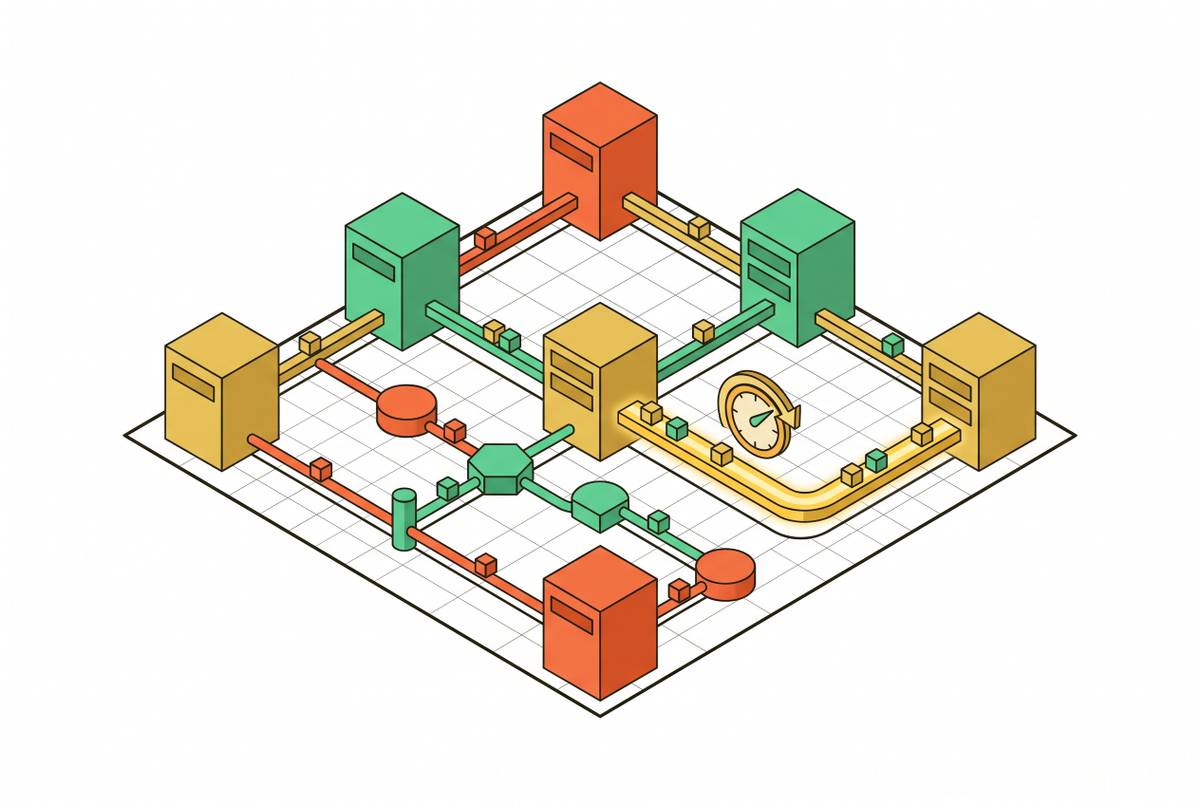
Caching isn't one setting, it's five layers stacked on top of each other, and each one has its own way of going wrong.
Start at the browser. This layer runs on Cache-Control, ETag, and Last-Modified headers, and the developer only controls what the client is told to do, not what the client actually does with that instruction. Move one step out and there's the CDN or edge cache, a shared cache sitting close to the user, invalidated by a tag or surrogate-key purge, or by a path-based purge. A live web data response cached at this layer gets served identically to every downstream consumer until someone explicitly purges it, which is a dangerous kind of quiet.
The reverse proxy sits closer to origin and behaves a bit differently: a soft-purge here marks an entry stale rather than deleting it outright, which is genuinely useful for stale-if-error fallbacks, but turns into a freshness risk fast if the configuration is off. Then there's the application cache, usually Redis or Memcached, invalidated by key deletion, TTL expiry, or an eviction policy kicking in. This is the layer most API teams actually tune day to day, and the cache stampede failure appears in its purest form here.
Last is the database or query cache, which matters when the API itself caches crawl results internally. Any write to a referenced table invalidates the cache, and in a write-heavy workload that invalidation overhead adds up fast.
Which layer is supposed to own this data's freshness. Most of these bugs trace back to two layers both quietly assuming they're the one in charge of the same value. For live web data specifically, freshness ownership should sit as close to the origin as it can. The farther a stale response travels down the stack, the more places it has to be hunted down and purged. For live web data APIs, not all five layers are always relevant, but a response can be cached (or go stale) at multiple layers simultaneously without the developer realizing it.
TTL-based expiration: how to set intervals that reflect actual content velocity
TTL is the baseline pattern everyone starts with: every cache entry gets a time-to-live, and once that clock runs out, the entry expires. For live web data, whether the TTL chosen is honest about how fast the underlying page actually moves is what matters.
Real-time data like prices or inventory levels calls for very short TTLs, on the order of 30 seconds, or real-time invalidation instead of a timer at all. But TTL isn't one number for the whole system, it's a function of how fast each type of content actually moves.
News articles, job postings, product descriptions: TTL measured in minutes to low single-digit hours. A company's "about" page, its documentation, its brand assets: hours to a day is a defensible window. Reference content that doesn't really change, historical facts and the like, can sit much longer, though a pipeline should still validate occasionally rather than assume nothing moved.
This isn't guesswork dressed up as a framework. The FreshCache-Bench benchmark tested 8,072 real web queries across five freshness classes, timeless, slow, medium, fast, and real-time, and found those categories hold up empirically rather than existing as an arbitrary label. Content really does move at different speeds depending on what kind of content it is, and TTL policy should track that directly. Prices, stock levels, live scores: TTL measured in seconds, a 30-second window is often the practical floor before the data is likely to drift.
Stale-while-revalidate: serving fast responses without blocking on origin freshness
Stale-while-revalidate, specified in RFC 5861 and supported by Cloudflare, CloudFront, and Fastly, solves a narrower but very common problem: how to serve instantly without waiting on a fresh fetch every single time. The cached response goes out immediately, and a background request quietly refreshes what's stored for next time.
A typical setup looks like this: Cache-Control: public, max-age=300, stale-while-revalidate=60, paired with an ETag. One engineering reference calls SWR the most underused directive in HTTP, and that's a fair complaint: it hides the round-trip to origin at essentially zero freshness cost to the person who happens to land in that stale window.
For live web data specifically, this matters because scraping and crawling calls have naturally unpredictable response times. Background revalidation decouples what the user experiences from how long the origin fetch actually takes. The stale window has to track content velocity, the same way TTL does. A 60-second stale window is fine for a news source; on a price feed, even 10 seconds might already be too generous.
The 304 Not Modified path pairs with this. When a validator like ETag confirms the stored content hasn't actually changed, the cache gets to skip re-sending the full response body, which is a real performance win whenever the underlying page happens to be unchanged.
Cache stampede: the concurrent-expiry failure that hits hardest on live web endpoints
Cache stampede, sometimes called thundering herd, is what happens when a hot cache key expires and every concurrent request misses at once, all of them slamming the origin simultaneously. One engineering reference calls it the canonical application-layer failure, and for live web data endpoints it's an especially sharp risk. A popular URL being watched by multiple agents or pipeline workers will produce a wave of synchronized misses the instant its TTL runs out.
Three mitigations actually work here, and they layer on top of each other rather than replacing one another. It works, but it adds latency for whoever's stuck waiting. Request coalescing, sometimes called the singleflight pattern, collapses every in-flight request for the same key into a single origin fetch and shares that one response across all the waiters, which tends to beat locking on latency for read-heavy traffic. Probabilistic early expiration treats an entry as "likely to expire soon" before it actually does, and triggers a background refresh stochastically, which sidesteps the synchronized-expiry cliff entirely without needing any coordination between processes.
For agentic workloads, where several agents might independently go after the same URL, the practical middle ground is per-URL caching with a short shared TTL, rather than letting each agent keep its own private cache. That cuts stampede risk while keeping the data about as fresh as a per-agent cache would anyway. For agentic workloads where multiple agents may independently request the same URL, per-URL content caching with short TTLs shared across agents, rather than per-agent caches, is the practical middle ground, reducing stampede risk while keeping freshness tight.
Event-driven and tag-based invalidation for data that changes on a known trigger
TTL and stale-while-revalidate are both polling models: they check freshness on a schedule, whether or not anything actually changed. Event-driven invalidation flips that around into a push model. The cache gets told to drop an entry the moment the underlying data actually changes, instead of waiting for a timer to notice.
Tag-based invalidation is the usual mechanism. Cache entries get tagged with identifiers, a domain name, a product ID, a page path, and when a change event fires, every entry carrying that tag gets purged at once, across every cache layer that's listening. At the CDN level, Cloudflare and Fastly both support surrogate-key or cache-tag purges, so a single API call can clear thousands of entries tied to one tag (CloudFront, by contrast, only supports path-based invalidation, not tag-based). At the application level, Redis pub/sub can broadcast an invalidation event across every distributed instance, so no node keeps serving a stale entry after something's actually changed.
A practical version of this shows up in how profile updates get handled: when a user changes their profile, an event fires that invalidates every cache entry tagged with that user ID across every service that cares. The same pattern maps directly onto a monitored URL. When a scraping pipeline detects that a page has changed, it publishes an invalidation event for every cache entry keyed on that URL, and everything downstream drops the old copy immediately.
This pairs naturally with change detection. That closes the lag that a pure TTL approach would otherwise leave sitting there. Event-driven invalidation pairs naturally with website change detection: pipelines that periodically re-fetch pages to detect changes can use the detection result to both update the stored content and trigger downstream cache invalidation, eliminating the lag that TTL alone would impose.
Semantic caching for AI pipelines: matching queries by meaning instead of string equality
Open-web RAG pipelines carry a specific kind of cost. Each query triggers a search API call, a batch of HTTP fetches for whatever pages come back, and then an LLM synthesis call on top of all of it, and latency for that whole chain routinely runs past three seconds.
Semantic caching is the fix that goes after this directly. Instead of matching on exact string equality, the system checks whether an incoming query means roughly the same thing as one it's already answered, and if so, serves that cached response instead of re-running the whole pipeline. In real deployments, 70 to 85 percent of queries across concurrent agents turn out to be identical or close enough in meaning to count, which makes this one of the higher-leverage optimizations available https://www.searchcans.com/blog/api-caching-strategies-real-time-data-performance-2026/. Earlier semantic caching systems reported search cost reductions of more than half on workloads with recurring query patterns.
But semantic caching on its own has a blind spot: it mostly ignores the fact that the open web keeps changing underneath it. A query that's semantically identical to one answered yesterday might deserve a different answer today, if the page behind it moved. The FreshCache paper tackles this head-on: it classifies cached responses by the freshness class of the web content they depend on, and it withholds a cache hit whenever the underlying content is likely to have gone stale. At a 24-hour window, its FreshCache_MLP variant reached a stale error rate of just 0.1 percent while still cutting search costs by 97 percent, tested against FreshCache-Bench's 8,072 real web queries, later expanded to 31,201 through paraphrasing https://arxiv.org/pdf/2607.04281. That's the real target for semantic caching on live web data: not just matching meaning, but matching meaning without losing track of whether the world underneath that meaning has moved on. A good starting point for connection pooling is 10-20 connections per application instance https://easyparser.com/blog/api-performance-optimization-caching-strategies.