Latency Management for Real-Time Web Data API Calls in Agent Tools
Agents need sub-second data access at every hop or their decisions become obsolete.
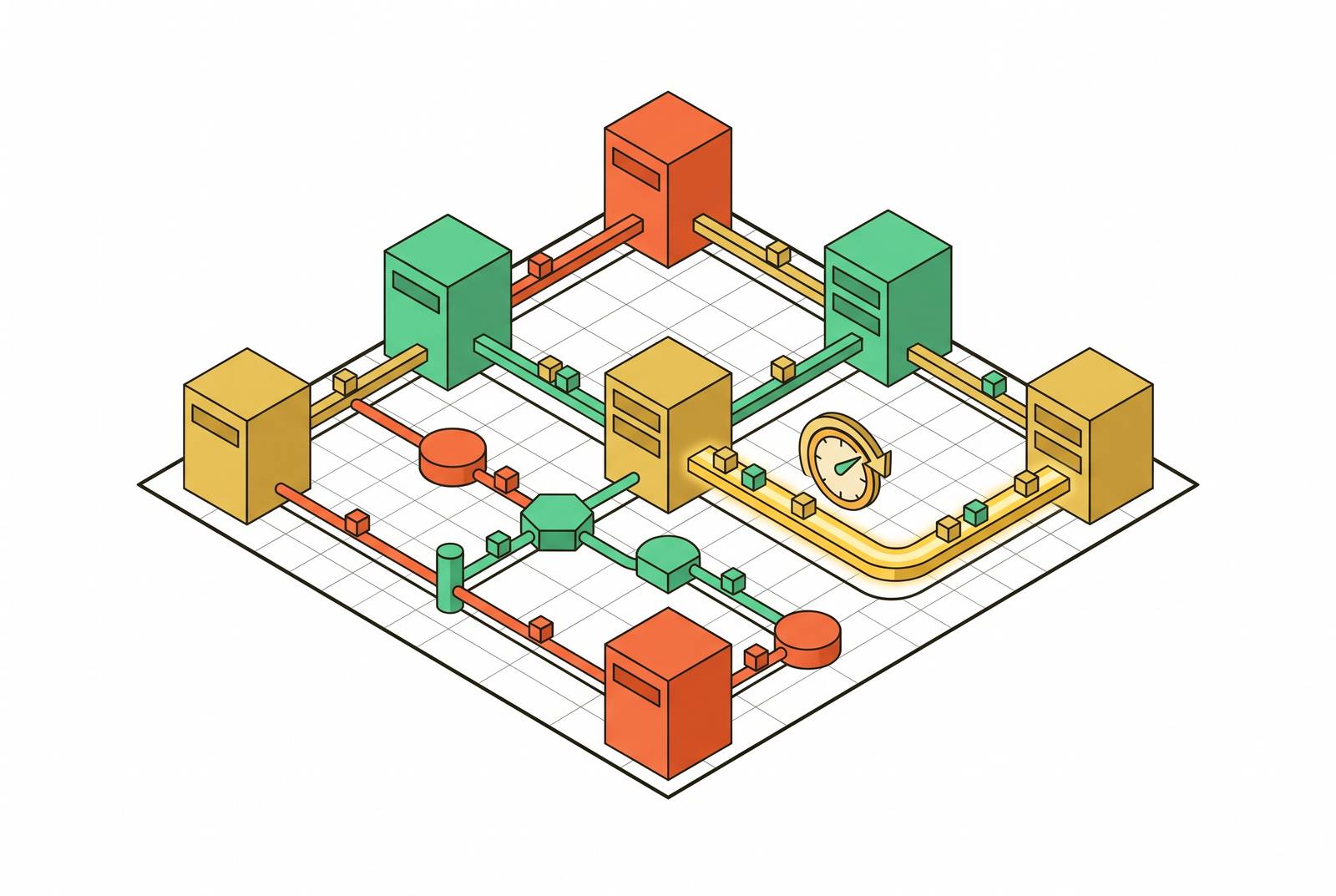
An AI agent that acts on live web data has to decide and act inside a window of roughly two to three seconds, with sub-second budgets at each hop along the way. Missing any single hop can invalidate the entire decision, which makes latency here a hard boundary on what the agent can do, not a number to shave down for the sake of user experience. That's the central claim of this piece: agentic web data access needs its own architecture, built around tiered rendering, connection reuse, parallel fetching, freshness-aware caching, and tail-latency budgeting, because the latency contract an agent operates under is nothing like the one a human-facing API was built to meet.
Latency in Agentic Web Data Calls
Human-facing systems can tolerate a slow response because a person is still there to wait, re-read, or shrug it off. An agent removes that person from the loop. It observes, decides, and acts inside a single live interaction, so any delay in getting data doesn't just feel slow, it changes what the agent can correctly do next.
Picture an agent built to offer a retention credit to a customer at risk of churning. The customer churns. Ninety seconds later, the agent gets the data and offers the credit. The reasoning was sound given what the agent had in front of it. The data simply showed up too late to matter. Nothing in the model was wrong. The pipeline delivering the data was.
That example reframes the entire problem this piece is addressing. Architecting an entire pipeline, end to end, means keeping it inside the decision window at every single stage, not just on average.
The latency stack an agent accumulates on every web call
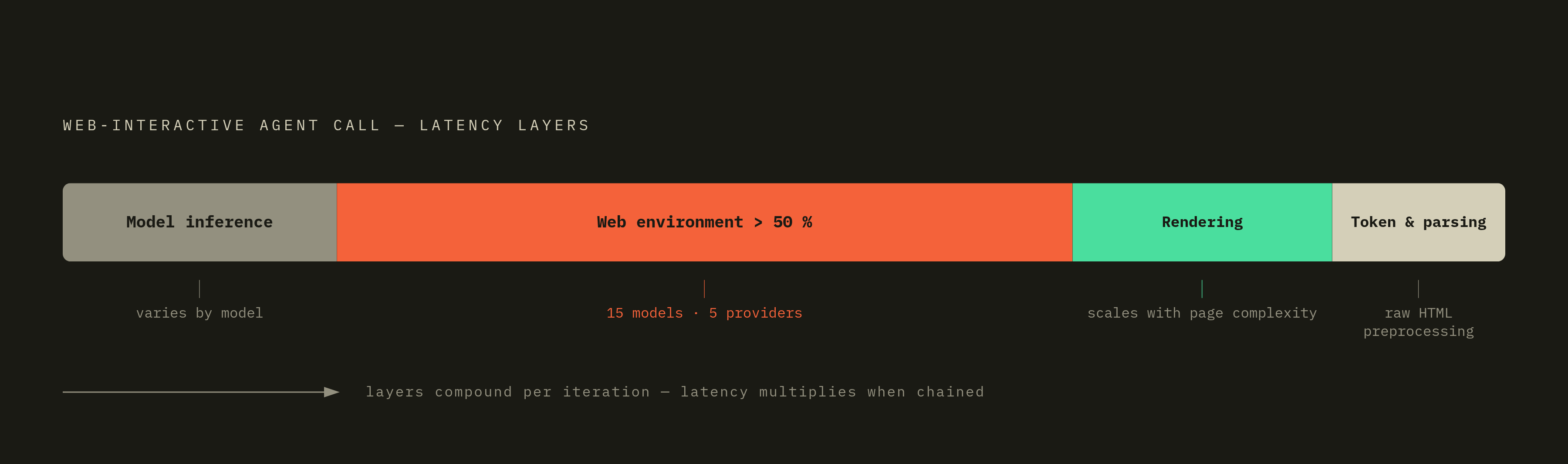
You can't optimize end-to-end latency in a web-interactive agent pipeline as a single number. It's the sum of at least four compounding layers, and each layer has its own variance profile, so a fix at one layer doesn't guarantee a fix anywhere else.
Model inference is one layer, and it's the one most teams watch closely. Web environment latency is a second layer, and in a study across 15 models and 5 providers, it accounted for more than half of total per-iteration latency in web-interactive agentic systems. That's frequently the larger cost of the two, not a rounding error sitting next to the model cost.
Rendering overhead is a third layer. JavaScript-heavy single-page applications need a full headless browser launch and execution cycle on every fetch, and that cost isn't fixed. It scales with how complex the page is.
Token and parsing overhead rounds out the stack as a fourth layer. Handing an agent raw HTML forces hidden preprocessing before inference even starts. Clean, LLM-ready Markdown or structured JSON strips that cost out of the critical path entirely. Platforms built for this, Context.dev among them, convert web content directly into Markdown or a structured JSON schema before it ever reaches the agent, which removes both the parsing burden and the token bloat from the inference step.
Chain web tool calls together in sequence and these layers don't just add up, they compound: a tail-latency event at the first layer delays every layer downstream of it. Most teams only instrument the start and end of this chain, event in, response out, with no visibility into the four to six stages sitting in between. That blind spot is exactly where systemic latency hides.
Why traditional data pipeline assumptions break under agent workloads
Most enterprise data infrastructure was built to answer a different question than the one agents are asking. A typical flow, event collection, batch ingestion, transformation, identity stitching, reverse ETL, can leave data anywhere from minutes to many hours old by the time any downstream system can act on it. That's a fine latency profile for a dashboard. It's disqualifying for an agent trying to act in the next three seconds.
The distinction that matters here is between analytical latency and operational latency. Analytical latency is how fresh data is for a model or a report. Operational latency is how fresh it is at the moment something needs to act on it. A team can have best-in-class analytical latency and still fail completely on the operational side.
Each stage in a pipeline can meet its own service-level agreement, and the pipeline as a whole can still miss the agent's decision window. Tuning any one stage doesn't close that gap. Reducing the number of stages does.
Serving an agent out of an analytics warehouse is a mismatch at the architectural level: the warehouse was built for aggregate queries, not the point lookups an agent's access pattern demands. And streaming infrastructure doesn't fix anything on its own if a nightly reverse ETL job quietly sits downstream of it. One scheduled batch job reimports all the latency the streaming migration was supposed to remove.
Serving agents from a warehouse or a batch-oriented pipeline reintroduces the exact delay that streaming infrastructure exists to eliminate. So once a decision window shrinks to seconds, you need purpose-built web data APIs, designed for live agentic access rather than adapted from analytics tooling.
Tiered rendering as the first architectural decision for any web data call
The first decision in any web data call is how the page gets fetched at all, and that decision sets the ceiling for how much anything downstream can be optimized further.
Static HTML pages, API endpoints, and RSS feeds can be pulled with a plain HTTP request, at a fraction of the cost and latency of launching a browser. JavaScript-heavy single-page applications and pages sitting behind soft paywalls genuinely need browser rendering, but that cost should get paid only when the page actually requires it.
The practical pattern is a rendering decision layer: classify the target URL first, then route it to the lightest method that will actually work, plain fetch, lightweight rendering, or full headless execution. Managed web extraction APIs handle this classification automatically, pulling the decision out of the agent's critical path. Teams running their own rendering stacks have to maintain that classification logic themselves as page structures change over time.
Output format is the second half of the rendering decision. Raw HTML coming out of a browser render wastes the rendering work that was just done. Converting that output straight to LLM-ready Markdown or a structured JSON schema gives the agent a payload it can use directly, instead of a document it still has to parse before it can reason. Context.dev folds rendering and output conversion into a single API call: rendering happens automatically and clean Markdown or JSON comes back directly, so both the rendering decision and the preprocessing step drop out of the pipeline in one move.
Connection reuse and transport-layer patterns that reduce per-call overhead
As inference gets faster, the overhead of setting up a new connection for every single step in a workflow becomes easier to see, and it adds up across a multi-step agent chain.
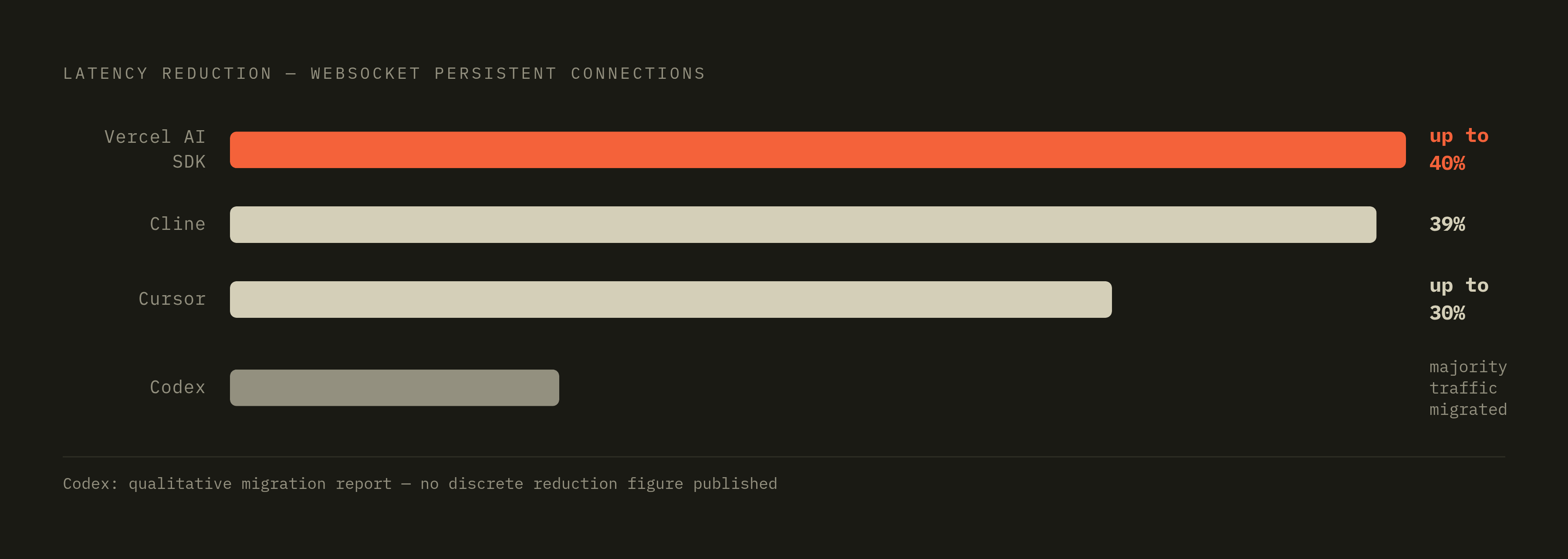
OpenAI introduced a WebSocket-based execution mode for its Responses API in April 2026, replacing separate HTTP request-response cycles with one persistent, bidirectional connection. It targets the overhead that builds up across tool calls, intermediate reasoning steps, and follow-up queries: the repeated round-trip cost of opening and closing connections for work that's really one continuous conversation.
Early production numbers back this up. Vercel reported a latency reduction of up to forty percent after integrating WebSocket mode into its AI SDK. Cline observed a thirty-nine percent improvement in multi-file workflows. Cursor reported gains of up to thirty percent. Codex migrated the majority of its Responses API traffic onto WebSocket mode after the alpha rollout, a sign the approach holds up at production scale, not just in a controlled test.
The mechanism behind the gains is straightforward: a persistent session lets the client warm the connection ahead of time, sending system prompts and tool definitions before the first substantive call goes out. That removes cold-start overhead from every step that follows in the chain.
None of this is specific to OpenAI. Any persistent connection that spreads handshake cost across multiple tool calls works on the same principle, HTTP/2 multiplexing, connection pooling to scraping APIs, keep-alive sessions to extraction endpoints. These gains stack on top of whatever improvements happen at the model or application level, because they change how the plumbing is arranged rather than what the agent is reasoning about.
Parallel fetching and structured schemas to reclaim time lost in sequential tool chains
Sequential web data calls are a choice teams make, often without realizing it, not a constraint the technology forces on them. An agent researching a competitor can pull pricing, product pages, and a press release all at once if nothing about the reasoning requires one result before the next call goes out. Running those calls in parallel drops the wall-clock cost to the time of the single slowest call, rather than the sum of all calls.
Parallelism only works if each response comes back in a predictable shape. An agent can't fan out calls and merge the results if each one arrives in a different format requiring its own custom parsing. Schema-driven extraction solves that problem: supply a JSON schema to the extraction API, get back a conformant object, and the agent knows exactly where each field lives before any of the responses even arrive.
Compare that to prompt-based extraction, where an LLM parses each freeform response. That approach adds a reasoning step for every single response before the agent can act on it, which reintroduces sequential latency at the merge stage even when the original fetches ran in parallel. Context.dev's structured JSON extraction mode follows the schema-driven pattern directly: a developer defines the schema once, and the agent can fan requests out and merge the results without writing downstream parsing logic for each one.
Freshness-aware caching as a latency buffer that does not sacrifice data currency
Caching looks like it fights against freshness, but that's only true if you apply one TTL across every kind of content. If you match the cache schedule to how fast the underlying data actually changes, the tension mostly disappears. A cached scrape returns a snapshot that might be hours or days old. A real-time fetch pays full network, rendering, and parsing cost on every single call. Neither one is the right default for everything an agent might ask for.
Research on web-interactive agentic systems offers a concrete model for resolving this: SpecCache, a framework that uses speculative execution to populate an action cache ahead of time, with a draft model predicting the agent's next move. SpecCache overlaps environment interaction and model reasoning instead of serializing them, and that cut web environment overhead by up to 3.2 times without any drop in agentic system performance.
Without that kind of speculative infrastructure, a simpler heuristic still holds up: match cache cadence to how fast the content actually moves. Pricing pages might need a daily refresh, product pages weekly, and press releases during earnings season might call for hourly polling. Change detection offers another lever: instead of expiring cache entries on a fixed clock, watch the page itself for structural change and invalidate only when something real shifts. That keeps content current without triggering re-fetches that accomplish nothing.
The failure mode to watch for is applying uniform short TTLs everywhere to "be safe." That approach throws away the latency benefit of caching without meaningfully improving freshness on data that barely changes. For agents querying brand intelligence, company data, or anything that moves on a known cycle, a freshness control that lets the caller specify how recent the result needs to be beats a fixed TTL on every count.
Tail-latency budgeting and the variance problem that averages conceal
Average latency is close to useless for budgeting an agent's tool calls, because what actually breaks the decision window is the tail, the slowest responses, not the typical ones. Benchmarking across multiple models and providers found that latency for fixed-length requests to the same model can vary by more than 69 times depending on when the request goes out. An average computed across that range says almost nothing about what the agent will actually experience once it's running under real load.
Tail-latency budgeting means you set the decision window against a high percentile rather than the mean: design for P95 or P99 response times and confirm the full pipeline still finishes inside the window even at those percentiles. Anything less is planning for a day that doesn't reflect the bad ones.
Timeout and fallback design matters here too. When a web data call blows through its tail budget, the agent needs a defined fallback, a cached response, a degraded-mode answer, an explicit signal back to the user, rather than sitting there blocking indefinitely. Some API providers offer priority processing tiers that move requests onto dedicated capacity, cutting variance by addressing queuing delay directly. That's an infrastructure purchase rather than an architectural change, but it goes straight at one of the main drivers of tail events.
In a multi-hop agent chain, even modest per-call variance can compound into high end-to-end tail latency. That's the variance case for parallelism covered earlier: running calls in parallel exposes the agent to only the single slowest response in the batch, not the sum of every slow response strung together.
Sources
- OpenAI Introduces Websocket-Based Execution Mode to Reduce Latency in Agentic Workflows - InfoQ
- SimpleTool: Parallel Decoding for Real-Time LLM Function Calling
- 2026 LLM API Latency Benchmarks: TTFT + Tokens/sec
- Latency-Sensitive Web Scraping: 2026 Benchmark | fastCRW
- 9 Tips for Reducing API Latency in Agentic AI Systems | Nordic APIs |
- Best AI Web Scraping Tools for LLM and RAG Pipelines in 2026
- Best AI Web Scraper Tools 2026: LLM-Powered Data Extraction Compared | Use Apify