Crawl-and-Index API Integration With LangChain and LlamaIndex
Crawl APIs keep RAG systems current by feeding fresh data into LangChain and LlamaIndex.
A RAG system can only answer with what it already has indexed, and that single fact explains most of the failures developers see in production. News, software version numbers, prices, security CVEs, and regulations all shift between the moment a crawl runs and the moment a user asks a question, so the system hands back an answer that was already out of date when it generated it. Swapping in a better language model doesn't touch this problem, because the gap is in the data pipeline, not in the reasoning engine sitting on top of it. So you fix it by building or buying a pipeline that keeps pulling fresh content from the live web, and that's what this guide works through, framework by framework, using LangChain and LlamaIndex as the two paths developers actually build on.
The usual response to this problem is to build a scraper in-house, and that response carries a cost that compounds instead of settling. A Playwright-based scraper needs weekly attention just to keep up with target sites changing their DOM structure, and in one practitioner case from the research for this piece, a whole Playwright fleet was replaced with a crawl API, cutting build time from three days to four hours and removing the recurring maintenance work entirely. The maintenance burden rarely stays contained to the scraper itself. Teams end up running a proxy layer to dodge blocks, a parsing pipeline to clean up whatever HTML comes back, and a monitoring stack to catch failures, and each of those pieces breaks on its own schedule, with its own on-call rotation attached.
A crawl-and-index API returns LLM-ready Markdown through a single REST call, so you can get rid of that entire stack and replace it with one managed surface. You don't maintain browser automation, proxy rotation, and a parsing layer; you make one call and get back text that's already shaped for an LLM to consume. Once fetching and cleaning the page is no longer the hard part, the real engineering work moves to wiring that output into a retrieval framework. That's where LangChain and LlamaIndex come in.
How LangChain and LlamaIndex divide the work differently
LangChain and LlamaIndex solve different problems, and a crawl API connects to each one at a different point because of that. LangChain's center of gravity is agent orchestration and chains: it gives a developer a Tool abstraction that lets an LLM call any function by name, and LangGraph, its stateful graph-based agent layer, is the path the framework recommends for production agents. LangChain hands over the interface for calling tools, not the tools themselves, so a developer still has to handle authentication, pagination, rate-limit backoff, and schema normalization outside the framework.
LlamaIndex is built the other way around, starting from data ingestion and retrieval. It ships built-in hybrid search that fuses BM25 and vector similarity, a router query engine, sub-question decomposition, and several response synthesis modes, all of which take manual assembly to replicate in LangChain. LlamaHub, LlamaIndex's connector library, lists more than 350 data connectors against LangChain's 200-plus document loaders, though LlamaHub's readers are built for batch ingestion rather than real-time, bidirectional access.
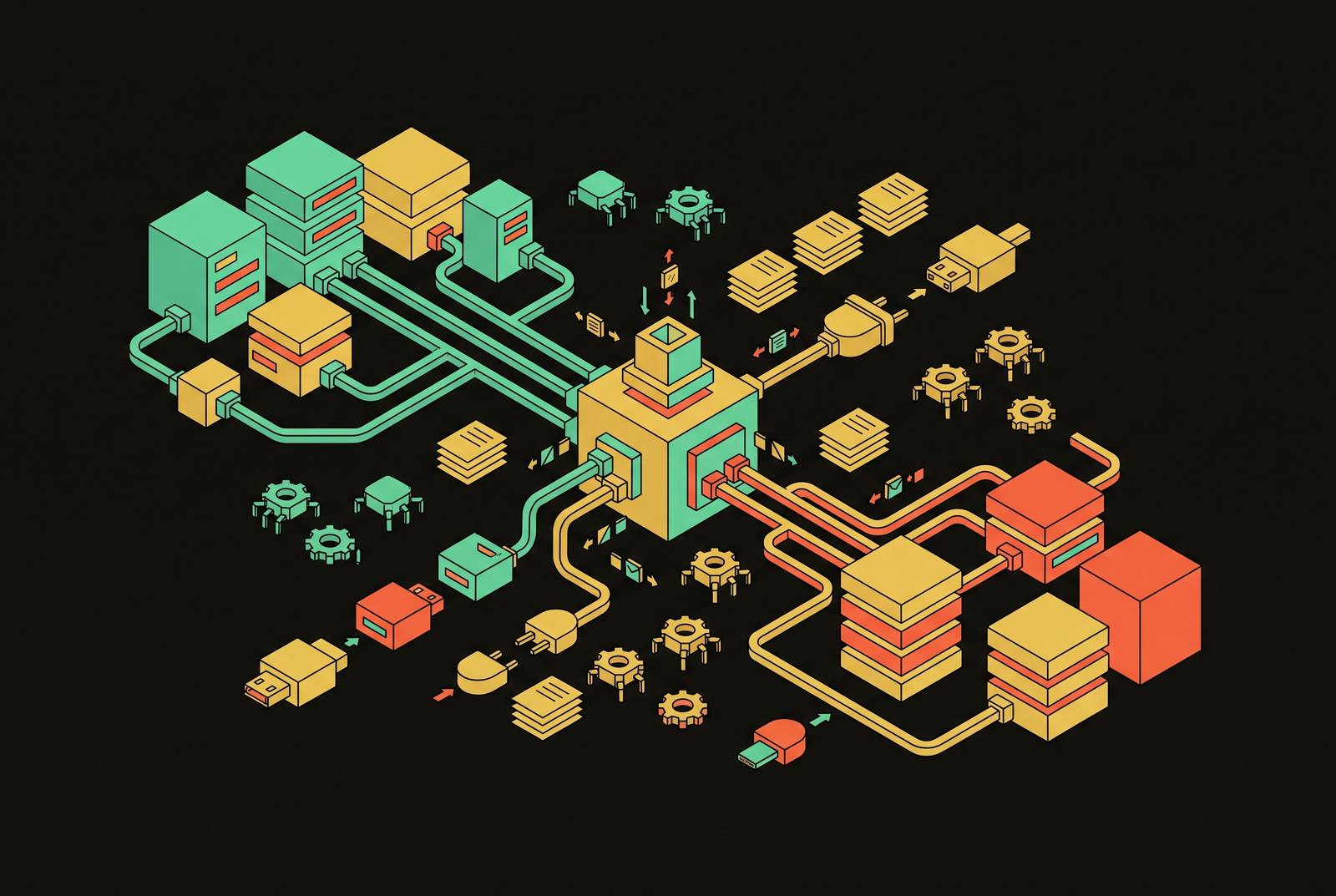
A common production pattern uses LlamaIndex for data ingestion and indexing, then wraps the LlamaIndex query engine as a tool inside a LangChain/LangGraph agent. A crawl API plugs into each framework at a different spot because of this divide.
LangChain path:
 crawl API (Markdown) -> Document -> TextSplitter -> VectorStore
 OR
 crawl API -> wrapped as Tool -> invoked by agent at runtime
LlamaIndex path:
crawl API (Markdown) -> Document -> Node Parser -> VectorStoreIndex
(hybrid search, re-ranking, routing run automatically on top)In LangChain, the crawl API's Markdown output becomes a Document that moves through a loader into a text splitter and then a vector store, or the API call itself gets wrapped as a Tool an agent invokes at runtime. In LlamaIndex, that same Markdown becomes a Document fed into a Node parser and then into a VectorStoreIndex, and the retrieval machinery, hybrid search, re-ranking, routing, runs on top of it without extra wiring.
The two retrieval patterns, scheduled indexing and on-demand crawling
You don't choose between pre-indexing on a schedule or fetching live at query time as a style choice. It follows directly from how fast the underlying data changes and how much query latency the product can afford to spend.
Scheduled batch indexing crawls known sources on a set cadence, refreshes the vector store, and serves queries from that standing corpus. So if content changes slowly and you need fast query response more than up-to-the-second accuracy, you'd use this for documentation sites, knowledge bases, and regulatory corpora. Cost scales with how the pipeline handles updates: batch ingestion re-processes every document on every run, while webhook-triggered ingestion only touches documents that actually changed, and for a large knowledge base that difference in processing time and embedding spend adds up fast.
On-demand retrieval, sometimes called SERP grounding, works the opposite way: it runs a live fetch at the moment a query comes in, builds a temporary index just for that question, and then either discards it or caches it against a freshness window. This pattern suits news, prices, CVEs, and competitor pages, anywhere staleness can actually be detected at query time. TalorData's integration support added in June 2026 for LangChain, LlamaIndex, Dify, and n8n targets exactly this gap, since an LLM has no reliable way to reach breaking news, shifting search rankings, or other live web content without a path like this built in.
Most production systems end up running both patterns side by side: a cheap indexed API covering the standing corpus, plus a live-crawl path reserved for the queries where staleness is actually detectable. Pick the right pattern before you write any integration code, because retrofitting a scheduled-index pipeline to handle live, time-sensitive queries later means rearchitecting the retrieval layer, not just adding a new data source.
Wiring a crawl API into LangChain: loaders, tools, and the agent invocation path
LangChain gives you two separate wiring points for a crawl API: a Document loader path for pre-indexed RAG, and a Tool path for live agent retrieval, and each one serves a different one of the two patterns just described.
The loader path fits the scheduled indexing pattern. A crawl API call returns Markdown already shaped for an LLM, and you can map that output directly onto LangChain's Document object. The typical pipeline runs the crawl API's output through a Document, into a RecursiveCharacterTextSplitter (where chunk size and overlap settings directly affect retrieval quality), then into an embedding step, a vector store such as Chroma, and finally a RetrievalQA chain. In skeleton form:
docs = crawl_api.fetch(urls) # returns Markdown
documents = [Document(page_content=d) for d in docs]
chunks = RecursiveCharacterTextSplitter(chunk_size=..., chunk_overlap=...).split_documents(documents)
vectorstore = Chroma.from_documents(chunks, embedding_model)
qa_chain = RetrievalQA.from_chain_type(llm, retriever=vectorstore.as_retriever())
The Scrapfly RAG guide walks through this exact pattern using ScrapflyLoader with LangChain, building a Chroma vector store from scraped Markdown and wiring in a custom prompt template for domain-specific retrieval.
The Tool path fits the on-demand, agentic pattern. Here, you wrap the crawl API call as a LangChain Tool, and the LLM decides at runtime whether to call it, passing along a URL or a query as the argument. A rough skeleton:
@tool
def crawl_page(url: str) -> str:
 return crawl_api.fetch(url) # returns Markdown

agent = create_agent(llm, tools=[crawl_page])
LangGraph, the production agent layer LangChain recommends, gives that tool call fine-grained retry logic, branching, and error handling, which matters because a live fetch can come back as an anti-bot block instead of usable content. Support for MCP lets agents like Claude or Cursor call crawl tools directly at runtime without custom glue code, and native SDKs or MCP servers are worth reaching for over hand-rolled wrapper code wherever they exist.
Neither path gives you anti-bot penetration, JavaScript rendering, or proxy routing on its own. Those capabilities have to come from the crawl API itself, and managed APIs vary widely here, with several treating JavaScript rendering as a separate paid feature. This guide covers anti-bot handling in full later on.
Wiring a crawl API into LlamaIndex: node parsers, vector indexes, and hybrid retrieval
LlamaIndex's data-first design means a crawl API's output slips in at the Document layer, so it immediately unlocks retrieval capabilities that LangChain requires manual assembly to replicate.
The ingestion path runs crawl API Markdown into a LlamaIndex Document object, then through a Node parser, where the choice between sentence-based, token-based, semantic, or hierarchical splitting changes retrieval quality, and finally into a VectorStoreIndex. In skeleton form:
docs = crawl_api.fetch(urls) # returns Markdown
documents = [Document(text=d) for d in docs]
nodes = SentenceSplitter().get_nodes_from_documents(documents)
index = VectorStoreIndex(nodes)
query_engine = index.as_query_engine()
The Scrapfly RAG guide demonstrates this same path using ScrapflyReader: it feeds scraped Markdown straight into VectorStoreIndex.from_documents() and ends up with a working query engine in four lines of code.
On top of that index, you can do a lot without writing any additional retrieval code. Hybrid search fuses BM25 keyword matching with vector similarity. A router query engine sends a query to the right sub-index for you automatically. Sub-question decomposition splits a complicated query into smaller pieces, retrieves for each one separately, then synthesizes a combined answer. Response synthesis itself is selectable per query, among modes like refine, compact, tree summarize, and accumulate.
The combined pattern pairs LlamaIndex with a LangChain agent. Wrapping a LlamaIndex query engine as a LangChain tool is a documented production pattern: LlamaIndex owns the data and retrieval layer, while LangChain or LangGraph owns reasoning, orchestration, and multi-step decision-making. That split is the architecture most knowledge-heavy agentic applications end up running: the crawl API feeds LlamaIndex, LlamaIndex exposes a query engine, and LangGraph orchestrates that query engine alongside whatever other tools the agent needs.
Schema-driven extraction: structured JSON instead of raw Markdown
Markdown isn't the right output for every pipeline. When you need structured JSON shaped to a schema you define, a crawl API with schema-driven extraction removes an entire parsing step that would otherwise sit between the crawl and the index.
Traditional scrapers rely on CSS or XPath selectors written by hand against one specific page layout, and the moment a site renames a class or restructures its markup, the scraper breaks and someone has to go fix it. Schema-driven extraction works differently: the developer defines the shape of the output they want as a JSON schema, and the API resolves that schema against whatever the page actually contains. Because it targets what the content means rather than how the markup is structured, it survives the kind of DOM changes that snap a selector-based scraper in half. The schema itself functions as a kind of contract written in plain language, so if you write it clearly for an LLM to interpret, it produces measurably better extraction results than a vague one.
Inside a LangChain or LlamaIndex pipeline, structured JSON from a crawl API maps directly onto node metadata or onto typed tool outputs, so the LLM downstream reasons over clean, named fields instead of parsing raw scraped prose for the facts it needs. That distinction opens up use cases unstructured Markdown can't really serve well: pulling structured product data across a catalog, tracking competitor pricing across many pages in a consistent shape, or building structured brand or company profiles for an agent to query against.
Schema-bound extraction still has limits: interactive, schema-bound extraction across a wide range of different websites remains genuinely hard, because most sites don't carry semantic markup, many use dynamic, auto-generated identifiers, and some hide the content a schema asks for behind interactive elements like tabs or expandable sections, a gap current benchmarks confirm sits unsolved even at the frontier of the field. For the common cases, documentation pages, product pages, blog posts, company profiles, schema-driven extraction holds up reliably and breaks far less often than selector-based scraping does.
Keeping indexes fresh: incremental re-indexing and change detection
Shipping a working pipeline is the starting line, not the finish. Source pages keep changing after launch, so you need content-hash-based incremental re-indexing to keep the index current without re-crawling everything from scratch.
The operational pattern is straightforward to describe. On each crawl, compute a SHA-256 hash of each page's Markdown content. If that hash matches the value already stored for that page, you skip it. But if it changed, you delete the old nodes tied to that page and insert fresh ones in their place, so only the pages that actually changed trigger a re-embedding call. That distinction is what separates webhook-triggered ingestion, which only touches documents that changed, from full batch ingestion, which re-processes the entire corpus on every run, and for a large knowledge base the gap in processing time and embedding cost between the two is substantial.
Production systems generally favor blue/green indexing over deleting and rebuilding a live collection outright: index the refreshed content into a shadow collection, then swap the alias over once it's ready, which avoids any query downtime while the re-index is running.
Change detection itself has become its own AI-native layer in the pipeline. Newer tools use an LLM to summarize what changed on a page in plain English, filter out noise that doesn't matter, classify changes by how important they are, and route only the changes that matter into the re-indexing job. That layer keeps a crawl-and-index pipeline from either missing a real update or re-embedding the entire corpus every time a page's footer timestamp ticks over.