Browser Fingerprinting Evasion in Production Scrapers
Evading modern anti-bot detection requires mastering six independent layers, not just proxies.
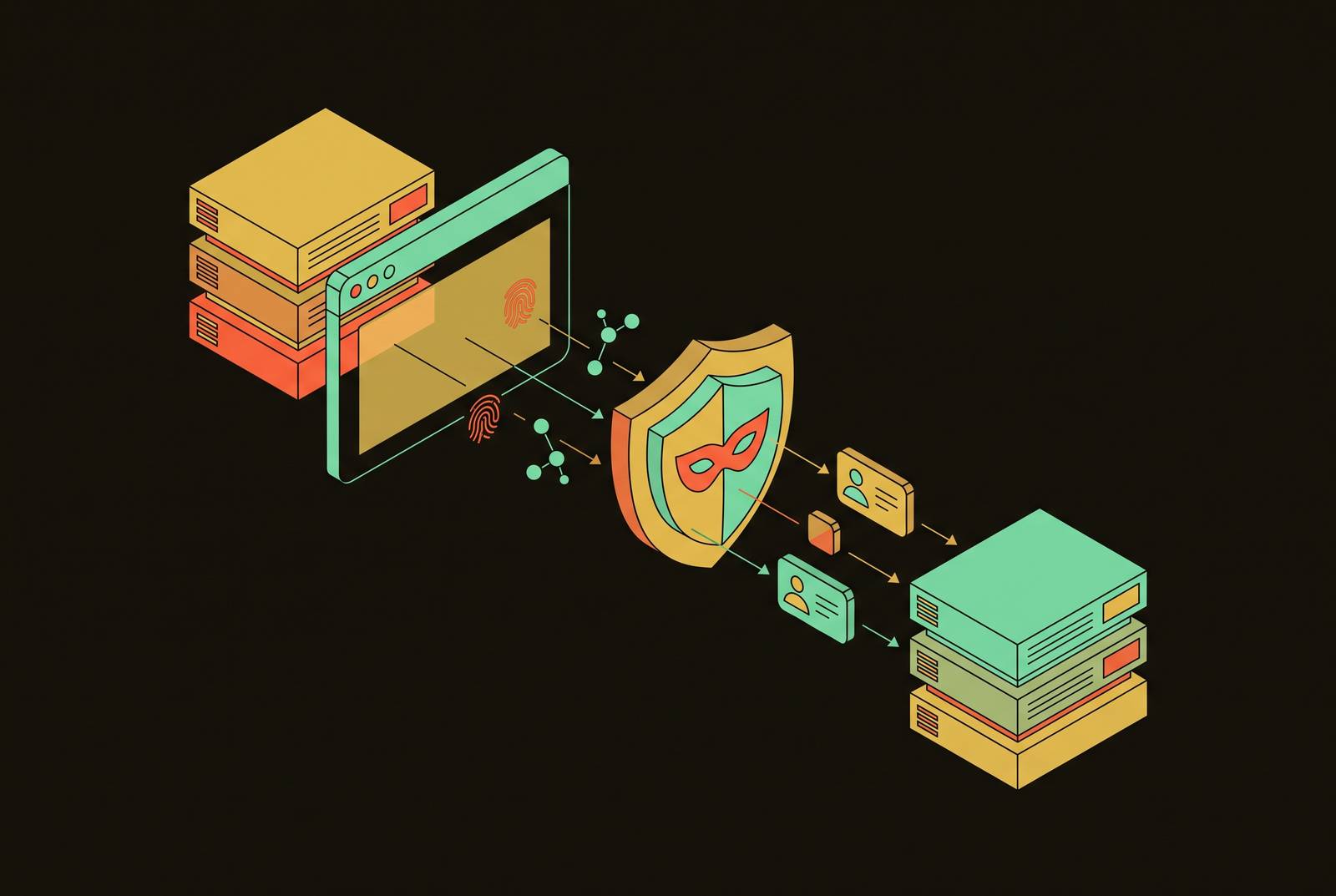
Web scraping is on track to hit $3.16 billion by 2029, and that growth explains why anti-bot vendors stopped treating detection as a network problem years ago. Detection in 2026 runs across TLS handshakes, HTTP/2 frames, canvas rendering, WebGL, audio processing, and mouse movement, all at once, all cross-checked against each other. Patch one layer and ignore the rest, and you still get caught. You just get caught one checkpoint later than you expected, usually when your ban rate spikes with no obvious cause, and by then the fix costs a lot more than it would have going in.
Scraping isn't a side hustle anymore, and the numbers back that up. Bots made up 51% of all web traffic in 2024, and scrapers alone still account for 10.2% of global traffic despite years of money spent fighting them. Anti-bot systems change every quarter, so treating detection as a puzzle you solve once means your fix expires within a season. The incentive to scrape keeps rising alongside the incentive to block, and neither side is showing signs of slowing down.
The detection stack modern anti-bot platforms run
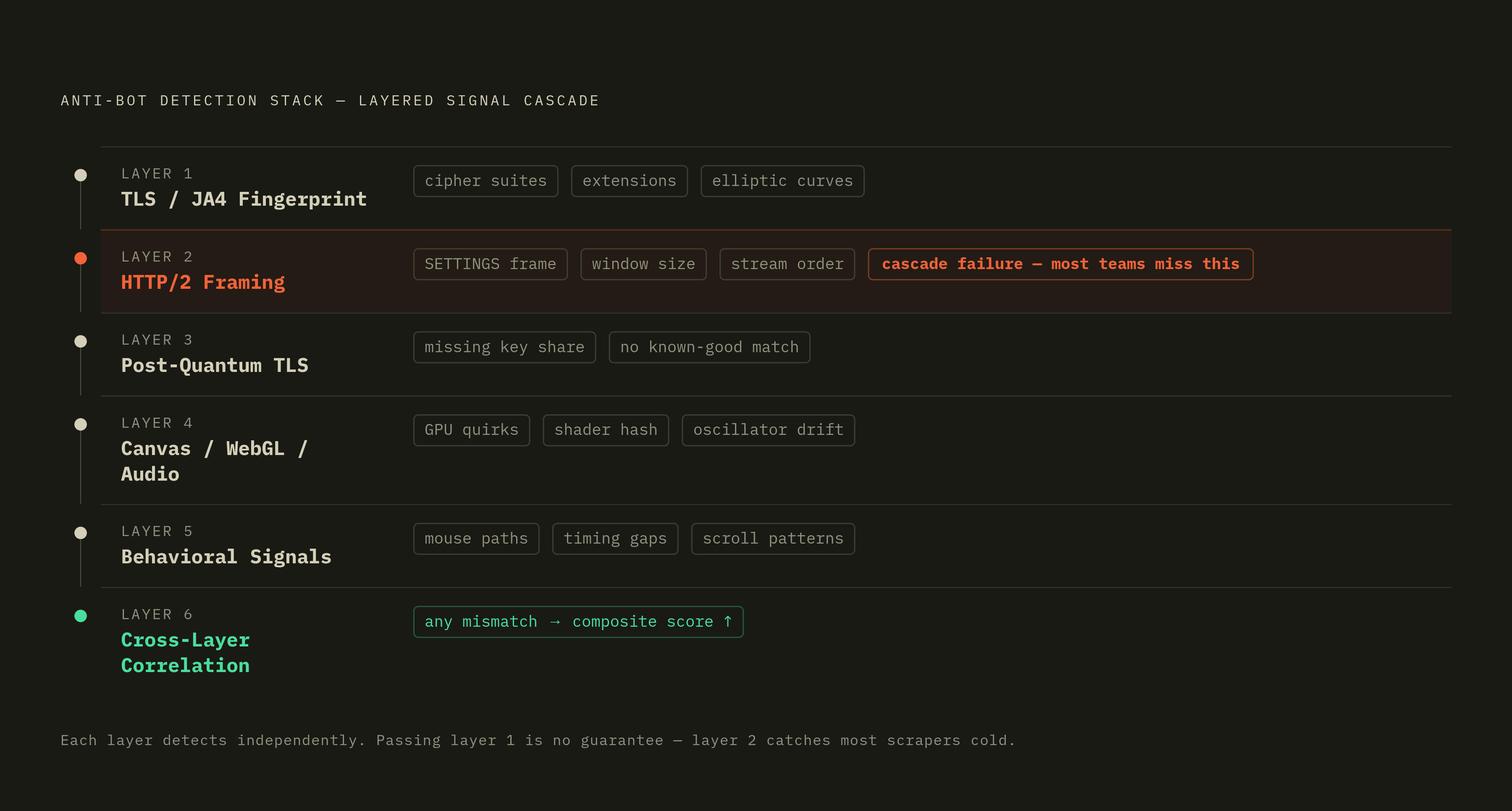
Anti-bot platforms don't bet on one signal. They collect several independent ones and watch for contradictions between them. A scraper can sail through layer one and still get caught cold at layer two, and most teams miss this failure point.
Layer 1 sits at the network level: TLS and JA4. A TLS handshake occurs before every HTTPS connection sends a single byte of HTML to the browser. That handshake, fingerprinted as JA4, replaced the older JA3 standard after Chrome began randomizing TLS extension order in 2023. JA4 reads cipher suites, extensions, and elliptic curves, then sorts them before hashing, so a routine Chrome update doesn't break the signature. Cloudflare, Akamai, and AWS WAF all lean on JA4 as a first-line signal in 2026. A scraper built on plain Python requests, httpx, aiohttp, Go's net/http, or Node's axios gets flagged before the server even reads a header, because each of those libraries produces its own recognizable JA3/JA4 hash. TLS fingerprinting is the hardest layer to fake, precisely because it sits below anything JavaScript or a browser extension can touch.
Layer 2 is also network-level: HTTP/2 frame fingerprinting. When a client opens an HTTP/2 connection, it sends a SETTINGS frame carrying values like initial window size, max concurrent streams, and header table size, and every implementation sets its own defaults. A session can nail a perfect Chrome JA4 fingerprint and still get flagged if it sends HTTP/2 frames in an order no real Chrome browser ever uses. That mismatch, a convincing TLS mask paired with the wrong frame order, is what separates a patched automation script from a genuine browser. These settings come from the client's own implementation, same as TLS, and nothing in JavaScript can touch them either.
Layer 3 is newer: post-quantum TLS. Traffic that spoofs a Chrome fingerprint without the matching post-quantum key share ends up with a signature that has no known-good match in Cloudflare's own database. Akamai has published research putting cross-layer bot classification accuracy at 92 to 98%. That number alone says how far this stack has moved past simple IP checks.
The newest evasion challenge: LLM-based web agents
Traditional automation, Selenium scripts, Puppeteer, Playwright, still gets caught by the layers above. LLM-based web agents pose a different kind of challenge. Since 2023 they've formed their own category: agents that solve CAPTCHAs, mimic human interaction patterns, and in some setups run right from a user's own machine, which makes blocking by network address close to useless.
A study out of Université de Lille (arXiv:2606.30119, Fayolle et al.) tested this directly. Researchers built honeysites protected by robots.txt, CAPTCHAs, proof-of-work challenges, and Cloudflare's free tier, then set six different LLM-based web agents loose on them. Some agents got past every anti-bot mechanism tested, which sounds like a win for the agents until you read the rest of the finding: all six could still be told apart, from humans and from each other, once researchers stacked fingerprinting across network, HTTP, and browser layers together. The stealth features built into these agents often made them easier to spot, not harder, because the act of hiding left a signature of its own.
General-purpose assistants like ChatGPT, Gemini, and Perplexity weren't part of that study, and they wouldn't have lasted long in it anyway. They pull content through simplified HTTP requests, closer to cURL than to a browser, with little to no interaction that resembles a user navigating a page. That makes them trivial to catch by comparison. Open-source agent frameworks like Crawl4AI and BrowserUse are the harder case: they advertise bot-detection bypass features right in their documentation, and the Lille researchers found stealth mechanisms baked into every open-source tool they examined.
Why the proxy-only approach fails
Proxies solve exactly one problem: IP reputation, ASN blocklists, geographic matching. Nothing more. They do nothing about TLS fingerprints, HTTP/2 behavior, canvas rendering, or mouse movement, because none of those live in the network path a proxy controls. Teams that treat proxy rotation as their whole strategy have solved a small slice of the problem and are calling it finished. That's the mistake, and it's a common one.
A badly matched proxy can actively work against you, too. A residential IP from one country paired with a browser reporting a US locale and a US timezone creates a mismatch, and that mismatch reads as a stronger signal of automation than a flagged datacenter IP that's at least internally consistent. It's exactly the kind of contradiction a real user never produces. Detection systems don't check IPs alone. They correlate requests across fingerprint similarity and keep historical fingerprint data across sessions, so once a pattern gets flagged, climbing back out gets harder each time, not easier.
At scale, that turns proxy rotation into a liability instead of a fix. Static or unusual fingerprints get clustered by detection models, and that clustering can take down an entire proxy pool at once, not just the one IP that tripped the alarm. The proxy did its job. The rest of the stack gave everything away anyway.
Fixing the network layer: TLS impersonation and HTTP/2 alignment
requests, httpx, and their equivalents in other languages all emit a recognizable JA3/JA4 hash, and a WAF can read that hash before a single line of your scraping logic even runs.
The cleanest fix skips faking a browser's TLS stack and just uses one. Running requests through Playwright makes the TLS signature real by construction. No impersonation needed, since an actual browser is doing the handshake.
Full browser automation isn't practical for every job, though, especially high-throughput, HTTP-only pipelines. For those, a library like tls-client in Python can impersonate specific browser TLS profiles at the library level. Configuration matters as much as the library choice here: set random_tls_extension_order=True, and rotate across multiple separate impersonation profiles. Running one static profile at high volume makes that consistency its own tell, no matter how convincing the profile looks on any single connection.
Fixing the browser layer: canvas, WebGL, AudioContext, and profile coherence
Headless browsers ship with defaults that give them away fast: missing plugins, inconsistent hardware values, an exposed navigator.webdriver flag, rendering quirks a normal setup never shows.
Canvas fingerprinting works by rendering hidden graphics and reading the pixel data back. GPU model, driver behavior, operating system text rendering, and font rasterization all shape that hash. Canvas alone rarely decides anything by itself. Anti-bot systems fold it into a composite profile, and what raises the score is the mismatch between canvas output and everything else the session reports.
WebGL exposes the GPU vendor and renderer strings, shader precision, and the browser's extension list. Headless environments routinely report a virtual or generic GPU, something a real user's machine almost never shows.
AudioContext picks up oscillator and dynamics-processing quirks that vary by hardware. A scraper returning an atypical audio fingerprint stands out against a population of real browsers, each with its own small audio signature.
Behavioral simulation: coverage and limits
Getting every fingerprint layer coherent is necessary, but it buys nothing on its own if the behavior layer on top is sloppy. One study (arXiv:2606.20910) put detection accuracy for telling AI web agents from humans at 97%, using network signals and browser interaction behavior together. Behavior is the layer left over once everything else lines up, and it still hands detectors plenty to work with.
Good behavioral simulation covers a handful of specifics. Mouse movement tools like GhostCursor, or custom Playwright scripts, trace curved paths at variable speed instead of snapping straight to a click target. Timing matters just as much: realistic pauses between actions, variable gaps between page loads, since fixed intervals and near-instant execution stand out before anyone even checks a fingerprint. Scrolling should move incrementally and unevenly instead of jumping straight to a target element, and keystroke timing needs variable gaps between presses whenever a script fills out a form.
None of it guarantees anything. The Lille study found all six LLM-based agents still distinguishable from humans through multi-layer fingerprinting, even with behavioral mimicry switched on, and in some cases the stealth mechanisms themselves made the agents easier to identify, not harder. Behavioral simulation costs something too: it slows down runs and adds script complexity, and none of that spend buys anything if the TLS handshake or the canvas fingerprint already gave the game away three steps earlier. Coherence across every layer beats extra effort on any single one. That's the whole game.