CAPTCHA Solving Services in Production Scraping Systems
Solving CAPTCHAS at the wrong architectural layer wastes money and latency.
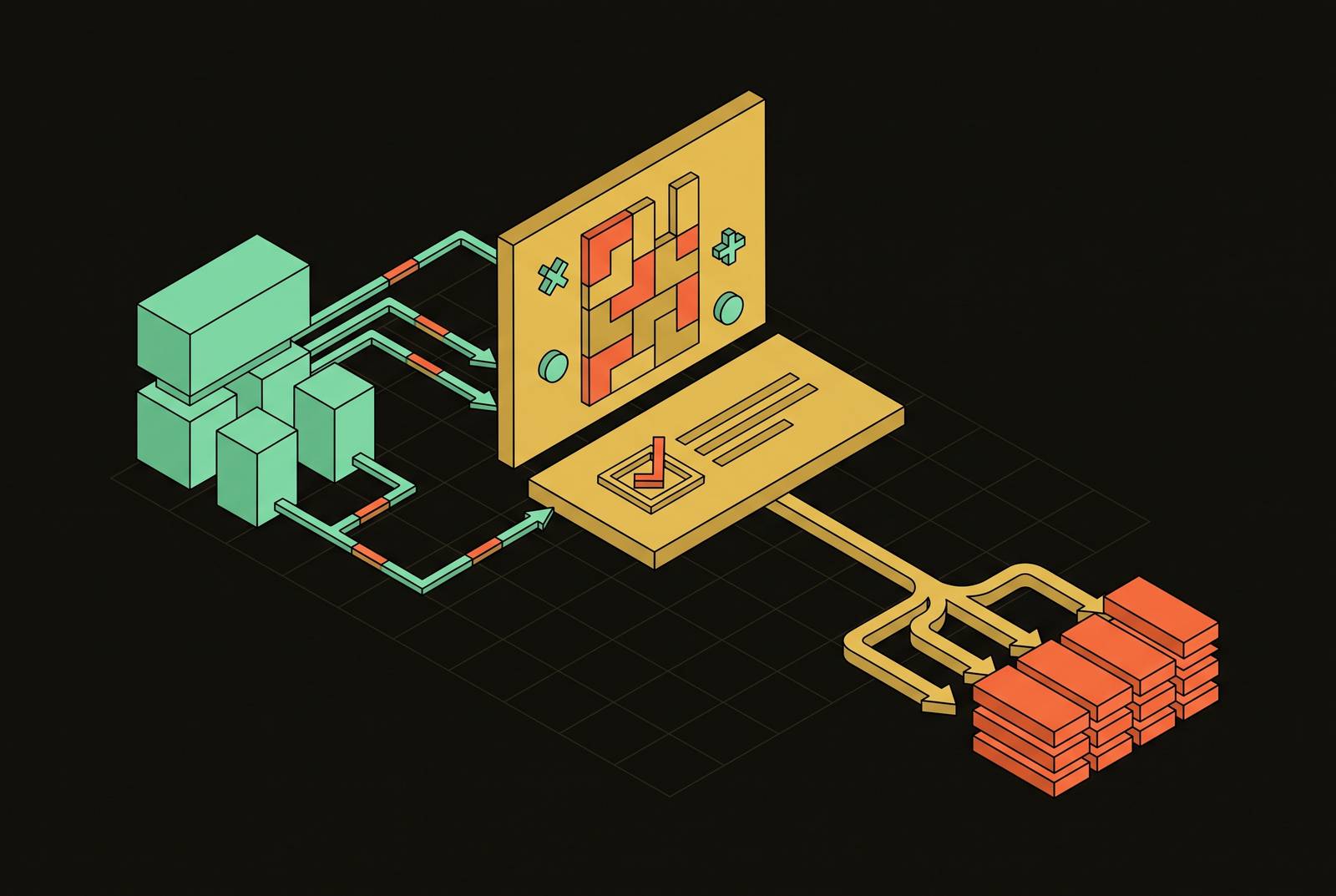
Picking a CAPTCHA solving service by headline price or advertised success rate used to be a reasonable shortcut. It is now a category error, because the real problem has moved upstream, into the question of architectural fit. A CAPTCHA itself is a symptom. Anti-bot systems from Cloudflare, Akamai, DataDome, and PerimeterX compute a trust score from dozens of signals before they ever show a challenge: TLS fingerprint, IP reputation, request headers, JavaScript execution, behavioral timing, browser environment. That score has to drop below the site's threshold before you ever see the visible puzzle. A scraper that fixes the signals feeding that score may never see a challenge. If a scraper ignores those signals and throws solved tokens at every challenge instead, it treats the downstream symptom, so the upstream cause just keeps generating new ones.
You never clear the detection stack behind that score at a single gate, because it is layered and connected. TLS fingerprinting, HTTP/2 analysis, Canvas rendering, WebGL checks, behavioral tracking, and automation marker detection all feed the same trust score, and one mismatch anywhere in that chain pulls the score down. So if behavioral signals start to look wrong later in the same session, a request that passed the first check can still get flagged and blocked.
That complexity is what makes the old approach, pick a solver, inject the token, move on, fall apart at scale. A single solver API handles one narrow piece of a much larger system, and treating it as the whole answer ignores everything happening above it in the request pipeline. Closing that gap takes a deliberate choice about which layer of the problem a team is solving.
The three architectural layers where CAPTCHA solving lives
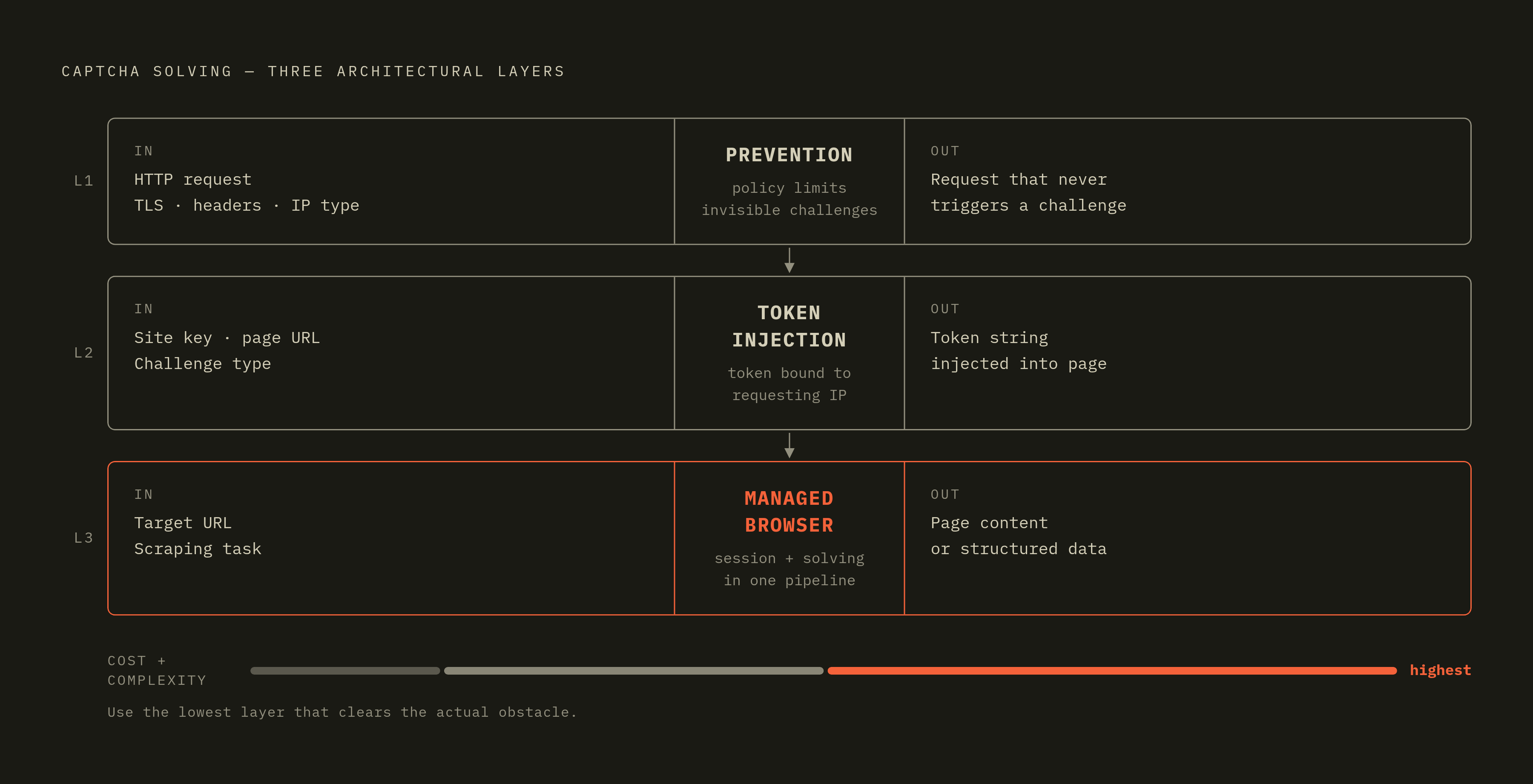
A token API, a browser-integrated solver, and a managed scraping API do not compete for the same job. They return different things, and they sit at different points in a request's life, so if you solve the wrong layer, even the right tool still fails. Ranking them against each other on price or speed misses the point: each one is built for a different boundary condition, and the question is which layer a given scraping job is actually stuck at.
Layer 1 is prevention; it works on the request before any challenge exists. The job here is repairing upstream signals: TLS fingerprint, IP reputation, request headers, browser environment, so that the trust score never falls far enough to trigger a challenge in the first place. Nothing gets submitted to a third party at this layer. So the scraper just looks, from the target's perspective, like traffic that doesn't need to be challenged.
Layer 2 is token injection, what most people mean when they say "CAPTCHA solver": the scraper detects a challenge, sends its parameters (site key, challenge type) to a solver API, waits for a token back, and inserts that token into the page so the request can proceed. This is a per-challenge, per-cost operation, and it only starts once a challenge has already appeared.
Layer 3 covers browser-integrated solving and managed scraping APIs, where detection and solving happen inside one continuous pipeline, so there is no round trip to an outside service. A managed scraping API folds TLS impersonation, proxy rotation, page rendering, and CAPTCHA solving into a single call, and the calling application gets back page content or structured data without ever coordinating individual solver tasks itself.
| Layer | What goes in | What comes out | Boundary condition | |---|---|---|---| | 1. Prevention | Raw HTTP request with repaired TLS, headers, IP type | A request that never triggers a challenge | Works only up to policy-based or invisible-challenge limits | | 2. Token injection | Site key, page URL, challenge type | A token string to insert into the page | Token is only valid from the IP that requested it | | 3. Browser-integrated / managed API | A target URL or scraping task | Page content or structured data | Session state and solving happen inside one pipeline |
None of these three layers replaces another. If you have already repaired every upstream signal and you still meet a mandatory CAPTCHA gate, you have not failed at prevention, you have simply reached the next layer the architecture was always going to need.
When prevention is the right move
Fixing upstream signals is the highest-leverage investment a scraping pipeline can make, because every challenge it prevents is a challenge that costs nothing in latency or per-solve fees. Prevention runs at full request speed, with no per-solve charge at all, but solver APIs add somewhere between 5 and 30 seconds of latency per challenge on top of a fee for each one.
Building that stack in practice means a few concrete swaps. Replace Python's default HTTP client with one that produces a realistic TLS fingerprint, match sec-ch-ua headers to that fingerprint consistently, rotate residential or mobile proxies instead of datacenter IPs (which arrive pre-flagged), and add stealth browser tooling wherever a target actually evaluates JavaScript execution. Every one of those signals has to agree with every other one. A Chrome TLS fingerprint sitting next to Python's default headers, or next to a datacenter IP, still gets flagged, because the mismatch itself is the signal. Stealth clients and residential proxies only earn their keep when you stack them together, consistently, not piecemeal.
Prevention does its best work against score-based systems. reCAPTCHA v3 and most Cloudflare Turnstile flows score a request silently and never show a visible puzzle if the trust score clears the threshold, so raising that score is the entire game. The same logic covers standard Cloudflare Free and Pro tiers, basic reCAPTCHA v2, and hCaptcha running at default sensitivity. For these systems, there is no challenge to out-solve, because the challenge was never going to appear in the first place if the signals line up.
Prevention also has a hard ceiling, and production systems need to plan for it rather than discover it under load. Mandatory CAPTCHA gates on login pages, checkout flows, or account creation appear as a matter of site policy, regardless of how clean the trust score is. Some enterprise hCaptcha configurations challenge every single request on a flagged subnet even when the IP itself is clean. Other sites simply challenge every Nth request by policy, a decision with nothing to do with behavioral scoring at all. Invisible Turnstile challenges present their own version of the ceiling: because the entire session is the challenge, with no discrete puzzle to target, automated solving against them is considerably harder than against a visible grid.
The strongest practical objection to leading with prevention is a matter of infrastructure, not strategy: prevention requires control over the HTTP client itself, and teams running existing scraper infrastructure often lack that control without a significant rebuild. That's the handoff point. If upstream signals are genuinely fixed and challenges still appear, or if you can't touch the HTTP client at all, reach for a dedicated solver next, not a second attempt at prevention.
Token-injection solvers: what the benchmark data shows and leaves out
Dedicated solver APIs mostly split along one line: human-powered solving versus AI-powered solving, and that axis produces a predictable speed-accuracy trade-off that any production decision must account for, though the trade-off is only part of the story. But a benchmark table omits the failure modes that decide whether a production pipeline actually works at volume.
In a test run in April 2026, you could see 10,000 CAPTCHAs solved across the same set of targets using identical proxy infrastructure, and the human-versus-AI divide held up across the board. 2Captcha came out as AI-first, falling back to human workers only for the hardest cases, and posted the highest success rates across hCaptcha, Turnstile, and reCAPTCHA v3, with an average solve time of 18.4 seconds and pricing at $2.99 per 1,000 solves. That profile fits batch jobs where you need the answer right more than you need it fast, and it also fits low-volume, high-value targets like financial data or marketplace pricing, where one failed solve costs more than a few extra seconds of latency. Current documentation describes 2Captcha as AI-first with human fallback, not a purely human-powered service, so you need this if you are comparing it against older write-ups that still describe it the old way.
Published capacity and pricing data split the same way by challenge type. Capacity runs far higher for reCAPTCHA v2 than for Turnstile across these services, and documented list prices run EUR 0.99 to 2.80 per 1,000 for reCAPTCHA v2 against EUR 1.40 per 1,000 for Turnstile, with task fields and pricing shifting by challenge type, so current rates are worth confirming directly before committing budget.
Those numbers don't capture the failure modes that appear once a pipeline runs at real volume. A human-solver round trip typically takes several seconds to return a token, but modern anti-bot systems issue short-lived tokens and run interaction timers in the background. If a solution lands after the window a human would normally take to respond, the session reads as high-latency, suspicious traffic, and the result is a token that gets accepted by the solver's own system but rejected at the target, a "solution accepted, access denied" loop that never shows up in a simple success-rate column. AI-native solvers carry a different version of the same problem: their comparatively lower success rates on Turnstile mean a meaningful share of requests fail silently once volume climbs, and that failure rate compounds into real data gaps across a high-volume pipeline rather than staying a rounding error.
There's also an operational constraint: the IP address used to request a token has to be the same IP used to submit it at the end, and a mismatch causes the target to reject the token regardless of solver speed or accuracy. Anti-bot systems cross-reference that pairing directly, so a token requested from one IP and submitted from another arrives worthless no matter how fast or accurate the solver was. A returned "ready" status from a solver is a statement about the provider's own task queue, not a guarantee the target will accept the token. The target can still reject it for being expired, mismatched to the task, submitted against a page that has since changed state, or inconsistent with the rest of the session. This is exactly the coordination problem that managed scraping APIs are built to absorb: because solving, proxy assignment, and submission happen inside the same pipeline, the IP that requests a token and the IP that submits it never drift apart in the first place. Among the documented production setups, one recommendation stands out directly: use CapSolver as the primary solver, and treat that choice as a starting configuration to validate against a given target's own challenge mix rather than a fixed rule.
Reach for a dedicated solver, rather than prevention, once prevention has genuinely been implemented and challenges are still appearing, once a page carries a mandatory CAPTCHA gate that no trust score can bypass, or once the target list is small enough and valuable enough that a per-solve fee is simply the cost of doing business. Outside those conditions, you ask a solver to fix what prevention could have stopped.