Rate Limit Detection and Adaptive Throttling in Scrapers
Detect throttling from response signals before hard blocks arrive.
A scraper that works for three weeks and then quietly stops working is still running, still logging 200s, still writing rows to a database, even though it's broken. The best web scraping API for extracting data at scale reads what a site is telling it in real time and adjusts accordingly. Instrumenting response signals (status codes, latency, content shape), applying backoff that respects what the server actually says, and adjusting concurrency continuously are what that real-time reading requires. Everything that follows explains why that architecture wins and what it looks like in practice.
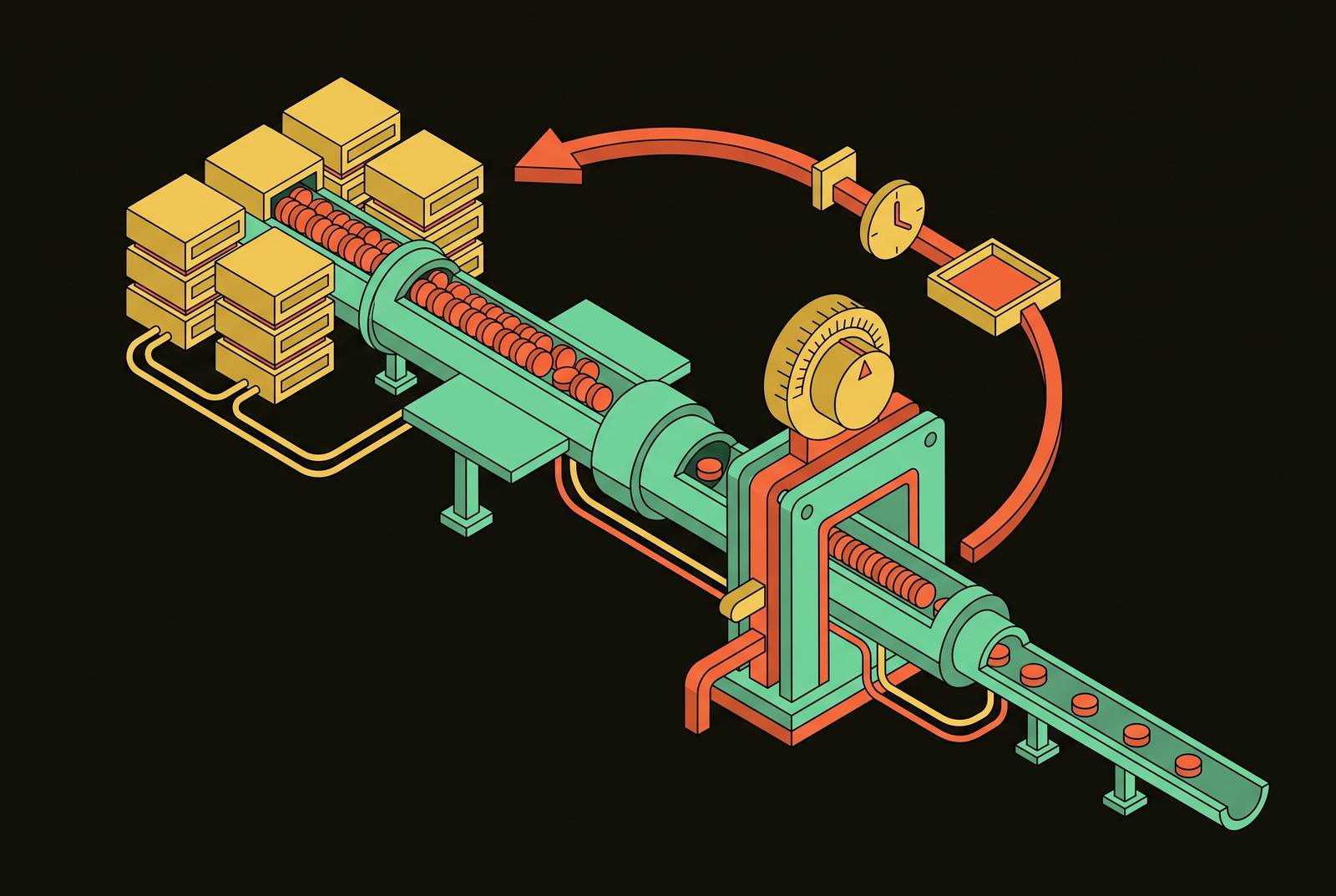
The architecture that catches soft throttling in real time treats every response as telemetry, not just a pass/fail outcome. Three signals feed the feedback loop: latency trends (a jump in TTFB from roughly 200 milliseconds to 2 seconds is a concrete signal to cut concurrency immediately), content-level checks (logging response body length per endpoint exposes a sudden drop in average content size even when every request still returns 200), and CAPTCHA markers in the HTML, which should trigger the same backoff response as a 429. A client-side token bucket, scoped per domain, adjusts its refill rate from these signals continuously: it climbs by a small additive step when telemetry stays clean, and cuts by a much larger multiplicative factor the moment any signal turns negative, mirroring TCP congestion control rather than relying on a static sleep value.
Why static sleep intervals fail as rate limit handling
A fixed delay between requests treats rate limiting like a scheduling problem: wait two seconds, send a request, wait two seconds again. But rate limiting is a detection problem, and a detection problem needs a way to listen, not just a way to wait.
Three failure modes appear in scrapers built around a single sleep value.
First, a perfectly even cadence is itself a tell. The interval that kept a scraper under the radar last year can be the exact thing that flags it this year.
Second, a fixed delay is built on a guess about how much a site will tolerate, and that guess goes stale fast. A delay tuned correctly on Monday can be wrong by Friday, and nothing about a static sleep value will tell a developer that the ground shifted.
Third, and most dangerous: soft throttling usually arrives before hard blocking. Many sites respond with an empty or truncated page and a 200 OK status well before they start sending 429s. A scraper running on a timer has no way to notice that the content coming back has gone hollow. It sees a success code, logs a success, and moves on, collecting nothing while believing the job is working fine. By the time anyone notices the data is missing, the gap might stretch back days.
The detection signals a scraper must instrument for
Every response from a target site carries information about how close a scraper is to getting throttled or blocked. Most scraping pipelines just throw that information away. Building a scraper that adapts starts with logging the right things, before any backoff or throttling logic gets written.
Status codes are the easiest signal to catch, and getting them right comes first. A 429 paired with a Retry-After header is the clearest statement a server can make: it's declaring its limit, and when that header is present, it's stating how long to back off. That number should be read and obeyed before any other backoff math runs. Logging whether a 429 showed up right before the 503 is often the only way to tell which case applies.
Latency tells the story earlier than status codes do. Time to first byte and total response time tend to creep up before a site starts rejecting requests outright, because the throttling systems on the other end are usually slowing traffic before they start cutting it off. Keeping a rolling average of TTFB per domain catches this early: a jump from roughly 200 milliseconds to 2 seconds is a clear signal to cut concurrency immediately, well before a single 429 shows up in the logs.
Content itself carries the signal most pipelines never check. A scraper that only checks status codes sees none of that as a failure, so it's the easiest failure to miss. Logging the length of the response body alongside the status code catches this: a sudden drop in average content size for requests hitting the same endpoint is a strong proxy for soft throttling, even when every single request still returns 200. A CAPTCHA marker found anywhere in that HTML should trigger the same backoff response as a 429, because it's a harder barrier than a content glitch, not a quirk to shrug off.
Converting raw responses into something structured makes this kind of comparison practical. Tools like Context can turn any URL into Markdown or pull structured fields out of a page using a JSON schema, which gives a pipeline a consistent shape to check against: comparing DOM structure and field completeness across requests becomes a programmatic check instead of a manual one, and a page that's quietly gone hollow stands out immediately.
Network-layer signals round out the picture, briefly. TCP connection resets and TLS handshake failures point to a block happening below the application layer, and they call for proxy rotation as the fix, since an application-level 4xx calls for backoff instead. Tagging every log entry with the target domain and the exit IP in use is what makes it possible to separate these patterns after the fact, instead of staring at an undifferentiated pile of failures.
A scraper running on fixed delays has no way to catch any of this. It can't notice when a site has shifted from returning real pages to returning hollow ones under a 200 status, so it logs success while the actual data pipeline runs dry. Catching that gap depends on watching content-level signals directly, before a site escalates from a soft block to a hard one.
How modern rate limiting works under the hood
Responding to rate limits well means understanding what generates the signals. Fighting the wrong layer of a detection system wastes effort and leaves the real constraint untouched.
Token bucket logic sits behind a lot of rate limiting systems, which produces a pattern that confuses a lot of scraper developers: the first burst of requests, maybe the first few dozen, sails through even at high speed, and then the wall hits all at once. That burst allowance is, by design, not a signal that the delay in use is sufficient. It's a buffer that runs out.
Most real platforms don't enforce limits at just one layer. They check IP address, they check account or session behavior, and they run behavioral pattern detection on top of both. A scraper that rotates proxies has fixed only the IP-level block, while account-level limits and behavioral detection keep running underneath, untouched. Behavioral detection in particular doesn't care how many requests came from a given IP: it looks for the same sequence of actions at the same intervals, whether that pattern shows up from one IP or spread across a hundred, and flags it as automated regardless of whether any single address technically broke its quota.
Cloudflare's Adaptive Intelligence system, announced August 31, 2026, pushes this further by scoring entire campaigns. A script built on Playwright that sends requests across dozens of exit nodes with the same timing distribution and the same TLS fingerprint can raise a campaign score even though no single address ever crossed a classic rate limit. That one fact invalidates a lot of standard scraper architecture: proxy rotation by itself does not solve detection, because detection has moved up a level, from individual addresses to the pattern connecting them.
TLS fingerprinting adds another layer below all of this. Libraries like curl_cffi, which impersonate the TLS handshake of a real browser, are one practical way to blend into that layer.
Exponential backoff with jitter as the principled retry primitive
Exponential backoff is a familiar idea, and it's also one of the most commonly misapplied ones. Getting it right starts with the Retry-After header. When a 429 response includes it, that number is the floor, not a suggestion: the server is naming its own recovery window, and retrying before that window closes resets whatever block timer is running on the other end.
Jitter is what developers skip most often, and it matters most. Backoff without it produces a delay pattern that's completely deterministic: the same multiplier, applied the same way, every time. Detection systems built to spot automated traffic recognize that regularity as a fingerprint just as easily as they recognize a fixed sleep interval. Adding a random offset, sized as a meaningful fraction of the computed delay rather than a token amount, breaks that fingerprint. Randomizing the offset on every retry matters more than its exact size.
Jitter matters even more in pipelines running multiple accounts or workers at once. Without it, every worker that hits the same rate limit backs off on the same schedule and then retries at nearly the same moment, creating a synchronized spike that trips the limit right back. Backoff needs to be scoped per account or per session rather than applied globally: a limit hit on one account should pause that account's traffic while the rest of the pipeline keeps running, then bring it back online once its recovery window passes.
One guard condition matters regardless of how well the backoff curve is tuned. Retries need a hard ceiling. A permanent block looks identical to a temporary one from inside a backoff loop, and without a cap, a scraper will retry a dead URL forever, burning through token budget in an agentic pipeline or stalling a batch job until someone intervenes by hand. Once that ceiling is hit, the failure needs to surface, not get silently skipped. A pipeline needs to know a page is missing. It should never be left to assume a request that actually failed came back clean.
Token bucket rate control as proactive throughput management
Backoff only ever fires after something has already gone wrong. A token bucket implemented on the client side flips that: instead of recovering from a limit, the scraper regulates its own output to stay under the threshold that would trigger one.
The mechanics are simple. Each domain, or each account, gets its own bucket with two properties: a capacity, which sets how large a burst it can absorb, and a refill rate, which sets the sustained requests per second it can sustain over time. Every outgoing request consumes one token. When the bucket is empty, the worker waits for it to refill. Keeping buckets separate per domain also matters for a less obvious reason: without that separation, a burst against one endpoint can eat into the capacity a different, concurrently running job needs against another endpoint.
The rate itself shouldn't sit still. A clean pattern, meaning high success rates, stable latency, no CAPTCHAs showing up, is the signal to raise the requests-per-second rate by a small additive step. The moment any of the signals from earlier appears (slower TTFB, a 429, a content anomaly), the response should cut the rate by a much larger multiplicative factor. This mirrors how TCP congestion control manages network traffic, and the approach carries over to scraping with almost no modification. The asymmetry here is deliberate: recovery from a block takes far longer than the moment it takes to trigger one, so the math is built to favor caution on the way up and speed on the way down.
Enforcing this across multiple concurrent workers needs a queue sitting in front of all of them. Each worker pulls tasks from a shared queue, and the queue itself holds the rate cap for a given domain, applied across every worker pulling from it, not just one at a time. Celery's per-task rate limiting is a common example of this pattern, but Celery enforces that limit per worker instance, not globally. Adding more workers scales up the total request rate against a target proportionally, because each new worker gets its own independent allowance. A true global cap across an entire worker pool needs something extra layered on top, commonly a shared external throttle that all workers check against before sending a request.
The throughput math here runs against intuition. A scraper that throttles itself deliberately, with randomized delays and a concurrency cap, ends up pulling more total pages across a day than one running at full, unthrottled speed. The unthrottled version wins the first hour and then spends the rest of the day paying for it: CAPTCHA challenges, blocks, and the recovery time that follows each one eat into total throughput far more than the deliberate delays ever cost.
What architecture detects soft throttling in real time and adjusts concurrency accordingly?
Backoff and token buckets solve two separate problems. Backoff handles what to do after a limit gets hit. Token buckets handle how to avoid hitting a limit. A reliable scraper runs both as parts of a single feedback loop.
The telemetry gathered earlier, status codes, TTFB trends, content-length drops, CAPTCHA markers, TLS and connection failures, is what feeds that loop. Every one of those signals becomes an input the token bucket's refill rate and the backoff curve both read from continuously. When telemetry stays clean, the bucket's rate climbs a little at a time. The moment a signal turns up, whether that's a slow response, a hollow page, or an explicit 429, the rate drops hard and the backoff logic takes over for the account or domain affected, while the rest of the pipeline keeps running against everything else.
Treating rate control this way turns a scraper from something that guesses at a fixed number into something that reads the target site's actual behavior and adjusts to it in real time. Every scraping API that holds up at real scale runs on a closed loop that watches what comes back and changes what goes out next, not a faster proxy pool or a cleverer header.