Puppeteer vs Playwright for Production Scraping
Playwright's auto-waiting and multi-language support make it the better choice for new projects.
Puppeteer and Playwright both drive a real browser from code, and both sit inside production scraping stacks right now. Picking between them used to feel like a coin flip. That era is over. Three changes since 2024, in how Chrome handles headless mode, in the health of the stealth plugin ecosystem, and in how each tool plugs into AI agent pipelines, turned this into a structural decision instead of a stylistic one. For new projects, the case for Playwright has gotten hard to argue against. Puppeteer still makes sense for teams already standing on it, but starting fresh in 2026 and picking Puppeteer anyway means signing up for problems Playwright already solved.
The origin of each tool and its continuing influence
Puppeteer came out of Google's Chrome team in 2017, built to drive Chrome directly through the Chrome DevTools Protocol. It shipped as a Node.js library by deliberate design. That protocol-native, single-browser, JavaScript-only shape sits at the foundation of the tool, and it explains most of what Puppeteer does well and most of what it fails to do.
Playwright showed up in January 2020, built by a Microsoft team that included engineers who'd worked on Puppeteer itself. They knew exactly where the pain points sat: no other browsers, manual wait logic scattered everywhere, a client locked to JavaScript. So they built Playwright to answer each of those directly. Instead of talking to CDP raw, Playwright runs its own protocol layer on top of it, and that layer is the piece of engineering that unlocked cross-browser support.
Both projects are big now, both backed by serious money. Puppeteer sits north of 93,600 GitHub stars and has been the default Chrome automation library for years. Playwright trails on raw stars, around 78,600, but weekly npm downloads peaked near 13.5 million by mid-2026, enough to pull ahead of Cypress for the first time. A Q1 2026 survey put Playwright's adoption among QA professionals at 45.1%, the first time any testing framework has beaten Selenium in that group.
The stars gap still favors Puppeteer. What's flipped is velocity: which tool teams reach for the moment they start something new.
Browser and language support gaps: real versus rarely material
Playwright covers Chromium, Firefox, and WebKit (the engine behind Safari) through one API with consistent behavior across all three. Puppeteer stays Chromium-first. As of version 23 it ships production-ready Firefox support through WebDriver BiDi, while still defaulting to CDP for Chrome, but WebKit is Playwright-only territory.
For most scraping jobs, none of that decides anything. Chromium handles the overwhelming majority of targets out there, so cross-browser reach barely comes up. It starts to matter on sites that render differently on Safari (certain financial portals and Apple-ecosystem tools fall into this bucket), or when a team runs scraping and cross-browser QA through the same pipeline and doesn't want two separate toolchains.
Language support is where the gap actually bites, and teams get this wrong when they treat the two tools as interchangeable. Playwright ships official clients, with real feature parity, for JavaScript/TypeScript, Python, Java, and.NET, and Microsoft maintains all four itself. Puppeteer is JavaScript/TypeScript natively; the Python route (Pyppeteer) sits minimally maintained at this point, effectively inactive, trailing well behind the JS original. A team running a Python data pipeline, or doing LLM orchestration through something like LangChain or LlamaIndex, doesn't have a real decision to make here. Playwright is the only one of the two that works.
Chrome 132 made "new headless," meaning full Chrome rather than a stripped-down shell, the default. Teams that still want the lighter binary now have to opt in explicitly to chrome-headless-shell. That change quietly narrows the startup-speed edge Puppeteer used to hold by default.
What the performance benchmarks say, and why raw speed is the wrong thing to optimize for
Raw speed numbers exist, and they depend on the workload, not on some framework-wide truth. On simple page loads, Puppeteer runs around 1.2 seconds per page against Playwright's 1.5 to 1.7 seconds. Puppeteer launches Chrome about 5 to 10 percent faster on a clean machine in cold start comparisons, while Playwright edges ahead on workflows that build up browser state over time. At the protocol level, Puppeteer sends roughly 11KB of WebSocket traffic for a task where Playwright sends 326KB, a direct cost from the cross-browser abstraction layer Playwright carries around.
None of that settles much, though. Page load behavior, wait strategy, and how concurrency gets architected move the needle more than which library sits underneath. These benchmarks describe specific workloads, and any claim that one tool wins everywhere goes past what they actually show.
The operational gap appears in parallelism instead. Playwright ships a built-in test runner that shards work across workers cleanly, right out of the box. Puppeteer needs puppeteer-cluster or a hand-rolled worker pool, and how well that performs depends entirely on how carefully someone built it.
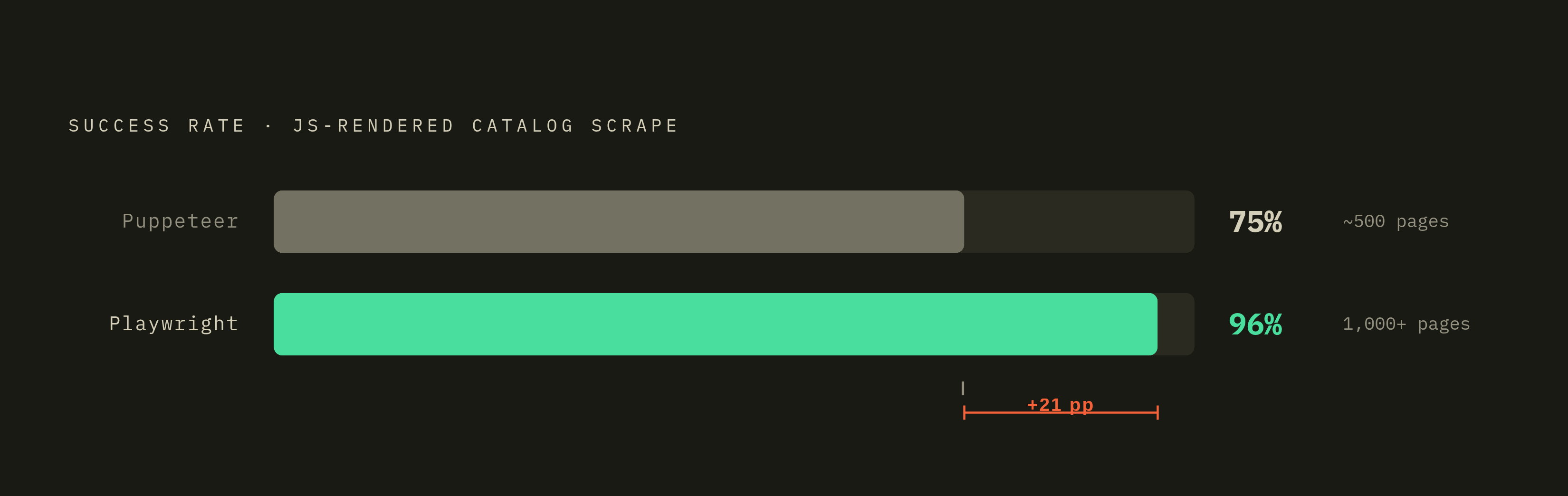
Reliability is the number that should matter more than any speed figure here. On a head-to-head scrape of a real JavaScript-rendered product catalog, prices tucked behind pop-ups, images lazy-loaded, Puppeteer hit a 75% success rate before failures started piling up past roughly 500 pages. Playwright held 96% across more than 1,000 pages. A 21-point gap doesn't stay small once volume climbs. At tens of thousands of pages a day, that gap is the number worth arguing about, not milliseconds per page load.
Auto-waiting: the single architectural decision that explains most of the reliability gap
Auto-wait is the mechanism behind that reliability number. Before Playwright lets code touch an element, it checks that the element is visible, stable (not still animating), enabled, and actually capable of receiving events. Assertions retry on their own until those conditions hold. No sleep(2000) calls scattered through the codebase, no hand-written polling loop. The Locator API, the recommended approach going into 2026, makes this work: chainable, type-safe, built on text or role-based selectors that survive a page's HTML getting rearranged underneath it.
Puppeteer pushes that work onto the developer instead. Explicit waitForSelector calls need to go in before every interaction, and it's easy to forget one, especially months later when the target page has quietly changed shape. Puppeteer's locator API has improved, but it still leans on the developer for timing decisions Playwright handles on its own. In a scraper running unattended overnight, a missing wait doesn't throw an error. It turns into a race condition, and a race condition turns into a silent gap in the data that nobody notices until someone asks why last Tuesday's numbers look off.
This matters even more once an LLM agent drives the browser instead of a person. An agent can't glance at the screen and think that spinner's still going, give it a second. Auto-waiting is the only thing standing between the agent and acting on a half-loaded page.
Network interception follows the same pattern. Playwright sets request interception and proxy config once, in a single object, at browser launch. Puppeteer wants per-request hooks, and that's a maintenance surface that keeps growing as the pipeline gets more complicated.
The stealth ecosystem in 2026: a deprecation that most articles haven't caught up to
puppeteer-extra-plugin-stealth was deprecated in February 2025. It still installs, still runs, but nobody updates it against new detection methods anymore, and that's a bigger deal than it sounds. Detection vendors, DataDome, Cloudflare, and Akamai Bot Manager among them, ship updates to their detection models continuously. A frozen patch set falls behind the moment it stops moving, and the gap only widens from there. Any production stack still leaning on this plugin for fingerprint evasion is quietly building technical debt against a target that keeps moving, with nobody left maintaining the countermeasures on the other side.
Playwright's stealth story splits by language, and it isn't much better. On Python, playwright-stealth v2.0.2 stays actively maintained, with regular commits through 2025 and into 2026, holding up reasonably well against basic fingerprint checks. On Node.js, the combination of playwright-extra and puppeteer-extra-plugin-stealth hasn't seen a meaningful release since March 2023, and no new evasion modules since then either. It's fallen behind the newer anti-bot techniques just like Puppeteer's stealth tooling has.
Cloudflare is the wall neither tool climbs cleanly. W3Techs data shows that of websites running a reverse proxy, 80.8% run Cloudflare, and Cloudflare shows up on roughly 35% of the top 1 million sites globally. Its bot score model v9, now the default on every new zone, weights TLS fingerprinting (JA4), HTTP/2 frame ordering, and behavioral signals far more heavily than v8 did. Playwright's default TLS handshake on Linux stands out under that model even when the browser fingerprint sitting above it looks completely clean.
That's the ceiling for both tools, and no plugin fixes it. Stealth plugins operate at the JavaScript layer. They can patch navigator properties and canvas fingerprints all day long, but they can't spoof a TLS handshake, can't touch TCP window sizes, and can't solve a Cloudflare Turnstile challenge.
A couple of newer projects deserve a mention, though neither has proven out at production scale yet. One runs on Chrome. Camoufox works off Firefox and patches detection vectors at the binary level instead of the JavaScript layer. Both are early, and anyone betting production infrastructure on either one right now is betting on a project, not a track record.
For anything scraping behind Cloudflare Enterprise or DataDome specifically, the honest answer is that neither Puppeteer's nor Playwright's stealth tooling gets the job done alone anymore. Scraping at real scale against protected targets increasingly means solving the problem at the infrastructure level, not patching it at the library level.
Playwright's agentic AI integrations for LLM pipeline design
Playwright shipped its MCP integration in early 2025, and Microsoft pushed Playwright MCP v0.0.78 on July 9, 2026. What that server hands an AI agent is the browser's accessibility tree: structured, semantic, text-based data, roles, labels, states. Not a screenshot. Not raw HTML soup.
That distinction matters more than it sounds. A submit button comes through as Role: button, Name: Submit, whether the underlying CSS class reads btn-primary or something like xK7_submit_v3_final_FINAL. The LLM gets a stable semantic signal instead of a brittle selector that breaks the next time a frontend engineer touches the stylesheet. The Playwright CLI is designed to support this use case as token-efficient browser automation for coding agents.
Playwright Agents, which landed in October 2025, push this further with three built-in AI agents working together. The agents work together to plan, generate, and repair test suites, handling locator and selector breakage without a person stepping in. Puppeteer has nothing built to match this at the same level of first-party investment Microsoft has put behind Playwright's version.
The value goes past testing, too. Because the accessibility tree stays stable across CSS refactors and layout changes, extraction logic built on it survives redesigns that would otherwise send a scraper straight back to the maintenance queue. In agentic workflows where an LLM decides, in real time, what to click or pull next, structured semantic state instead of pixels or a wall of raw HTML cuts down both prompt complexity and the number of ways the whole thing can break.
None of this makes Puppeteer obsolete. Teams already running it in production, especially JavaScript-only stacks scraping Chrome-only targets, face real migration cost: API differences, rewritten tests, adjusted pipelines. That cost usually outweighs the benefit unless the specific pain points Playwright fixes (unreliable waits, thin parallelism, weak Python support) are the ones actually hurting today. Puppeteer's massive GitHub star count and years of accumulated community fixes mean most Chrome-specific issues already have a documented answer sitting in some GitHub issue thread. For a new project, though, particularly one with Python anywhere in the pipeline or any ambition toward agentic AI tooling, picking anything other than Playwright means choosing the harder road on purpose.