Scraping Architecture for LLM Pipeline Data Ingestion
LLMs need clean data from day one, or noise compounds across nine pipeline layers.

Feed a database a malformed record and it throws an error. Feed a large language model a page full of nav menus, stale pricing, and duplicate boilerplate, and it doesn't crash. It hands back a confident, wrong answer, with no stack trace and no warning sign anywhere in the output.
That difference changes what a scraping pipeline has to do. Traditional web scraping was built for structured consumers: price comparison engines, business intelligence dashboards, a database feeding some quarterly report. Those systems shrug off noise. A stray field or a mangled table doesn't break the downstream product, because a human or a query engine routes around the mess. LLMs don't route around anything. They read what they're given and treat it as fact, full stop.
Five things end up mattering more than the rest, and they belong at the front of the pipeline, not patched in later as edge cases.
Semantic clarity comes first: every token spent on a nav bar or a cookie banner is a token not spent on the answer. Structural coherence matters because a chunk boundary that slices a sentence in half quietly degrades both retrieval and generation, every time it happens. Freshness matters because a stale page never announces itself, the model answers with six-month-old data in the same tone of certainty it would use for something published this morning. Schema conformance matters because agents and tool chains downstream expect typed fields, and free-form text breaks that chain the moment one field goes missing. Deduplication matters because near-duplicate content can skew a model's output toward the most-repeated version of a fact instead of the most accurate one.
None of this works bolted on after the fact. Every layer, from the first crawl request to the final storage write, gets built around these five constraints from day one, or it doesn't get built right.
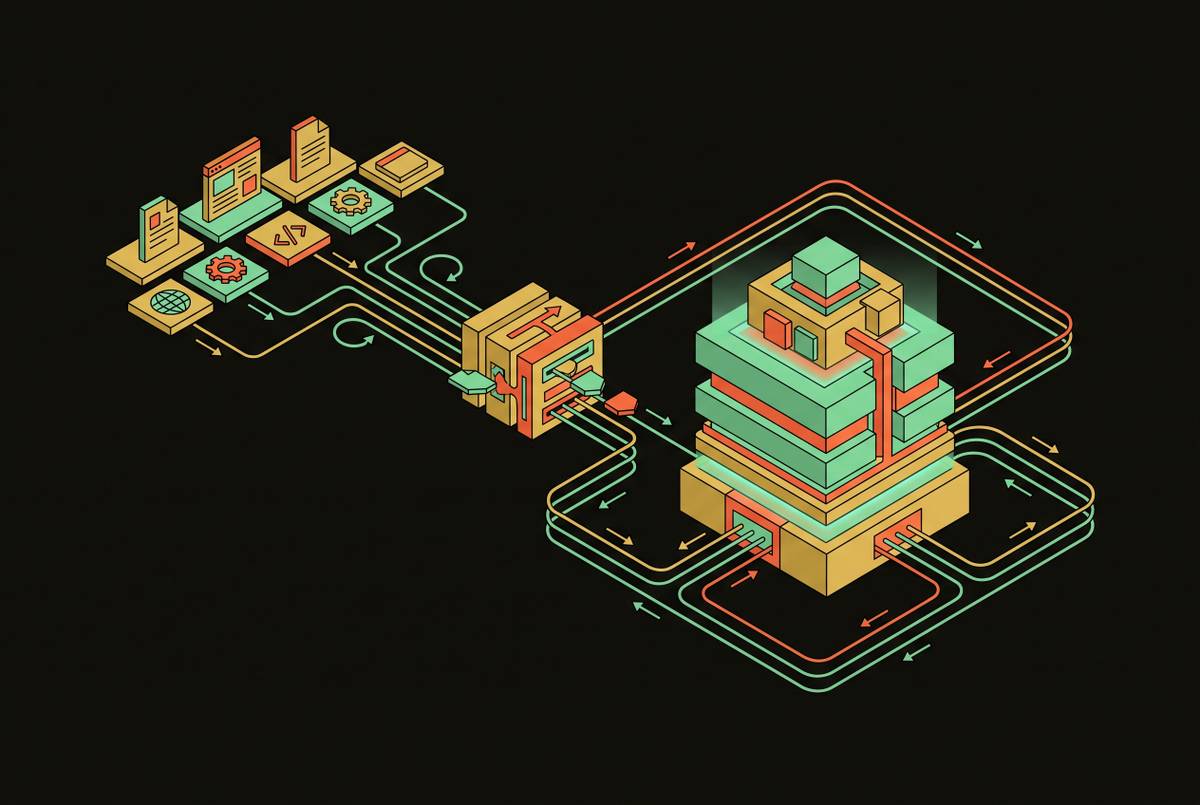
Think of the pipeline as a chain, not a toolbox. Each layer hands its output to the next, and a mistake made early doesn't stay contained. It shows up three layers downstream, usually as a mystery nobody traces back to where it started.
Nine layers, in order. Source discovery: seed URLs, sitemaps, domain lists, APIs. Crawling: URL traversal, scheduling, rate limiting, retry logic. Rendering: headless browsers or a hybrid setup for JavaScript-heavy pages that don't show their real content in the raw HTML. Extraction: isolating the content, parsing metadata, tables, lists. Cleaning and normalization: stripping boilerplate, fixing whitespace, standardizing encoding. Deduplication: catching exact matches and near-duplicate clusters, often through embedding-based similarity. Structuring and chunking: splitting content into token-friendly pieces while keeping semantic boundaries and metadata tags intact. Storage: data lakes, warehouses, vector databases for embeddings. Monitoring: job success rates, latency, completeness, and flags when something's changed.
A working benchmark for pipeline health: a data quality score above 90 percent, meaning at least 9 of every 10 pages meet quality thresholds. Below that line, problems don't add, they compound.
Each layer should swap out on its own. Changing the headless renderer shouldn't force a rewrite of the crawl scheduler. Changing the chunking strategy shouldn't touch extraction logic at all. Ignore that principle and the pipeline turns into a monolith nobody wants to open, let alone fix.
Most teams skimp on the same three layers, and it's always these three: rendering, deduplication, monitoring. All three stay invisible right up until the day they fail, and by then the bad data's already shipped downstream, sitting in a vector store, waiting to get retrieved with total confidence.
Crawl strategy decisions that determine what the rest of the pipeline receives
Source discovery isn't a setup task you do once and forget. For an LLM pipeline, the sources define the model's entire coverage. Skip a category of pages and the model develops a blind spot nobody notices until a user asks about exactly that gap.
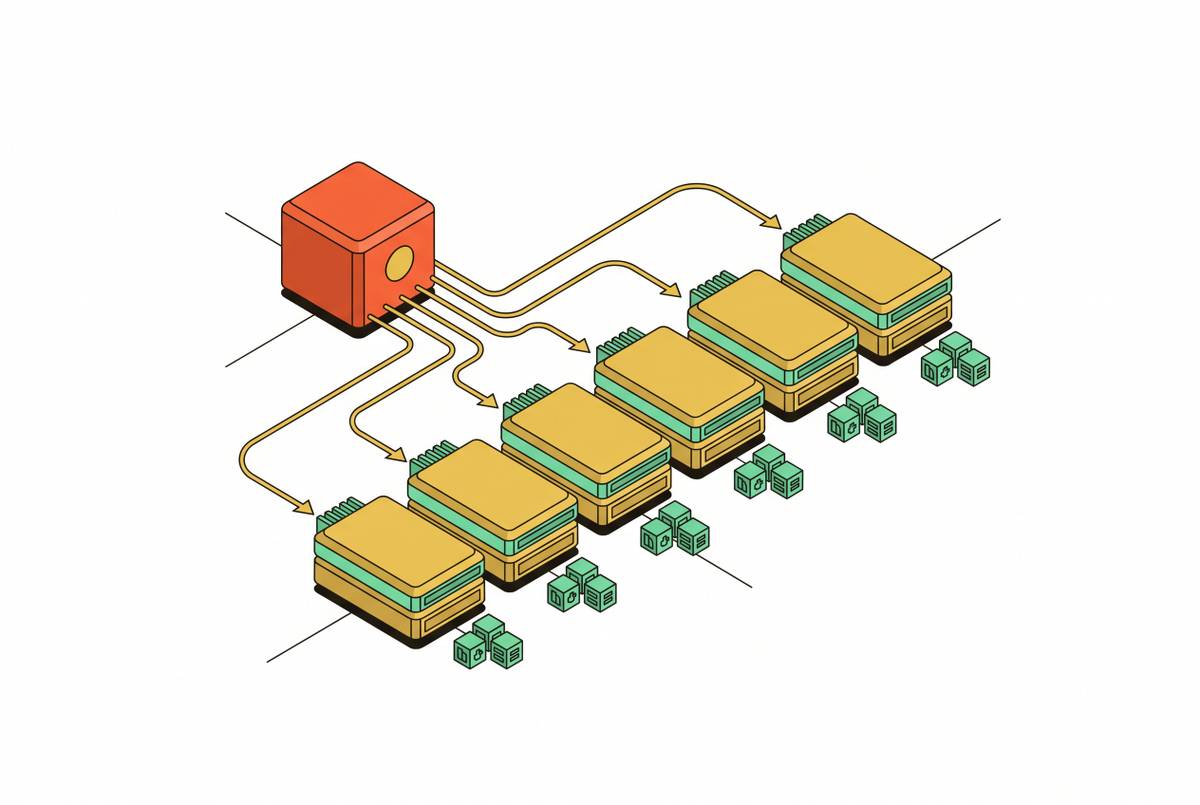
Two crawl modes cover most jobs, and picking the wrong one wastes real budget. A full-site crawl fits knowledge base construction, RAG corpus building, competitive intelligence work, anything that needs the site's structure intact. A targeted URL crawl fits monitoring known pages, pulling structured records from fixed locations, or feeding an agent's tool-use calls where speed matters more than breadth. Running a full-site crawl to watch a handful of pricing pages is overkill. Running a targeted crawl to build a knowledge base leaves gaps nobody finds until a user hits one.
Scheduling is a freshness lever, not an afterthought. A news site or a financial data feed needs a completely different crawl cadence than a static reference document that hasn't changed in two years. Treat both the same and the reference doc eats crawl budget it doesn't need, while the news site goes stale waiting on its next pass.
Rate limiting and retry logic aren't courtesy to the target site. They're survival mechanics. Behavioral detection, browser fingerprinting, CAPTCHA challenges, and other traffic defenses have gotten sharper across the web, and a crawler that gets blocked partway through a job doesn't fail cleanly. It leaves behind a partial dataset, and a partial dataset is worse than no dataset at all, because the model retrieves on a biased sample without anyone knowing it's biased.
JavaScript rendering deserves the same weight, maybe more. A large share of modern pages load their real content dynamically, after the first HTML response comes back. Skip rendering and the pipeline doesn't throw an error on that content, it just never sees it. The gap shows up later as a missing fact nobody flagged in time.
Compliance belongs in the architecture, not in the judgment of whoever wrote a particular crawler script that week. Robots.txt handling and terms-of-service checks need enforcement at the system level, applied the same way every time, not left as a call some engineer makes under deadline pressure.
A well-built crawling layer handles proxy rotation, retries, rendering, and scheduling as one managed system. Skip that, and the alternative is standing up a distributed systems project and staffing it indefinitely, instead of shipping the product the crawl data was supposed to support.
Converting raw HTML to LLM-ready Markdown without losing signal
Raw HTML is a bad diet for a language model. Scripts, inline styles, nav bars, footers, ad slots: all of it eats tokens and gives nothing back. Converting to Markdown decides what the model actually gets to read, which makes it one of the highest-leverage steps in the whole pipeline.
"LLM-ready" means boilerplate gets stripped before content reaches the model, heading hierarchy stays intact, lists keep their nesting, tables keep their columns lined up, and code blocks survive when they carry real meaning.
A common assumption in this space falls apart here. Pages that stored their data only in JSON-LD, Microdata, or RDFa, the structured, machine-readable formats built for exactly this purpose, were not reliably used by AI crawlers for extraction. Pages with visible, well-organized HTML got extracted consistently instead, across major AI crawlers alike.
That's a real reversal. Structured metadata was supposed to be the shortcut, built specifically for machines to read. Instead the visible DOM, the plain text a person would actually read on the page, mattered more than the hidden markup underneath it. Any pipeline pulling in third-party content should plan around that: assume the structured metadata isn't there, and build extraction logic off what's visible on the page instead.
Chunking quality flows straight from this. Clean Markdown with a preserved heading structure gives a chunker clear lines to split on. Raw, unconverted HTML gives it nothing, and the chunks that come out the other end tend to cut sentences in half or split one concept across two pieces that don't make sense read apart.
Where LLMs belong in the extraction layer, and where they don't
LLMs don't fetch pages. They don't click buttons, and they don't parse JavaScript. Their job starts after a page has already been retrieved and turned into text: fetcher first, then an HTML parser, then the LLM steps in for field classification and schema alignment. Reverse that order and the pipeline gets slower and more expensive for no reason at all.
Selector-based extraction, the older approach of writing rules that point at specific DOM elements, still wins in a few clear spots: stable, high-volume targets whose markup doesn't shift day to day, fields sitting at predictable locations on every page, and pipelines where per-page inference cost matters at scale, since a selector call costs almost nothing and an LLM call never does.
LLM extraction earns its keep somewhere else: variable layouts where no two pages look alike. Insurance claims portals, multilingual e-commerce catalogs, legal archives with deeply nested clauses, places where the long tail of page templates is too inconsistent for any fixed set of selectors to cover. It pays off during rapid prototyping too, when a team can describe the fields it needs in plain language before anyone's mapped a single selector.
Maintenance is the real argument here, and it isn't small. A notable portion of engineering time on scraping teams goes toward keeping existing scrapers alive after some site redesigns its markup, not toward building anything new. AI-driven extraction that adapts to layout changes cuts straight into that burden. It doesn't remove monitoring entirely, something still has to watch for extraction quality dropping, even once nobody's watching for one specific broken selector anymore.
One case worth sitting with: teams that have shifted to AI-driven extraction report meaningful cost reductions alongside accuracy improvements, a useful sense of scale for what happens once extraction logic stops depending on someone rewriting selectors every time a site changes its layout.
By 2026 the honest picture is that LLM extraction sits alongside selectors, browser automation, and vendor APIs as one option among several, usually combined in the same pipeline rather than picked exclusively. Concurrency matters too: asyncio-based concurrency in extraction APIs can cut total ingestion time by as much as 40 percent on high-latency targets, and that adds up fast once LLM calls are in the loop, where every extra second of latency multiplies across thousands of pages.
Schema-driven extraction as the interface between scraping and AI systems
Schema-driven extraction rests on one idea: a developer defines a JSON schema describing the fields and types needed, and the extraction layer hands back data that fits it. That schema is the contract between the scraping system and whatever consumes its output, an index, an agent, or another model downstream.
Getting conformance right is harder than it sounds. OpenAI, Anthropic, Gemini, and Mistral all offer native structured output that constrains a model to a given JSON schema. The real question underneath that is whether the constraint gets enforced at the token level, where the model literally cannot produce an invalid token, or just requested through a prompt, where the model can still wander off and hand back something malformed.
A dataset drawn from 9 million raw production events isolates 93,695 real schema-constrained extraction cases spanning more than 18,000 unique schemas across 15 languages. It shows sharp failure thresholds as schema complexity climbs, a pattern synthetic benchmarks built in a lab never caught. A 1.7 billion parameter student model, fine-tuned on this real-world data, closes in on the performance of a much larger 30B-A3B mixture-of-experts reference model with 3.3 billion active parameters. Grounding fine-tuning in messy, actual practitioner workloads changes small-model behavior in ways clean synthetic data just doesn't.
Amazon's PARSE system tackles the same problem from the schema side instead of the model side. It pairs two components: ARCHITECT, which optimizes JSON schemas for LLM consumption automatically while keeping backward compatibility through a mechanism called RELAY, and SCOPE, which runs reflection-based extraction with static and LLM-based guardrails checking the output as it comes back. Extraction accuracy on the SWDE benchmark improved by up to 64.7 percent, extraction errors dropped by 92 percent within the first retry, and the full framework combined produced a 10 percent improvement across models.
Schema quality drives extraction accuracy as much as model quality does, maybe more. That's the position worth taking here, and it's not a close call. An ambiguous or incomplete schema is an architecture problem, and no amount of prompt tweaking fixes it after the fact.
The practical setup that follows: use schema-based extraction for fields whose meaning stays consistent but whose layout varies page to page, pair it with static selectors for fields sitting at known, stable DOM locations, and validate every output against its schema at the pipeline boundary, before it reaches an agent or an index.
Freshness architecture: how to decide which pages need re-crawling and when
Stale data doesn't announce itself in a model's output. No 404, no null field, no exception thrown anywhere. The model answers with the same confidence whether the page underneath got scraped this morning or six months ago, and nothing in the response tells the user which one happened.
The gap shows up clearly in the numbers. On a dataset built from questions asked after February 2025, a baseline LLM running without retrieval-augmented generation scored well below a quarter of available points. The gap between a configuration running on a web corpus and one without widened from 16.3 percent on a standard validation set to 44.16 percent on that post-cutoff dataset. Knowledge cutoff barely shows up on old, well-worn benchmark questions. It shows up hard the moment a question is genuinely recent.
Freshness needs differ by domain, and one refresh schedule across an entire corpus is almost never the right call. News, financial data, and product pricing need near-real-time or daily re-crawling. Documentation and regulatory content usually work fine on a weekly cadence, or triggered the moment a change gets detected. Historical archives and evergreen reference material can sit on an on-demand schedule without losing much of anything.
Change detection is what makes this efficient instead of wasteful. Comparing content hashes or running diff detection on a page catches real updates without re-crawling pages that haven't moved in months. Uniform scheduling burns crawl budget on stable pages while still missing changes on volatile ones, whenever the schedule doesn't happen to line up with when they actually update.
Hybrid pipelines route queries based on freshness need. A query signaling recency, something about current events, live pricing, a recent release, gets routed to a live scrape. A query without that signal gets served from the existing indexed corpus. The classifier making that call can be as simple as keyword matching, or something sharper: a quick LLM call returning a boolean.
None of this matters if the index itself is bad. A perfect scrape-and-inject step can't rescue a search step that returns stale, noisy, or irrelevant pages in the first place. Freshness architecture has to cover the index, not just the crawler feeding it.
Incremental crawling paired with versioned datasets lets a pipeline track exactly what changed and when. That matters for compliance audits, for debugging a strange model output at 2am, and for understanding how model behavior drifts as its underlying data drifts underneath it.
Underneath all of this sits a connectivity problem: agents need dependable, standardized ways to reach external tools and data sources. Without a shared protocol, every connection between a model and a tool is a one-off integration that breaks the moment either side changes. One protocol addresses that gap directly. Anthropic released MCP as open-source in November 2024, built to be vendor-neutral rather than tied to any single company's stack. OpenAI followed with MCP support in its Agents SDK in March 2025, and announced ChatGPT desktop support as coming, though it hadn't shipped yet at that point.