Web Data API Authentication and Secret Management for AI Pipelines
Secrets sprawl across AI pipelines puts projects at risk without proper centralized management.

A web data API key in an AI pipeline doesn't sit still. It moves from a developer's laptop into an orchestrator, out to individual agent tool calls, across a retrieval layer, and sometimes back through session references before the loop closes. Every one of those hops is a place where the key can be logged, copied, or exposed. That's the whole problem in one sentence: this isn't a single-caller system where one script holds one secret, but a relay race where the baton keeps changing hands.
The reason this relay race exists at all comes down to a structural gap in how language models work. Most LLMs carry a knowledge cutoff baked into their training, and once a user asks about anything past that date, the model doesn't know to stop, it just answers anyway, confidently, often wrong. Production teams handle that by wiring in live web retrieval, pulling fresh pages continuously instead of relying on what the model already "knows." But continuous pulling changes who's making the call. It's no longer a developer testing an endpoint by hand, but a non-human workload, hitting the web data API on a schedule or in response to an agent's own reasoning, over and over, unattended.
Layer onto that the fact that agentic projects are already failing at a troubling clip. Gartner's projection puts a large share of agentic projects headed for cancellation by the end of 2027, and the reasons aren't exotic: costs that spiral, business value nobody can point to, risk controls that were never built out. Secret leakage and credential mismanagement sit squarely inside that last category. A pipeline that can't say with confidence where its keys live, who's using them, or when they were last rotated is a pipeline that's accumulating risk it hasn't priced in.
And the tooling landscape isn't making this simpler. Each one has its own opinions about how credentials get provisioned, injected, and passed around. A team running multiple frameworks, which is increasingly the norm rather than the exception, ends up managing the same web data API key across several incompatible provisioning postures at once. The surface area for a mistake multiplies with each framework added: five different postures for the same secret is five different chances to get it wrong.
How secrets leak in agentic and LLM pipelines
None of the failure modes below require a sophisticated attacker. They're ordinary developer habits that become dangerous the moment a system runs continuously and without a human checking each step.
Start with the simplest one: keys hardcoded directly into source code or dropped into a prompt. This sounds like a beginner mistake, and it is, except it's the default outcome rather than the exception. A 2026 audit by AxonBuild looked at 21 third-party AI-built apps and found that a significant share shipped with a real, live secret sitting in the code, a routine, expected outcome when nobody builds a guardrail in. That's a routine, expected outcome. That's what happens when nobody builds a guardrail in.
Container images carry the same problem forward. The 2026 GitGuardian report found secrets embedded in a material share of scanned Docker images, and only a minority of those secrets were even still valid. AI pipeline images aren't some special exception here. If anything, they're more exposed, because developers bake environment variables straight into build layers for convenience, and that convenience turns into a leaked credential the moment the image gets pushed somewhere public or semi-public.
Then there's just sheer sprawl. Cycode's 2026 data shows nearly all organizations reporting secrets scattered across code, configuration files, and multiple environments. At that level of distribution, rotating or even tracking a key becomes close to impossible because nobody knows where all the copies are.
Agentic systems add two failure modes that don't show up in traditional API usage. The first is tool call logging: when a web data API key gets passed directly as a parameter into a tool call rather than resolved quietly on the server side, it appears in LLM trace logs, observability dashboards, and whatever replay tooling the team uses for debugging. Those surfaces almost always have looser access controls than a production secrets store does, so the key ends up sitting somewhere far less guarded than where it started.
The second is session exposure. Agentic scrapers that need to get behind a login have to manage cookies or saved credentials somehow, and if those get passed as raw strings through the agent loop instead of as opaque references, they're exposed just as badly as the API key itself. A leaked session cookie can do just as much damage as a leaked key, and it's often treated with far less care.
The architecture of a web-data retrieval call and the location of credentials within it
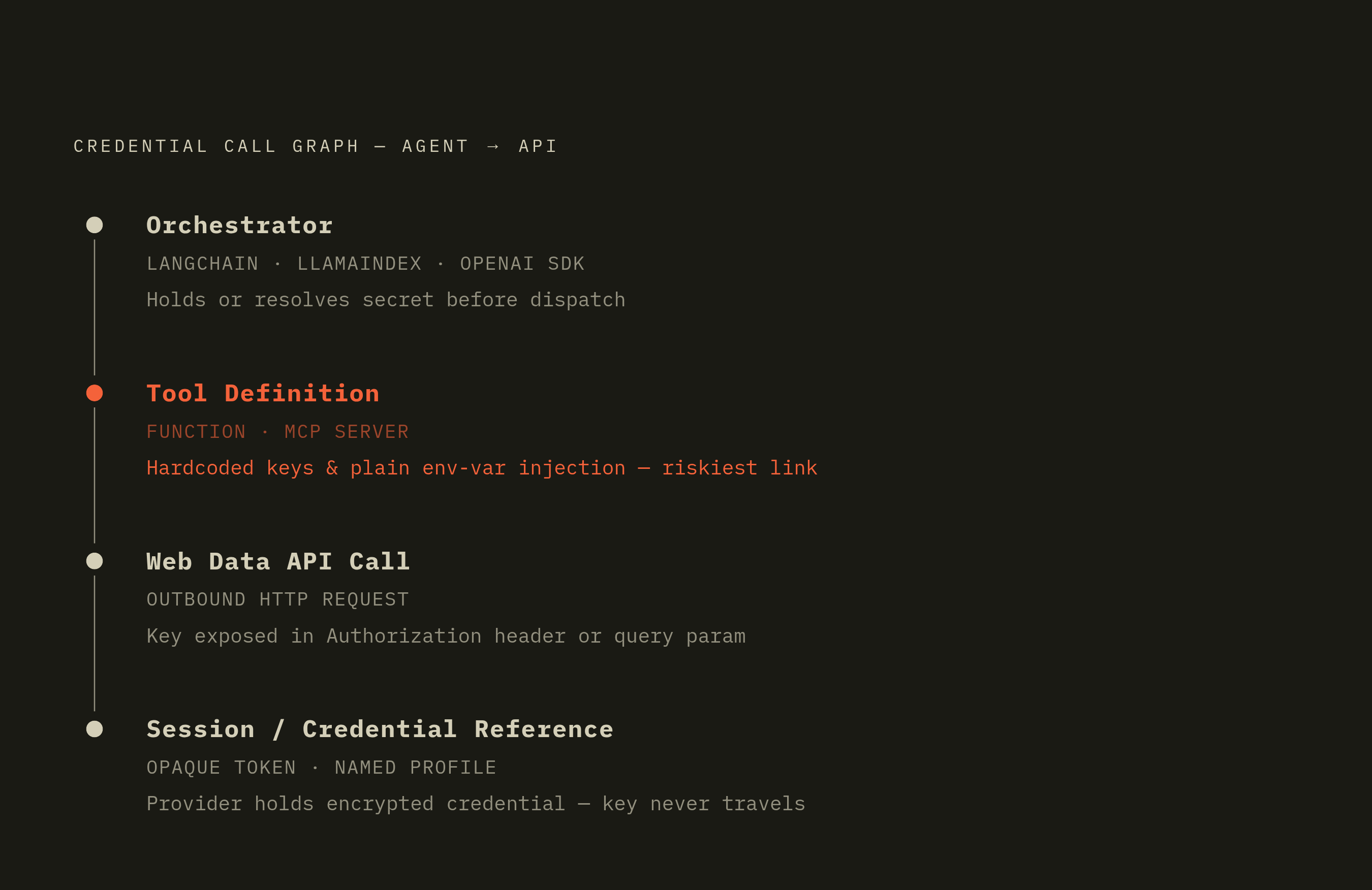
Picture the call graph as four layers, each one a place where a secret is briefly in motion.
At the top sits the orchestrator, the agent runtime that holds or resolves the secret before it dispatches any tool call, such as LangChain, LlamaIndex, the OpenAI Agents SDK, or a custom-built runner. Below that is the tool definition itself, the function or MCP server that wraps the actual web data API call. This is the layer where a key most commonly gets hardcoded outright or injected as a plain environment variable, and it's arguably the riskiest link in the chain because it's where developers write code by hand.
Below the tool definition is the web data API call proper: the outbound HTTP request, carrying the key either in an Authorization header or, less safely, in a query parameter. And for pipelines that touch authenticated sites, there's a fourth layer, the session or credential reference, where a session token or named profile stands in for credentials the API provider keeps encrypted on its own side rather than exposing them to the agent at all.
This four-layer model holds regardless of what the agent is actually built to do. The task changes. The four-layer call graph, and the places within it where a credential can go wrong, doesn't. That's the useful takeaway here: whatever kind of agent a team is building, the secret management plan has to account for all four layers, including cases beyond the simplest read-only one where nothing behind a login ever gets touched.
Environment variables and secrets stores: the baseline that every pipeline needs before anything else
None of the more advanced practices matter if a key is still sitting hardcoded somewhere else at the same time. Centralizing secrets in a proper store isn't an advanced move, it's the prerequisite everything else depends on.
Start with the basics that too many teams skip. A .env file should never get committed to version control, full stop. A .gitignore entry helps, but it's not sufficient on its own, since a single manual git add . can undo it in a second. Pre-commit hooks that scan for secret patterns catch that mistake before it ever reaches a shared branch, and they cost almost nothing to set up.
Beyond a single-developer prototype, the key move is adopting a dedicated secrets store, something like HashiCorp Vault, AWS Secrets Manager, Google Secret Manager, or Azure Key Vault. What these tools actually buy a team is three things: centralized storage, access logging, and automated rotation, and those three properties are what make tracking and revocation feasible in the first place. Without them, revocation is guesswork.
A Cycode 2026 survey found that 96% of organizations report secrets scattered across code, configuration files, and multiple environments. Without visibility into where a secret actually lives, rotating it on any kind of schedule, or revoking it when something goes wrong, becomes close to impossible. A secrets store is what gives a team that visibility back.
Scoping matters just as much as centralizing. Most web data API providers let a team create separate keys per environment, so a dev key and a production key should never be the same string. That way, a leaked dev key can't quietly run up charges against the production crawl budget. Where the provider supports finer-grained scoping, tying a key to a specific operation such as a read-only crawl, structured extraction, or brand intelligence, that's worth doing too, because a compromised key for one narrow operation shouldn't unlock the entire API surface.
Once the key leaves the secrets store and enters an outbound HTTP request as part of the tool call, it becomes the riskiest single moment in this whole architecture, because it now passes through layers that log absolutely everything by default. The fix is server-side resolution: the key should never be something the LLM itself sees as a parameter. In pseudocode, the anti-pattern looks like this:
tool_call("fetch_page", url=..., api_key="sk-live-abc123...")The corrected version keeps the key out of the call entirely:
tool_call("fetch_page", url=...)
# inside fetch_page():
# key = secrets_store.get("web_data_api_key")
# response = http.get(url, headers={"Authorization": f"Bearer {key}"})
The tool wrapper resolves the key internally, from the environment or the secrets store, and only then makes the outbound request. The LLM sees a tool name and a query. It never sees a credential, because it never needs to.
MCP servers deserve a quick note here, since they run as separate processes and need their own injection pattern. The web data API key should go into the MCP server's environment at startup, through the host's MCP configuration file, and that config file should itself point to a secrets store or an OS keychain rather than holding the key in plaintext. Host configurations like Claude Desktop and Cursor already accept environment variable references inside their JSON config files, so there's no reason to paste a raw key directly into that config when the indirection is right there.
Authenticated scraping needs a similar layer of indirection. The right abstraction is a named session reference: the API provider holds the encrypted credentials on its side, and the agent's tool call only ever passes a session name or ID. That's how managed scraping APIs handle persistent logins without ever putting a raw credential inside an agent loop where it could get logged or replayed.
Last piece of the baseline: logging hygiene. Frameworks like LangChain and LlamaIndex will log tool inputs and outputs when verbose or debug mode gets turned on, and that's exactly the mode a developer flips on while troubleshooting a broken pipeline. Filter or redact before those logs ever hit permanent storage: strip Authorization headers, strip anything matching a secret pattern. It takes an afternoon to configure and it closes a leak that otherwise opens every time someone debugs.
Key rotation, revocation, and the automated lifecycle that agentic scale demands
A key that's stored correctly and injected cleanly is still a liability if it never rotates. Every day it stays valid is another day of accumulated exposure, and a leaked key paired with no rotation practice means whoever has it keeps having it, indefinitely.
Manual rotation was never a great practice, but it becomes genuinely untenable at agentic scale. Each new non-human workload added to a pipeline is another credential that needs tracking, rotating, and access-controlling, and Cycode's research points out that this burden compounds as agent count grows. It compounds again when every framework in use has its own secrets posture layered on top.
The pace of the outside world doesn't help either. Zyte's 2026 Web Scraping Industry Report found that anti-bot defenses now get updated multiple times a week, and this forces the access infrastructure underneath a scraping pipeline to keep adjusting just to keep working. A secret management layer that only rotates keys on a quarterly schedule is badly mismatched to infrastructure changing several times a week. The rotation cadence a team picks should track the sensitivity of the data being pulled and how exposed the pipeline actually is, not some fixed calendar interval borrowed from a compliance checklist.
Automating rotation is the only version of this that survives contact with agentic scale. Set a policy inside the secrets store, propagate the new key to every consuming service, and only then revoke the old one, so nothing breaks mid-rotation. For anything running in CI/CD or inside containers, rotation should trigger an automatic redeployment or a live secret reload, never a manual edit to a config file that someone forgets about three weeks later.
Revocation deserves the same design discipline, and arguably more urgency. Every web data API integration should be built so that revoking a key is one action that propagates everywhere automatically. Keeping even a simple registry of which agents and pipelines hold which key is worth the overhead, because knowing where a key lives is the precondition for revoking it at all, and that circles right back to centralized secrets management as the foundation this whole lifecycle rests on.
Graduating from API keys to short-lived credentials and workload identity
Static API keys are a reasonable place to start, and for most teams they're the right starting point, full stop. But they're not the right place to end up once a pipeline has agents running continuously, touching sensitive data, or spanning more than one cloud environment.
There's a fairly well-worn migration path here. None of this is about abandoning API keys as a bad practice. It's about recognizing that a key valid forever, until someone remembers to revoke it, carries a different risk profile than a token that expires in minutes.
That difference is the entire argument for moving up the chain. An attacker who manages to extract a short-lived token gets a narrow window to use it before it expires on its own. An attacker who extracts a static key gets access that lasts exactly as long as it takes someone to notice and revoke it, which, given how sprawl and manual tracking tend to work in practice, could be a long time.
Workload identity sits at the far end of this progression, and it's built specifically for cloud-native agent deployments running on AWS, GCP, or Azure. Instead of an agent holding any stored credential at all, the platform itself attests to the workload's identity based on where it's running, and issues a short-lived token at runtime. There's no key to leak, because there's no key sitting anywhere to begin with. For a team running agents at real scale, that's the direction the architecture is heading: less about protecting secrets more carefully, and more about designing systems where there's nothing static left to protect. The migration path runs from API keys to short-lived credentials.