Benchmarking Web Scraping APIs Under Real Anti-Bot Pressure
Most scraping benchmarks measure only whether pages return, not whether they're usable by AI models.
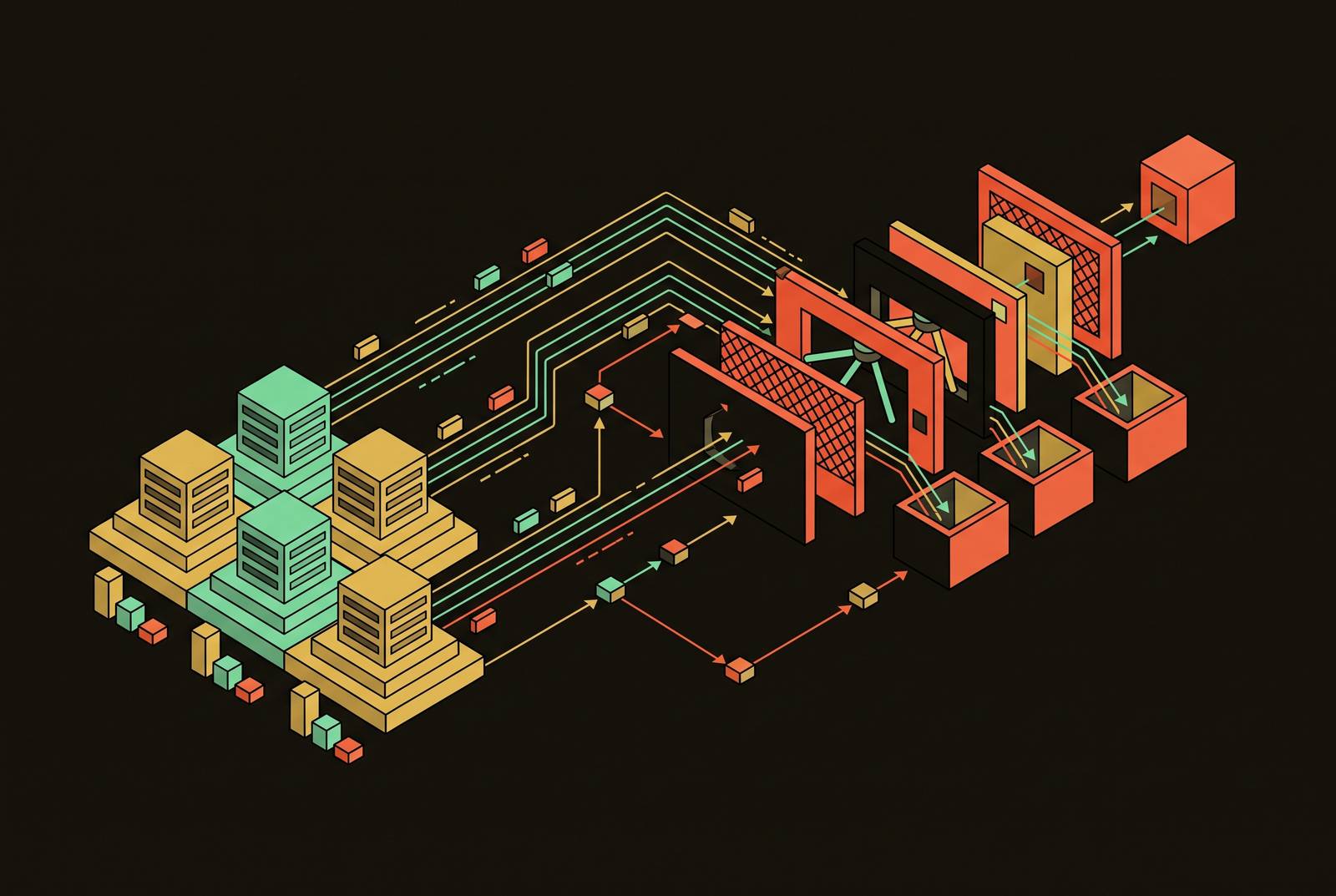
The best scraping API for AI pipelines clears anti-bot defenses and hands back clean, structured output your model can use without a second processing step. Most published benchmarks measure only the first half of that job. A team can pick the top-ranked provider and still end up building a cleanup layer behind it. That gap between "the page came back" and "the page is usable" is what this piece is about.
Why anti-bot benchmarks mislead AI builders
A team reads a benchmark, picks the top-ranked provider, and signs up expecting to plug it straight into a retrieval pipeline. A week later, they're writing regex to strip navigation menus out of raw HTML, because the API never promised anything beyond "the request didn't fail."
The standard benchmark metric, raw page retrieval success rate, answers a narrower question than most buyers think it does. It tells you whether an HTTP response came back with valid HTML. It says nothing about whether that HTML is clean, structured, or usable by a language model without further work.
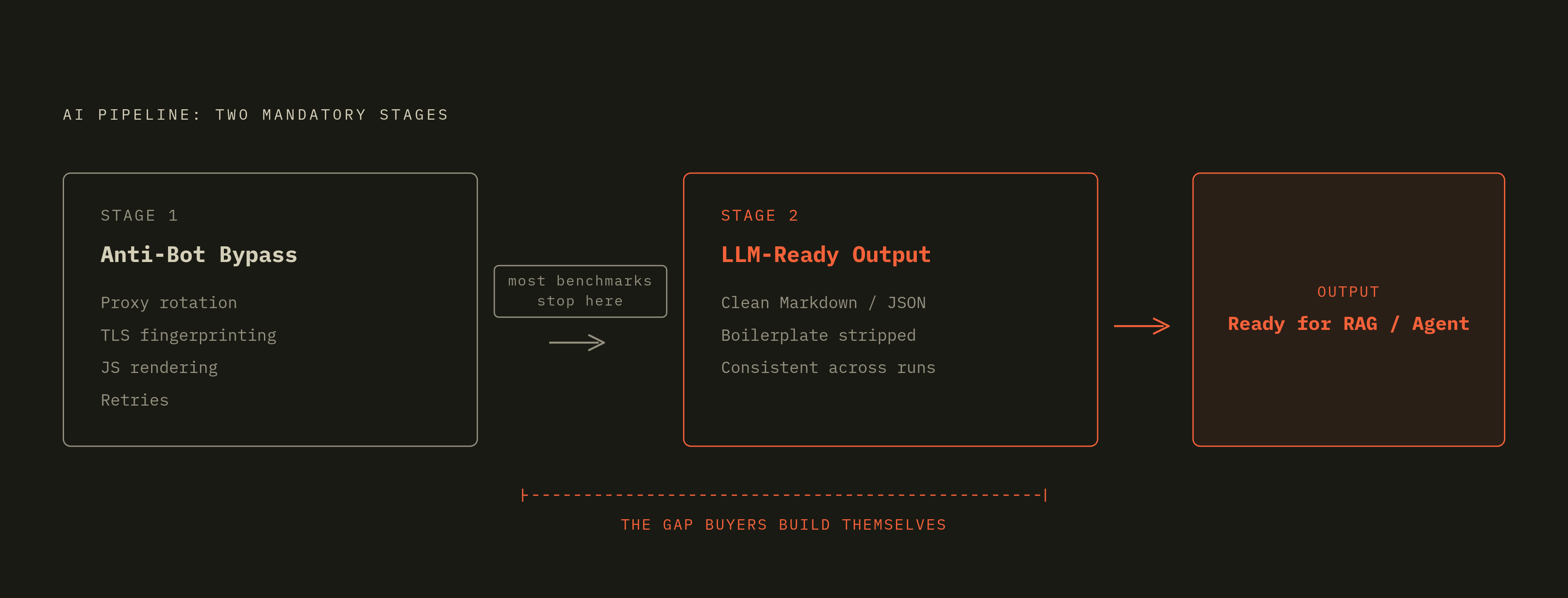
AI pipelines carry a two-stage requirement that generic scraping benchmarks were never built to measure. Stage one: get through the anti-bot wall. Stage two: produce output that can be embedded, reasoned over, or handed to an agent. A provider that clears stage one and dumps raw HTML into stage two hasn't delivered value, it's handed the team a second job.
That split explains why the category has bifurcated into two distinct kinds of product. One kind is the raw page-retrieval unblocker, built for analysts and data engineers who expect to write their own parsers downstream. The other is the structured, LLM-ready extraction API, built for AI product pipelines that need output ready to embed on arrival. A benchmark designed to rank the first kind will mislead anyone shopping for the second, because it's measuring a different job.
How the anti-bot landscape distributes difficulty across targets
Anti-bot difficulty is a spectrum, and understanding that spectrum is the only way to read any benchmark number correctly.
Protection stacks in layers, and each layer catches a different kind of bot. JavaScript challenges get cleared by any competent headless browser. TLS and HTTP/2 fingerprinting flags a non-browser client before a single byte of HTML gets served. IP-reputation systems blacklist entire datacenter ranges on sight. Behavioral and device fingerprinting goes further still, separating a realistic human session from a scripted one by watching how a request behaves over time.
Most open-web targets are at the first layer or two. A minority of high-value targets, the kind with real commercial incentive to block scrapers, are at all four simultaneously. That distribution matters because it means the vast majority of scraping jobs are easy by design, and a small number are genuinely hard.
Two mistakes follow from misreading that distribution. Some teams buy the heaviest anti-bot tier for every request, so they pay premium pricing for targets that never needed it. Others benchmark their own evaluation only against easy targets, which inflates an aggregate success number that tells them nothing about the handful of protected sites their pipeline actually needs to hit. Both mistakes come from treating difficulty as uniform when it isn't.
Independent benchmarks in 2026
Independent benchmarks run in 2026 show real, material divergence across providers and across targets. Even the most rigorous of them stop at raw retrieval success, leaving output quality untested.
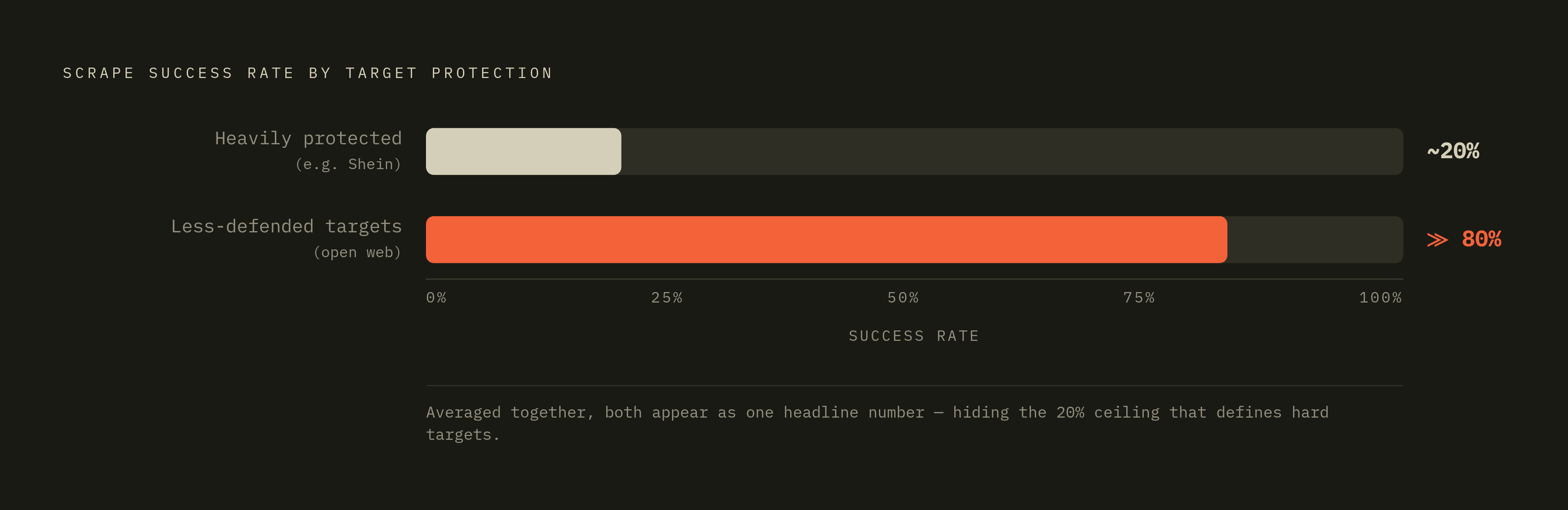
Per-target variance inside that data is the clearest evidence that a single aggregate number hides more than it reveals. Independent testing found that Shein, a heavily protected e-commerce target, came back successfully only around one in five times across providers. Less-defended targets, tested on the same APIs, returned success rates far higher. A provider's headline number averages across both kinds of targets, so it tells you almost nothing about performance on the site you actually need.
None of this testing measured four things that matter enormously to an AI pipeline. Whether the HTML that came back was fully rendered, cleaned of navigation chrome and boilerplate, and arrived structured as Markdown or JSON that a language model can use without further transformation. Whether it stayed consistent across repeated runs is what a monitoring or change-detection pipeline depends on. The benchmarks answer whether the page came back. They don't answer whether the page was worth catching.
Output quality is the second half of the benchmark that nobody runs
A page that clears the anti-bot wall in raw HTML can still be a failure for a RAG system or an LLM pipeline. If it arrives as unstructured markup, the cost of that failure doesn't stay contained, it compounds through every stage downstream.
RAG pipelines embed, chunk, and retrieve text. Raw HTML embeds navigation menus, cookie banners, footer links, and script tags right alongside the actual content. That noise degrades retrieval accuracy and inflates token usage on every query the pipeline runs, for as long as you keep using that provider.
Agentic workloads carry a sharper version of the same problem. If an agent clears the bot wall but gets back malformed or partial HTML, it still burns LLM inference on a job that fails anyway. That cost hits at the model layer, not the scraping layer, making it harder to trace back to its source and easier to under-budget when a team is pricing out a pipeline.
The distinction matters most for teams building RAG systems and agentic workflows, which need page retrieval plus LLM-ready output in the same step. APIs purpose-built for AI pipelines, like Context's web scraping infrastructure, are designed around that two-stage requirement: clearing anti-bot defenses and converting the result directly to clean, structured Markdown that an LLM can reason over without post-processing.
The right benchmark axis for an AI pipeline has three parts, not one. Retrieval success rate on the actual target sites the pipeline will hit. Output format quality on those same sites. Consistency across repeated runs. A single aggregate number on a generic test set answers none of the three, so you should design your own evaluation before you trust a published ranking.
The tiered scraping architecture that separates infrastructure concerns from extraction concerns
Teams that get reliable, structured output from protected sites don't ask one API call to do two jobs. They treat anti-bot bypass and semantic extraction as separate concerns, so each one gets handled by its own layer.
The bypass layer is infrastructure. It handles proxy rotation, TLS fingerprinting, JavaScript rendering, rate limiting, and retry logic, and its only job is to return a fully rendered page reliably. Success-rate benchmarks measure this bypass layer, and it's a real engineering problem worth solving well.
The extraction layer does something benchmarks don't touch. It turns a rendered page into something a language model can actually use: stripping boilerplate, converting the result to Markdown or structured JSON, applying a schema the developer defines, and keeping output consistent across runs even as the underlying page shifts slightly.
That separation reshapes the build-versus-buy calculation most teams run when they first hit this problem. A homegrown pipeline that scrapes, renders JavaScript, computes diffs, stores versions, and retries failures can work for a while. Then a target site changes its layout, adds a new bot defense, or shifts to client-side rendering, and the pipeline breaks. Maintaining that pipeline tends to consume a disproportionate, ongoing share of developer time, and a managed API is built to remove that ongoing cost.
Evaluating scraping APIs for AI pipelines
Running a meaningful evaluation doesn't take a quarter of engineering time. It takes a short list of target URLs, a handful of API keys, and a day spent testing the right things before committing to a provider or a published ranking.
Test on the actual targets the pipeline will hit, not a generic benchmark set. Per-target variance is large enough that a provider's aggregate score on a public test set predicts almost nothing about performance on the specific sites that matter. The gap between Shein's roughly one-in-five success rate and the far higher rates on less-defended targets, on the same APIs, makes that case directly.
Measure output quality as its own line item, not an afterthought. If the response comes back, is it clean Markdown, free of navigation chrome, cookie banners, and script tags? Does a structured JSON extraction return the same field names across runs when the page layout shifts even slightly? When evaluating a scraping API, teams should test whether it returns unstructured HTML, which degrades RAG embedding quality and inflates token costs, or clean, structured output built for LLM ingestion. Web context APIs built specifically for AI agents embed that distinction into their core design rather than pushing it into a post-processing step the buyer has to build.
Check the billing model before the success rate. Credit multipliers for JavaScript rendering, premium proxy tiers, and per-record versus per-request billing can leave you with an invoice that looks nothing like the headline rate. When you check cost across billing models, the gap between headline price and real cost can run very large on list-returning workloads, the kind that return dozens or hundreds of records per request.
For monitoring and change-detection pipelines, test consistency directly. If a provider returns different Markdown structure on two consecutive fetches of the same unchanged page, you get false-positive diffs, and those diffs fire downstream alerts and burn agent cycles on noise that was never a real change.
Demand transparency about what a published success rate actually measures. Ask whether it counts a plain HTTP 200 or a response verified to contain valid content with page-specific markers. Rigorous independent testing shows these come out as different numbers on the same provider; an HTTP 200 alone isn't a pass. The next section covers what the best-designed APIs in the category actually provide, so there's a concrete standard to test against.
What well-designed scraping APIs for AI pipelines provide
The strongest options in this category combine reliable anti-bot bypass with first-class output formatting, structured extraction, and pipeline-native features like monitoring and batch crawling. A high retrieval success rate alone doesn't make the list.
Context.dev is built specifically for AI agents and LLM pipelines. Every request loads in a real browser with JavaScript rendering always on, with no opt-out, so there's no configuration step where a team accidentally ships half-rendered HTML downstream. Proxies escalate automatically when a site blocks a request, and retries adapt strategy before returning a failure, so the team never has to pick a proxy tier or pay extra for one. Context.dev publishes a 99.96% scrape success rate on its homepage. Batch crawling runs thousands of URLs, or entire sites, as background jobs with paginated results, keeping a RAG system grounded in current site content on an ongoing basis. Monitors watch pages for changes on a schedule and push updates to a webhook, so a RAG index refreshes on meaningful changes instead of running on a fixed crawl schedule that can miss updates or waste credits re-crawling pages that never changed. Brand intelligence retrieval pulls a company profile and a website's design system from a single domain, covering structured web data that most pipelines need but most scraping APIs don't expose as a first-class endpoint. Pricing starts with a free tier at $0 a month, with a modest monthly credit allowance, JavaScript rendering and proxies included, a handful of monitors, and no credit card required. Developer and Pro tiers step up credit volumes, monitor limits, and support options at higher monthly rates, and overage is priced per thousand credits that varies by plan. Mintlify, SiteGPT, and Sourcely use it as the data infrastructure layer powering their own AI products.
Bright Data remains the enterprise standard for raw scale, with a very large residential proxy pool and a library of pre-collected datasets and prebuilt scrapers for common targets. Its pricing splits across separate product lines: bandwidth-based billing for proxies, request-based billing for scraping APIs, which makes it more complex to budget against than a single flat-rate plan. It fits large organizations with dedicated data engineering capacity and volume requirements well beyond what a single product tier is built to simplify.
Zyte has built its reputation on the scraping infrastructure side of the business, with strong support for JavaScript rendering and a long track record handling complex, large-scale extraction jobs for teams that expect to do their own parsing downstream. Oxylabs competes on proxy scale and enterprise support, and it offers a wide pool of residential and datacenter addresses if you need to run high-volume collection across many geographies. Decodo positions itself as a more accessible proxy and scraping provider, for teams that want solid anti-bot handling but don't want the enterprise sales process that larger vendors require. ScraperAPI focuses on simplicity, a straightforward API that handles proxy rotation, anti-bot challenges, and headless browsers behind a single endpoint, aimed at teams that want anti-bot handling solved without managing infrastructure themselves. Scrapfly rounds out the field with a developer-first approach that bundles anti-bot bypass, JavaScript rendering, and some structured data extraction, aimed at teams that want more than raw HTML without committing to a full AI-pipeline-specific platform.
Each of these vendors solves anti-bot bypass credibly, at real scale, for real customers. The question for a team building a RAG system or an agentic pipeline is whether bypass alone is enough, or whether the output needs to arrive already structured for a language model to use, and that's the evaluation to run before any contract gets signed.