Component Selection Tradeoffs When Engineering a Large-Scale Web Scraping Pipeline
Reconcile rendering, proxies, parsing, and orchestration to balance speed, cost, and reliability.
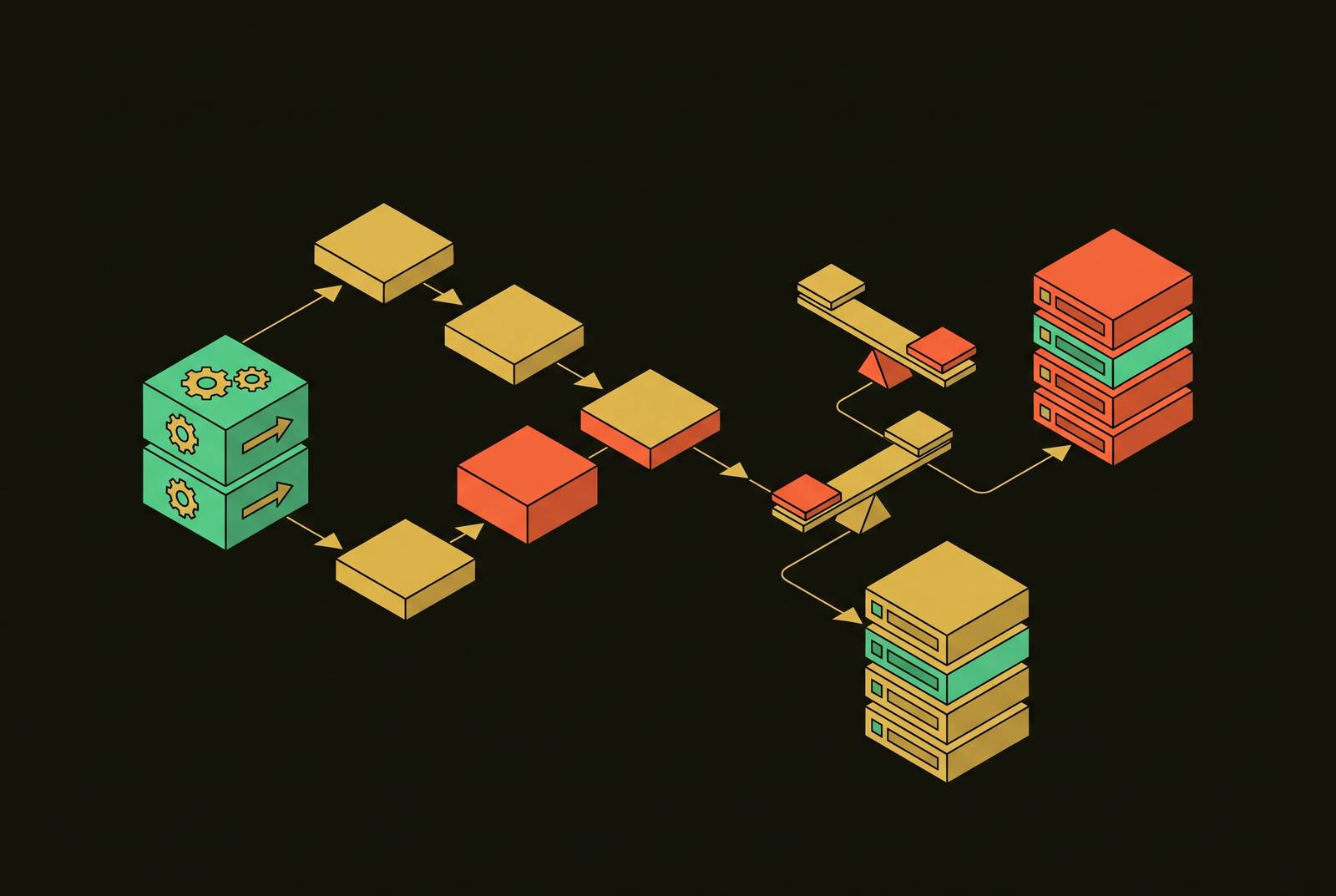
A large-scale web scraping pipeline combines fetching, proxies, anti-bot handling, extraction, orchestration, and change detection to collect usable data reliably. Which components fit depends on target difficulty, output format, freshness, and how much work the team can take on.
Why large-scale scraping forces architecture decisions that a prototype never does
One more site needs browser rendering, or a dataset now needs to be refreshed before the single-machine script can finish. The script still runs, but it no longer meets the requirement. Adding workers does not solve every problem. More requests meet more IP resistance, and each new site brings its own anti-bot setup and extraction rules. A sequential task has become a concurrent system that needs queues, workers, proxies, and retries.
That transition forces decisions the prototype could avoid. Volume must fit inside the freshness window, and access must hold across sites with different defenses. Downloading HTML is not enough when the consumer needs typed fields ready for an AI workflow. A design that solves throughput alone can still deliver blocked responses, empty records, or stale data.
The six-layer stack and why each layer constrains the ones below it
The six layers are fetching, proxies, anti-bot handling, parsing and extraction, orchestration, and change detection. They form a chain of constraints. Rendering shapes which proxy configurations will work, and proxy trust limits which anti-bot strategies can be used. Parsing determines what downstream consumers receive, and orchestration determines when they receive it. Change detection establishes whether another collection or extraction pass is needed.
No layer works independently of the others. Switching to residential proxies, for example, does not change an HTTP client's TLS fingerprint. Detection can simply move to that weaker signal.
Fetch layer — choosing between HTTP clients and browser rendering
For pages whose content arrives in the initial HTML, requests, HTTPX, or aiohttp offer fast, lightweight fetching. They have no browser binaries to manage or concurrent tabs to use up memory, so horizontal scaling is simpler. JavaScript changes the requirement. Dynamic pricing, login-gated content, and infinite scroll can require execution before the desired content exists in the DOM. Those workflows call for browser rendering.
Playwright fits new JavaScript-heavy workflows that need custom interactions, while Puppeteer also provides headless browser control. Selenium remains viable for teams with an existing WebDriver estate. Browsers impose their own infrastructure work. Instances use a lot of memory, must work together across workers, and need browser versions that keep pace with the detection environment. That makes rendering a capability purchase with a continuing operating cost.
However, JavaScript is not the only selection criterion. Python's requests library sends a different TLS ClientHello signature from Chrome, so anti-bot systems can identify it before any HTML loads. Static content does not guarantee HTTP-client access. A managed rendering API can absorb browser coordination, but replaces that work with per-request pricing and reduced transparency.
Proxy tier — why this single decision has the highest leverage on pipeline success rate
A correctly rendered request can still fail because the target distrusts its source IP. Datacenter proxies offer low cost and high throughput for permissive static content and public APIs, but are a poor match for targets protected by Cloudflare, Akamai, or DataDome. Residential proxies route through consumer IPs and provide higher trust for guarded retail, e-commerce, and social targets. Standard residential bandwidth costs around $4/GB, while mobile proxies are trusted the most and cost the most for niche uses.
Datacenter proxies fit bulk work on permissive targets, while residential rotation belongs on strictly guarded domains. Paying for residential access everywhere wastes budget. When most cheap requests get blocked, the usable data still costs more. Public APIs, government open data, and low-traffic sites without anti-bot middleware may need no proxies at all.
Session behavior must match the job as well. Login flows need sticky sessions that preserve the same IP through a sequence of requests. Independent page collection calls for rotation instead. Confusing the two creates intermittent failures that consume proxy budget and diagnosis time.
Anti-bot systems as adaptive feedback loops, not static gates
Modern anti-bot systems watch for patterns across requests and change how they respond over time. A configuration that passes today can look suspicious tomorrow even if the scraper has not changed. Access is not a permanent property of a setup. Behavioral signals, TLS and browser fingerprints, network topology, and JavaScript challenges work together, so addressing one signal can expose another.
Spoofing a single header or rotating a fixed IP pool can still produce detectable patterns across a large crawl. Even a headless browser that mimics user behavior needs continuing calibration as fingerprinting databases change. The architectural decision is how much of that ongoing work the team can support.
Parsing and extraction — how output format requirements should drive library and tool selection
Once access works, the consumer's needs determine extraction. Raw HTML fits a system that processes HTML natively, but wastes LLM tokens on navigation, advertisements, tracking scripts, and layout tags. Clean Markdown removes boilerplate while preserving document hierarchy. Structured JSON goes further when an agent needs named, typed fields. These formats solve different downstream problems.
Library selection follows from that distinction and the page's rendering needs. requests with BeautifulSoup fits static HTML where the team controls selectors, while Scrapy supports high-volume structured crawls through item pipelines. Playwright or Crawlee fits pages that need rendering before extraction. Crawl4AI targets Markdown and configured structured extraction for AI workflows. The useful comparison is not just fetch speed, but how much maintenance each approach leaves behind.
Engineer time can dominate the cost of extraction. CSS and XPath selectors need repairs when layouts change, and those repairs consume time after the initial build. LLM-driven extraction changes that bargain. A model takes content and extracts named fields, so the team pays for tokens and depends on model reliability in place of keeping selectors in working order.
Orchestration — job queues, scheduling, and the crawl coordination layer
Orchestration is often designed last and fails first in production. Even sound fetching and parsing components need coordination to run unattended. The URL frontier holds pending work, sets crawl priority and frequency, and distributes jobs across workers. Mistakes there produce duplicate scrapes, missed URLs, or idle workers beside a growing backlog. Retries and deduplication belong to this coordination layer.
RabbitMQ, Redis, and AWS SQS separate URL production from worker execution so the fleet can scale without the producer tracking worker count. Scrapy offers another route within its own architecture. Its framework-based asynchronous I/O, AutoThrottle extension, and DUPEFILTER_CLASS support custom multi-page crawls. Crawlee combines HTTP and browser crawling with request queues, routing, retries, sessions, and storage. That gives teams a single toolkit for coordination, collection, and storing results.
A one-time crawl produces a snapshot. To keep a dataset up to date, the pipeline needs schedules, change detection, and re-crawl triggers as well as working fetchers. A scraper can still work while it serves old data. That distinction sets the requirements for the next layer.
Website change detection as a first-class pipeline requirement, not an afterthought
A RAG system depends on the freshness of the content it indexes. Without change detection, the evidence it retrieves can fall out of step with the live web even while retrieval works correctly. Freshness requires re-ingestion when content such as prices or product descriptions changes so downstream systems get up-to-date information.
Structural changes create a different failure mode. A new HTML layout can break selectors while the server still returns HTTP 200. The request succeeds, but extraction returns wrong or empty data. Detecting access alone cannot catch that failure. Production monitoring needs to tell when the source content has changed and when the extraction method has broken.
For automated consumers, structured JSON diffs make changes actionable by identifying which field moved from one value to another. Screenshot comparisons and raw HTML diffs instead leave interpretation to a person. The output schema thus shapes monitoring too. Without that connection, downstream users may discover wrong prices, stale descriptions, or incorrect firmographics only after using the data. Retrofitting detection then costs more than designing it into the pipeline.
Build vs. managed API (how target difficulty and output requirements set the decision threshold)
Building in-house makes sense when targets are stable, well understood, and permissive enough to support predictable costs at high volume. It also gives teams direct control over rendering, proxies, and extraction. That control requires engineering capacity to maintain it. Proxy management, browser versioning, anti-bot calibration, retry behavior, and selector repairs all remain internal responsibilities. The build decision must account for both the first successful crawl and that recurring workload.
A managed API moves proxy, rendering, retry, and anti-bot work behind an endpoint. Where it provides the required structured output, product code can consume that output without owning the underlying collection stack. The tradeoff includes per-request pricing, vendor lock-in, and opacity at the proxy layer, which reduce control. Those drawbacks matter most when steady, high-volume workloads make it cheaper to run infrastructure in-house.
For a small team facing difficult targets, however, engineering time may be the tighter constraint. A low infrastructure bill is not a saving if maintaining access absorbs the team. Output requirements also shift the threshold. Buying access alone leaves parsing work in-house, while buying schema-ready extraction transfers more of the maintenance burden. The relevant comparison is the work retained on each side.
Legal and compliance risk as an architectural input, not a post-launch audit
Legal risk in 2026 depends on purpose, downstream use, and access method. Price monitoring and AI training can create different exposure even when the collected data is identical. Technical behavior alone does not settle permission. In the EU, robots.txt has gained statutory legal force for AI training use cases, but compliance with it is not a general safe harbor. This remains an evolving risk.
The architectural consequence is a need for provenance and purpose records. Teams building AI pipelines should record what was collected, where it came from, and its intended use. Provenance belongs in the schema from the start. Those records support evaluation of permissible use, but do not themselves prove that a use is lawful. Treating them as a post-launch addition leaves the legal review without information the pipeline should already preserve.
How do you build a web scraping pipeline that matches your requirements?
Static public pages, JavaScript-heavy sites, and enterprise-protected domains set different minimum fetch and proxy requirements. Output format then sets the extraction approach. A snapshot needs less coordination than recurring crawls or continuous change detection, while maintenance capacity determines how much of the stack can reasonably stay in-house.
For a lean team on permissive targets, requests with BeautifulSoup fits static pages, with Playwright where rendering is required. Datacenter proxies and lightweight rotation fit work that actually needs proxies. Heavily guarded domains can go through a managed API. That pattern keeps the simple work simple without forcing the team to maintain a difficult access stack for every target.
A mid-sized data team with mixed targets has a different fit. A Scrapy and Playwright hybrid can combine structured crawling with browser rendering, while Redis or SQS handles queue-based dispatch. A tiered datacenter and residential proxy pool matches access cost to target difficulty. Structured JSON extraction serves AI consumers without leaving them to interpret page markup.
For an AI pipeline requiring continuous freshness, managed fetching and rendering can pair with schema-defined extraction and Airflow or Prefect orchestration. Change detection then feeds RAG re-ingestion triggers. The rendering choice changes what workers need, the output schema changes what can be compared, and the freshness promise changes how work is scheduled. Optimizing any one of those without its downstream consequences is how a capable collection of tools becomes an unreliable pipeline.