Handling Schema Drift in Long-Running Extraction Pipelines
Design for change rather than hoping schema drift won't happen to your extraction pipeline.
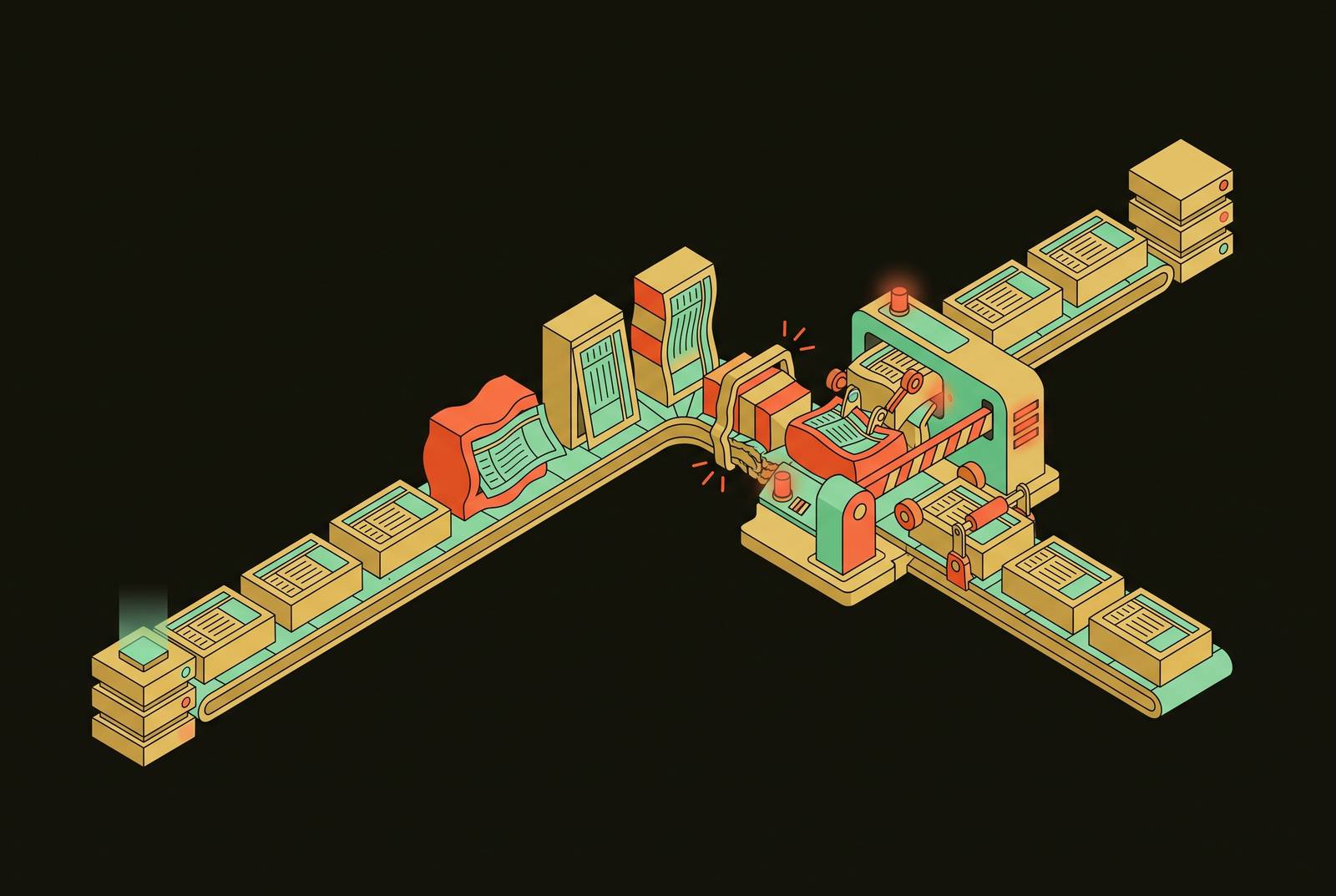
Schema drift is the default state of any extraction pipeline whose sources are maintained by people other than the pipeline's owners. That covers almost all web data. The practical question is not whether a source will change, but whether your pipeline will catch the change before it corrupts downstream consumers.
Start with the column-rename scenario. Nobody receives an alert, because the job did not fail. This is not an edge case. It is what happens when a static schema contract meets a dynamic source.
Selector-based extraction tools break every time a site updates its layout. The fix requires manual intervention, and the engineering time consumed often exceeds the original automation's value. The economics invert quickly.
Internal pipelines face the same exposure from a different direction. Your own organization's data warehouse is not a frozen artifact. The root cause in both cases is the same: pipelines are written against a snapshot of a source that will keep changing. HTML structure, CSS selectors, JSON response shapes, and API field names are all moving targets.
This is not a bug that more careful engineering can eliminate. It is a structural property of the problem. Your pipeline's contract with those sources is a one-sided agreement. The only engineering response is to design for the change, not to hope it will not come.
How drift fails silently and why silent failure is the worst outcome
The most dangerous failure mode is not a broken pipeline that alerts someone. It is a pipeline that keeps running while producing degraded or wrong output. That distinction drives every design decision that follows.
Traditional rule-based monitoring catches known failure modes. No error is logged. The pipeline reports success, and every consumer of its output receives plausible-looking garbage.
The same gap appears in periodic re-indexing. The extraction layer still maps to the old structure, so the re-crawl produces the same fields as before. A price update buried in a redesigned product page looks identical to the old page's output, because the extractor never reaches the new content.
For retrieval-augmented generation systems, the failure is temporal as well as structural. Any topic that changes faster than the indexing cadence, such as prices, library versions, security advisories, or regulations, returns answers that were stale before the query arrived. It returns it with confidence.
The cost compounds. An agent or analyst acting on stale or structurally corrupted data does not fail visibly. By the time a human catches the discrepancy, the wrong output has already shaped decisions.
What catching drift early actually requires at the detection layer
Effective drift detection requires monitoring at a different layer than most teams instrument. Not job health, but schema shape and field semantics, continuously against a live baseline. The distinction matters because job health monitoring answers the question "did the pipeline run?" while drift detection answers "did the pipeline run correctly?"
Four fundamentally different detection approaches exist, and they solve different problems. Traffic-based detection observes real API traffic via proxy or SDK. It provides the most complete signal but requires infrastructure changes that many teams cannot absorb.
Reality-to-reality monitoring compares live responses against a learned baseline, with no spec required. For web extraction pipelines specifically, this is the only approach that works without cooperation from the source. You learn the baseline by observing the source over time, then alert on deviations from that baseline.
Severity classification matters as much as detection. A detection system that treats all diffs equally produces alert fatigue, and teams respond to alert fatigue by ignoring the signal entirely. A field that appears in only some responses should not trigger a breaking-change alert every time it is absent.
Column-level lineage is the prerequisite for making a drift alert actionable. Not table-level lineage, but field-level. An agent that reads metadata on a nightly refresh is reasoning from a stale map.
The gap between CI-only detection and continuous monitoring for live web data
CI-only drift detection catches planned changes. This is not a criticism of CI tooling. It is a statement about the architecture of the problem.
A CI pipeline runs at deploy time. If a site rewrites its layout two weeks after your last deploy, your CI pipeline will not know until your next deploy, which may be two more weeks away. That is a month of silently degraded extraction.
Unannounced website rewrites, the most common cause of selector-based extraction failures, occur on the source's schedule. The timing is uncorrelated. No amount of CI discipline changes that.
Tools like oasdiff are the gold standard for spec diffing inside CI, with broad adoption and a large rule set for breaking-change classification. For pipelines ingesting live web data, the detection interval must be shorter than the source's likely rewrite cadence. Polling-based continuous monitoring with a configurable check interval is the appropriate architecture.
The practical tradeoff is clear. Teams must size the interval to the business cost of missing a change, not to a default. The interval should reflect that distinction.
How to choose and configure drift detection tooling for web extraction pipelines
The right tooling choice follows directly from three variables. How frequently your sources change. Whether drift events should feed a human inbox or a data pipeline.
You can lay this out as a decision tree. If sources publish OpenAPI specs and changes are planned, spec-to-spec diffing with oasdiff in CI is sufficient as a baseline. If sources are third-party APIs or websites with no published schema, reality-to-reality continuous monitoring is required. If drift events need to feed an automated pipeline rather than a human alert, the monitoring tool must produce structured, machine-readable diffs in JSON, not screenshot diffs or notification emails.
The structured-diff requirement deserves emphasis. Visual diff tools that compare screenshots produce false positives from rotating ads, cookie notices, timestamps, and layout shifts. A JSON diff that enumerates changed fields and their old and new types is a machine-readable event. That event can feed a RAG pipeline directly. A detected change becomes a re-indexing event rather than a ticket in a queue.
API-first extraction platforms handle the schema-instability problem at a different layer. By abstracting selector maintenance and producing consistently structured output, such as Markdown or JSON, regardless of how the source's HTML changes, they push the drift problem down below the pipeline's schema boundary. This matters specifically for AI agent pipelines. Agents that call a web extraction API with a stable JSON schema get consistent structured output even as the underlying source evolves. That removes one class of drift from the pipeline entirely.
Configuring severity routing is the final piece. Additive changes, such as new optional fields, and layout-only changes can queue for business-hours review. The routing rule encodes the operational truth that not all drift is an emergency.
Isolating blast radius when drift does reach a running pipeline
Even a well-instrumented pipeline will occasionally miss a drift event. Detection is probabilistic at the margins. The architectural goal is to contain the damage to the smallest possible surface area before the change is caught and resolved.
Column-level lineage is the prerequisite for blast-radius analysis. Knowing that a changed field flows into three specific dbt models and seven dashboards allows targeted isolation. The difference in resolution time is the difference between an hour and a day.
Schema contracts between pipeline stages create a hard boundary. Explicit, versioned declarations of what each stage expects to receive mean drift is caught at the stage boundary rather than propagating to consumers. A failed expectation halts the pipeline at the entry point before bad data flows downstream.
Quarantine patterns complete the containment story. Routing records that fail schema validation to a separate store for human or agent review, rather than dropping them or passing them through, preserves the data for remediation while protecting downstream consumers. The pipeline does not need to choose between losing the data and poisoning the warehouse.
Autonomy-level design sets the boundary for agents. A well-configured pipeline agent should have a defined escalation path. An agent with unbounded write access to production is a risk. The Replit incident, where an agent deleted production data, documented that risk in production AI deployments. Lineage-aware alert routing, sending the drift alert to the team that owns the affected downstream assets rather than only the pipeline owner, compresses resolution time by reaching the right person immediately.
Building pipelines that adapt to schema changes rather than break on them
The emerging architecture for long-running pipelines replaces brittle static schema contracts with a feedback loop. The extraction layer proposes schema revisions and re-extracts when output fails to match the expected contract. The pipeline adapts rather than breaks.
Semantic extraction is the enabling technique. An LLM-based extractor that understands "this field contains a price" will find a price field even after a layout rewrite moves it to a new HTML container. The December 2025 SCIR paper (arXiv:2512.12337) proposes a self-correcting iterative refinement framework for LLM-based schema information extraction, addressing high training costs and difficulties in aligning with LLM preferences.
Together, these research directions establish iterative schema refinement as a practiced pattern, not a research prototype. The TASER system from J.P. The loop is detect mismatch, propose revision, re-extract, validate, commit or escalate.
Developer-defined JSON schema extraction is the practical implementation at the API layer. The developer specifies the output contract. The extraction system is responsible for mapping source content to that contract regardless of how the source is structured. Schema drift in the source does not automatically become schema drift in the output.
The open engineering question is auditability. Iterative LLM-based schema refinement introduces probabilistic behavior into a process that was previously deterministic. The answer will vary by domain, but the question cannot be deferred.
Freshness TTL and event-driven invalidation as the operating model for live web data
A pipeline that survives schema drift but serves stale content has solved half the problem. The operating model for AI pipelines over live web data must treat freshness as a configurable, per-data-type property, not a single global cadence. Different data types change at categorically different rates. Prices and availability scores change in seconds to minutes. TTL should be set per data type based on observed change velocity. Stable reference data gets a longer TTL with scheduled re-crawl.
Query-intent detection shortens or bypasses TTL. The NeurIPS 2025 FreshStack benchmark formally established that retrieval quality is critical for answer accuracy on niche and fast-growing technical domains. For RAG pipelines, indexing cadence is not a performance detail. It is a correctness variable.
Event-driven invalidation complements TTL. A detected schema change or content change at the source should trigger immediate re-extraction for that URL rather than waiting for the next scheduled crawl. The monitoring layer and the extraction layer must be connected. A URL that returns a 404 or redirects to a different resource after a site restructure represents a structural change that invalidates cached content and requires the same event-driven response as a schema change.
For AI agent pipelines, the implication is architectural. A cached snapshot baked at indexing time is already stale by the training-cutoff logic that motivates using live web data in the first place. The pipeline that silently serves stale content recreates the exact frozen-snapshot problem it was built to escape.
A layered implementation checklist for drift-resilient extraction pipelines
A drift-resilient pipeline is not a single tool choice. It is a set of interlocking layers, each handling a different surface where schema or freshness problems originate. Continuous monitoring is the second layer. Deploy reality-to-reality monitoring with structured JSON diff output on a check interval sized to the cost of a missed change. For external web sources, CI-only detection is insufficient.
Schema validation at ingestion is the third layer. Route failures to quarantine rather than passing them downstream. Log every failure with the field name and upstream source for lineage tracing.
Column-level lineage is the fourth layer. Maintain lineage at the field level across ingestion, transformation, and consumption layers. Configure alert routing to reach asset owners, not just pipeline owners.
Iterative schema refinement is the fifth layer. For extraction jobs over heterogeneous or frequently-changing sources, implement a detect-mismatch, propose-revision, re-extract loop. Require human or automated test approval before committing a revised schema.
Freshness TTL and event-driven invalidation form the sixth layer. Set TTL per data type. Detect recency intent at the query layer and bypass cache when it is present.
The governance overlay sits across all layers. Without it, you have traded a pipeline that breaks loudly for one that adapts opaquely. With it, you have built something that can run for years against sources you do not control.